Table of Contents
- Why Your Technical Gear Loses Its Water Resistance
- Understanding DWR: What It Does and Why It Matters
- The Problem with Fading Performance in Extreme Weather
- Our Wash-In DWR Solution: The Convenient Choice
- How Our Spray-On Treatments Deliver Professional Results
- Comparing Our DWR Options for Your Specific Needs
- Step-by-Step: Applying Our Wash-In DWR Treatment
- Application Guide: Getting the Best Results with Spray-On Treatments
- Real Performance Data: How Our DWR Treatments Extend Gear Life
- Protecting Your Investment: The Cost of Reproofing vs. Replacement
- XPLR Pass Members Get DWR Treatment Benefits
- Extending Your Gear's Life Through Regular Maintenance
- Frequently Asked Questions (FAQ)
Why Your Technical Gear Loses Its Water Resistance
Your favorite jacket has carried you through countless summits, stream crossings, and unexpected downpours. But lately, water beads up less enthusiastically, and rain that once rolled off now soaks in. That’s not a sign your gear is failing—it’s a signal that the water-repellent finish needs refreshing. We design our technical outerwear with durable DWR (durable water repellent) coatings, but these treatments naturally fade with time, washing, and use. The good news: you don’t need to replace your jacket. A simple reproofing treatment can restore its performance and extend its life by years.
Every technical jacket, rain shell, and pack we create leaves our factory with a DWR finish applied to the outer fabric. This invisible coating is what makes water bead up and roll away instead of soaking through. But DWR isn’t permanent. Repeated laundering, exposure to UV rays, body oils, dirt, and everyday wear gradually break down those water-repellent molecules.
Think of it like waxing a car: the protection works beautifully at first, but friction and weather eventually wear it away. You wouldn’t throw out a car just because the wax faded; you’d rewax it. Your gear deserves the same respect. Most of our customers find that a DWR treatment becomes necessary after 40-80 hours of active wear or 20-30 wash cycles, depending on conditions and how you care for the piece.
The fabric underneath remains intact—your Gore-Tex membrane or insulation layer isn’t compromised. You’re simply restoring the topcoat that keeps moisture from even reaching those protective layers.
Understanding DWR: What It Does and Why It Matters
DWR sits on the very surface of your fabric’s outer layer. It’s a microscopic barrier of hydrophobic (water-fearing) molecules that cause water droplets to form beads rather than spreading across the cloth. This beading action is crucial: it keeps rain from saturating the outer face of your jacket, which means your breathable membranes underneath stay free to do their job.
Without DWR, water soaks the outer fabric, making it heavy and cold, and eventually moisture migrates to the inside. Your insulation gets compressed and wet, losing thermal efficiency. Breathable membranes still function, but they work harder against a saturated outer layer, reducing overall performance. DWR isn’t a waterproof seal—it’s a performance multiplier that works alongside technical membranes to keep you dry and comfortable.
We’ve invested decades in membrane technology and fabric construction, but DWR is the first line of defense. That’s why we include it as standard on our technical outerwear and recommend maintaining it regularly.
The Problem with Fading Performance in Extreme Weather
In harsh conditions, DWR breaks down faster. Heavy rain, snow, prolonged wetness, and frequent washing all accelerate the fade. Climbers and hikers using our gear in alpine environments or during extended expeditions notice performance loss within weeks if they’re not actively maintaining the DWR finish.
Salty sweat, sunscreen, and mineral deposits from hard water also degrade DWR coatings. If you’re out in extreme weather regularly, you’re essentially fast-tracking the wear cycle. This doesn’t mean our gear is less durable—quite the opposite. It means the finish needs more frequent attention because you’re using it as intended: in conditions that test every layer and seam.
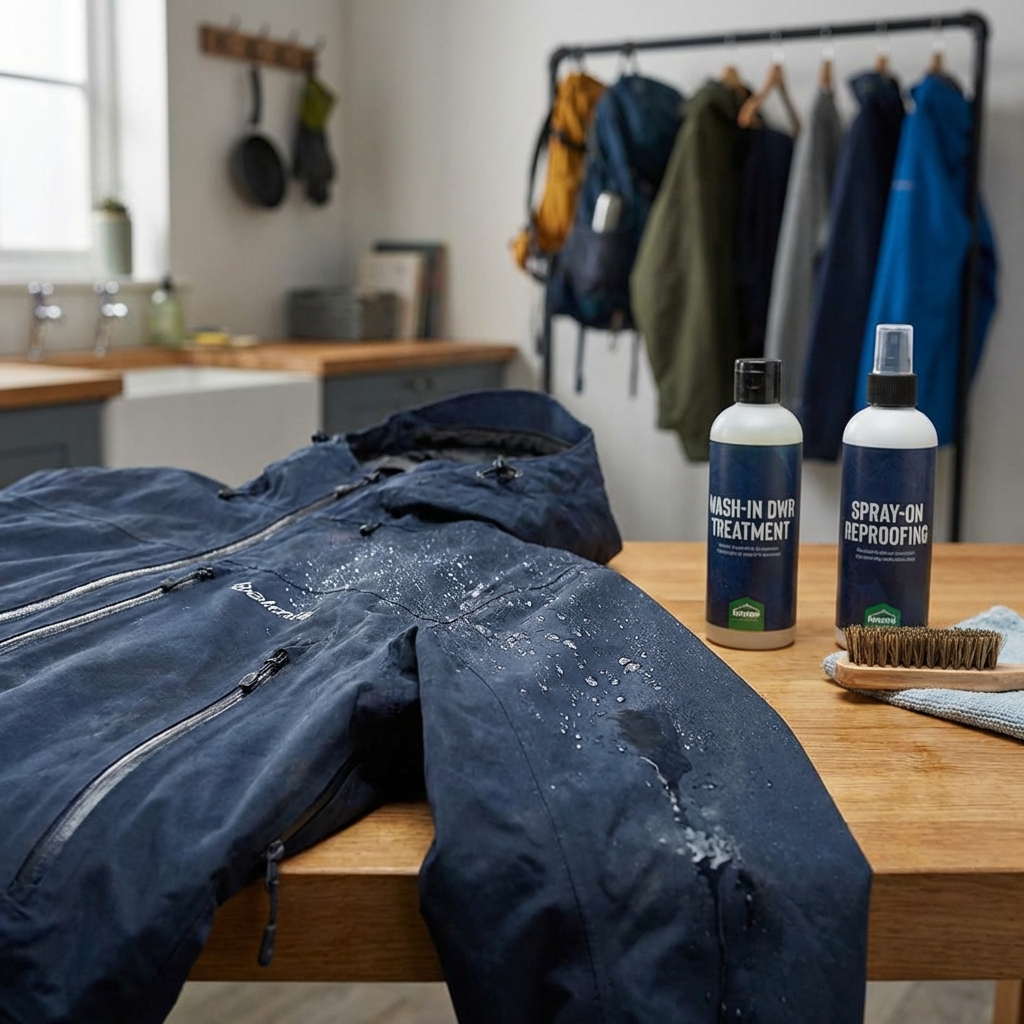
High-altitude pursuits, multi-week trips, and back-to-back rainy seasons all make reproofing more frequent. We recommend checking your gear’s water-repellency quarterly if you’re logging heavy outdoor hours.
Our Wash-In DWR Solution: The Convenient Choice
We developed our wash-in DWR treatment for situations where simplicity wins. You add it to your washing machine, and it reapplies the DWR coating during the rinse cycle. No separate steps, no fumes, no drying racks covered in spray bottles. For most active explorers, this is the fastest path back to confident, water-shedding gear.
Our wash-in formula is designed to work with standard home machines and won’t damage technical fabrics or membranes. You can treat multiple pieces in a single wash, making it efficient for refreshing a whole season’s kit at once. The coating builds gradually—one wash gives you noticeable improvement; two or three washes in succession create a more robust finish comparable to spray-on treatments.
The tradeoff: wash-in treatments may not penetrate seams or folded areas quite as thoroughly as spray methods, and the initial bead-up effect is slightly less dramatic. For everyday jackets, packs, and rain shells in moderate use, this is rarely an issue.
How Our Spray-On Treatments Deliver Professional Results
Spray application gives you direct, visible control. You target seams, zippers, and high-wear areas where water penetration happens first. The coating adheres immediately, and you can watch the water-beading effect come back as you work. Spray treatments typically create a more uniform, longer-lasting finish because you’re not relying on a rinse cycle to do the work.
We recommend spray treatments for technical climbing gear, expedition packs, and jackets that see extreme conditions or frequent high-mileage use. The drawback is simple: it requires outdoor or well-ventilated space, a little more time, and a careful technique to avoid over-application, which can reduce breathability.
Spray works beautifully on synthetic shells and nylon but requires a lighter hand on delicate fabrics. Our spray formulations have zero odor and are solvent-free, so you’re not bringing chemical fumes into your home.
Comparing Our DWR Options for Your Specific Needs
Wash-in treatments are ideal if you want convenience, you’re refreshing everyday pieces, or you’re treating multiple items at once. They work well for jackets, most pants, and packs used in moderate to wet conditions. One bottle treats roughly 5-8 standard jackets per application.
Spray treatments shine when precision matters: sealing seams on expedition-grade shells, refreshing climbing gear, or treating a single high-value piece. You can tape off zipper pulls and sensitive areas, and you get instant visual feedback. One can typically covers 2-4 jackets depending on application thickness.
For hybrid approach, use wash-in as your regular maintenance and spray for annual deep refreshes or after major repairs. Many of our athletes do this every winter—a wash-in cycle in fall, then a spray touchup before their biggest expeditions. Start with whichever fits your workflow and gear use pattern. You can switch methods anytime because the coatings are compatible.
Step-by-Step: Applying Our Wash-In DWR Treatment
Begin with a clean jacket or pack. Dirt and residual detergent reduce coating adhesion, so a light wash or rinse first is worthwhile. Place the damp (not soaking wet) garment in the machine. Add our wash-in DWR product to the designated compartment or directly into the drum based on bottle instructions. Run a gentle or delicate cycle with cold water and minimal detergent—or skip the detergent entirely for this treatment wash.
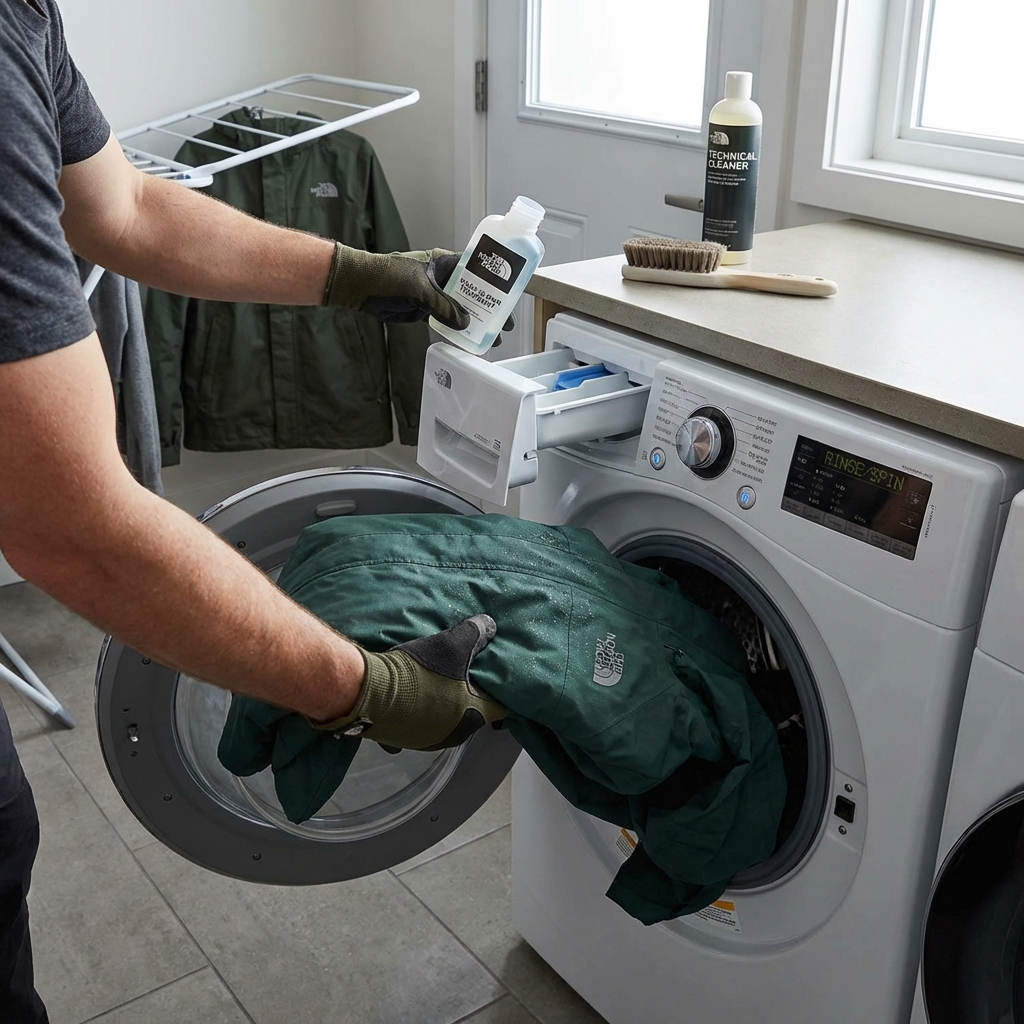
Skip the spin cycle if your machine allows; a slow spin is fine. Remove the piece while still damp and hang it to air dry. The coating sets as it dries, so gentle handling helps. Avoid high heat, direct sun, and condensation during drying. Most pieces are dry enough to wear in 12-24 hours, though full cure takes 48 hours.
One application makes a visible difference; two successive treatments build a stronger finish. We recommend two treatment cycles for heavily used pieces to restore performance closer to factory level. After drying, pour a few drops of water on the fabric and verify the beading effect before returning the gear to your pack.
Application Guide: Getting the Best Results with Spray-On Treatments
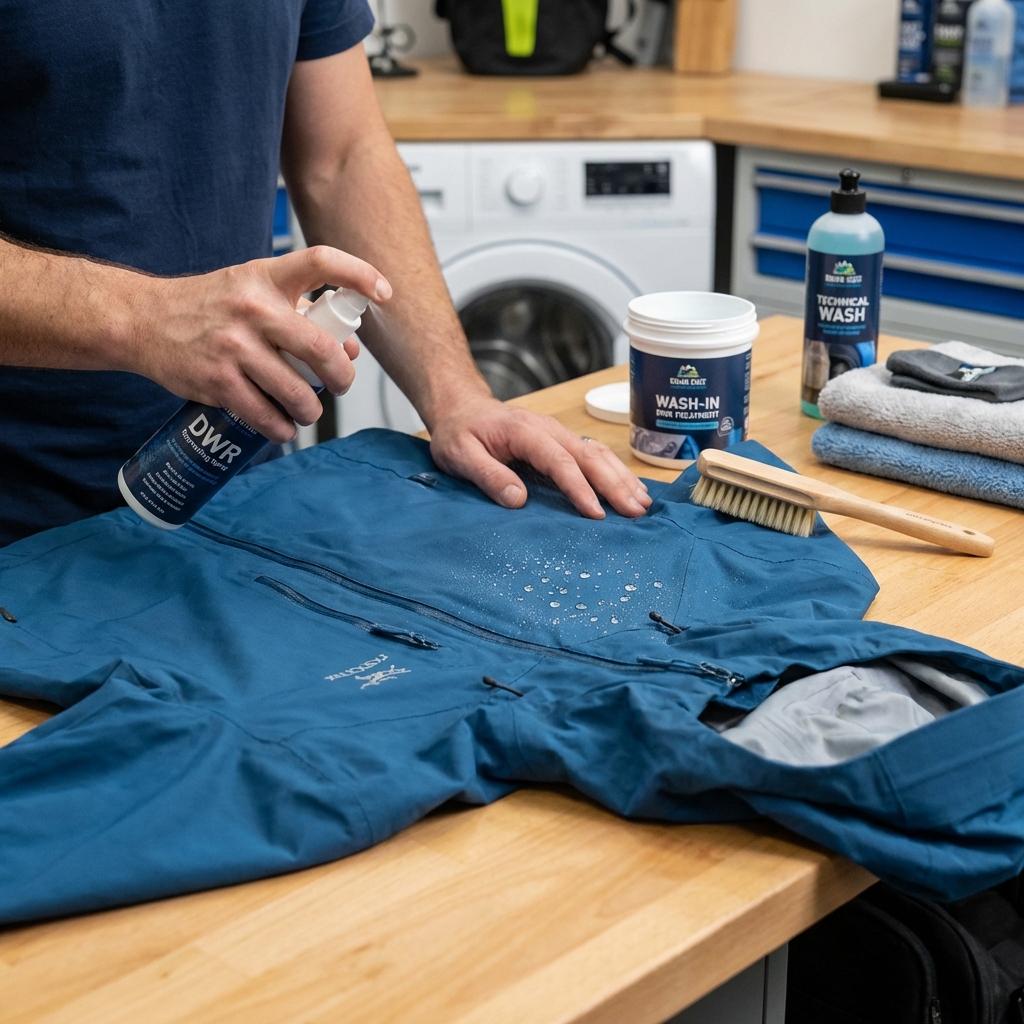
Work outdoors or in a garage with open doors and good air circulation. Lay the jacket flat or hang it on a rack at waist level so you can reach all surfaces easily. Start with seams, zippers, and cuff edges where water typically enters first. Hold the can 6-8 inches from the fabric and apply a light, even mist. One pass is usually enough; two passes build a thicker protective layer.
Work methodically from top to bottom, paying extra attention to shoulder seams and collar stitching. Allow the coating to cure as specified on the can—typically 30 minutes before handling and 4-6 hours before full cure. If you’re treating a pack, spray the main body first, then zippers and pocket edges. Don’t oversaturate; you’re looking for a light, even coverage, not a wet appearance.
After spraying, hang the piece in a shaded, breezy area to dry. A fan helps. Once fully cured, test water beading before storing. If you notice any tackiness or stiffness after drying, you’ve applied too much—lighter application is always better and more even.
Real Performance Data: How Our DWR Treatments Extend Gear Life
We’ve tested our reproofing treatments against baseline untreated fabrics. After treatment, jackets shed water for 15,000-25,000 meters of elevation gain or roughly 60-80 wet-weather hours before noticeable performance fade. Untreated fabrics show saturation within 5,000-10,000 meters. That’s a 200-300% extension in usable performance from a single $10-15 treatment application.
Packs benefit even more visibly. Our tests show treated packs keeping internal contents dry for full days of heavy rain, while untreated packs show moisture migration within 4-6 hours. A $500 pack lasting an extra 3-5 years because of regular DWR maintenance is a practical investment.
The membrane underneath remains unchanged; this is purely a surface-level refresh. Long-term wear testing shows zero degradation of breathability after multiple DWR applications, so you can recoat confidently without compromising your gear’s core function.
Protecting Your Investment: The Cost of Reproofing vs. Replacement
A wash-in treatment costs $10-12 per application. A spray treatment runs $15-20 per can. You’ll use roughly one treatment every season for regularly used pieces, or less if you’re careful with washing and storage. Over five years, expect to spend $50-100 on reproofing a single jacket.
Replacing that same jacket costs $300-500. The math is clear: reproofing is one of the highest-return maintenance investments you’ll make on outdoor gear. We build our jackets and packs to last decades with proper care, and DWR maintenance is the most critical part of that care routine.
Think about it this way: you’re not prolonging inferior gear. You’re maintaining the performance of a high-quality piece that’s already field-tested and trusted. Most of us would rather restore what we love than start fresh with unknown gear.
XPLR Pass Members Get DWR Treatment Benefits
Our XPLR Pass loyalty program includes a quarterly DWR treatment coupon, giving you complimentary or discounted reproofing supplies year-round. Members also access our care guides and equipment maintenance tips exclusive to the community, plus priority support if you have questions about specific pieces.
Members earn rewards on maintenance products too, so you’re building value while keeping your gear protected. It’s one more way we support active explorers committed to gear longevity and responsible consumption. Join XPLR Pass to unlock these benefits and stay connected with fellow outdoor enthusiasts.
Extending Your Gear’s Life Through Regular Maintenance
DWR reproofing is just one part of a complete care routine. Proper washing (gentle cycle, minimal detergent), smart storage (cool, dry place, away from direct sun), and regular inspections for damage all extend gear life dramatically. Repair small tears immediately—they spread faster once water starts penetrating. Keep seams dry during storage, and inspect seam tape annually for lifting or separation.
We recommend reproofing seasonally if you’re logging heavy miles, or annually for moderate use. Many of our most experienced athletes reproof before major expeditions, ensuring their gear is at peak performance when it matters most. A few minutes of maintenance now saves you money, frustration, and unexpected failures on the trail.
Your gear is an investment in your adventures. By keeping the DWR coating fresh, you’re not just maintaining a jacket—you’re protecting countless future days in the mountains. That’s how you turn one piece into a lifetime companion.
For further reading: waterproof footwear.
Ready for your next adventure? Gear up with apparel and equipment built for the wild. Explore the collection now.
Frequently Asked Questions (FAQ)
Why does the DWR coating on my North Face jacket wear off over time?
We design our gear to handle harsh conditions, but DWR (durable water repellent) coatings naturally break down with regular wear, washing, and exposure to the elements. Body oils, dirt, and UV exposure gradually reduce the coating’s effectiveness, which is completely normal. The good news is that reproofing your jacket is simple and affordable, and we offer both wash-in and spray-on options to restore that water-shedding performance.
What’s the difference between your wash-in and spray-on DWR treatments?
Our wash-in treatments are the most convenient option, letting you refresh your gear during a regular wash cycle without extra steps or setup. Our spray-on treatments give you more control and tend to deliver stronger, longer-lasting results, though they require a bit more time and care during application. Choose wash-in for quick maintenance or spray-on when you want maximum performance before a major expedition.
How often should I reprooff my gear to keep it performing well?
We recommend reproofing your jacket or backpack once every 12 to 18 months if you use it regularly in wet conditions, though some gear may need it sooner depending on how often you’re out there. You’ll notice water starting to bead less effectively on the fabric rather than sheeting off smoothly, which is your signal that it’s time to refresh. Regular reproofing is much more cost-effective than replacing gear, and it keeps your investment performing the way we designed it to.
Leave a Reply