Blog

  • Emergency Field Repairs for Waterproof Shells: Our Guide to Staying Dry

    Emergency Field Repairs for Waterproof Shells: Our Guide to Staying Dry

    Table of Contents

    When Your Shell Fails in the Field: Why Quick Repairs Matter

    You’re three hours into a ridge traverse when you spot the small tear on your shoulder. It’s not catastrophic, but the sky is darkening and mist is rolling in. In that moment, the difference between a ruined trip and a salvaged one often comes down to how quickly you can seal that breach.

    We’ve been building waterproof shells for decades, and we’ve learned that field repairs aren’t a failure of design—they’re a practical necessity in serious outdoor conditions. Rocks snag fabric. Branches catch sleeves. Zippers take abuse. What matters is your ability to respond fast and effectively before a small problem becomes hypothermia risk.

    A quick repair in the field serves multiple purposes. It stops water intrusion immediately, preserving your core body temperature and morale. It buys you time to reach shelter or descend to safer conditions. It also extends the life of your shell by preventing water from seeping into insulation layers where it causes real damage. We design our shells expecting they’ll get fixed in the field—and we’ll show you exactly how.

    What to do next: Assess the size and location of damage before deciding on a repair strategy. Small pinhole leaks or seam separations under 2 inches benefit most from immediate field tape application.

    Understanding Your Waterproof Shell Damage

    Not all waterproof shell damage is created equal, and the repair approach depends entirely on what you’re actually dealing with.

    Punctures and small tears are straightforward: a rock, a sharp tree branch, or equipment snag creates a localized hole. These are excellent candidates for field tape because they’re isolated and easy to target. Seam failures are trickier. When the thread holding two panels together lets go, water finds a highway. These often need seam sealant to work properly because tape alone won’t seal a gap that flexes with your movement.

    Abrasion damage—where the outer layer has been scuffed or worn thin from repeated contact—requires a different mindset. You’re not dealing with a hole yet, but compromised protective coating. If you can feel the underlying fabric texture, moisture can follow eventually. Zipper damage and slider failures are their own category: water runs along the zipper track itself, and no patch fixes that permanently in the field.

    Delamination is the sneakiest culprit. When the waterproof membrane separates from the fabric layer, you get pockets where water gets trapped. This often happens at stress points like shoulders or elbows. It’s harder to spot in the field and harder to repair, which is why prevention matters so much.

    What to do next: Run your hand over suspected damage areas. Can you feel texture or separation? Does water bead and roll off, or does it wet the fabric? This tells you whether you’re dealing with surface damage or structural failure.

    Essential Repair Tools We Recommend Carrying

    The weight cost of carrying repair supplies is negligible compared to the misery of a wet core temperature. We recommend keeping these items accessible in your pack, not buried at the bottom.

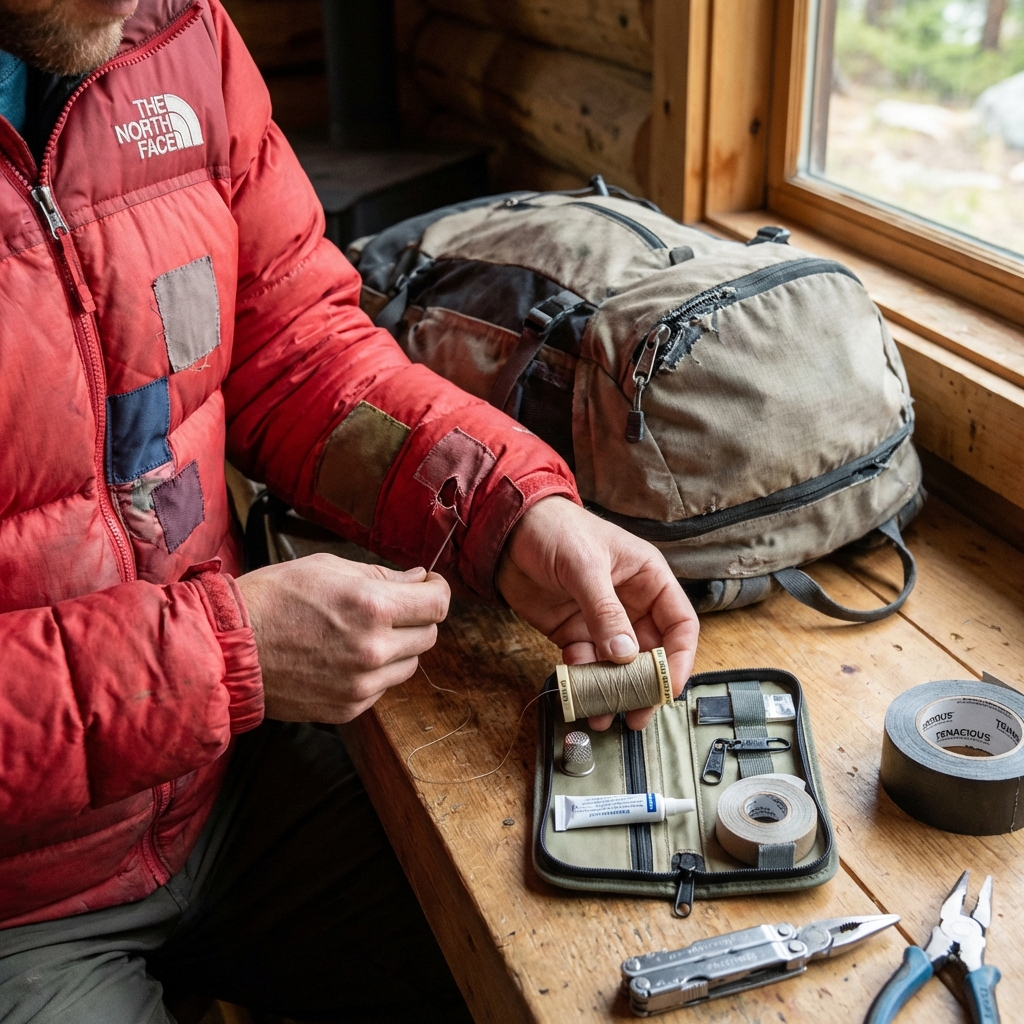
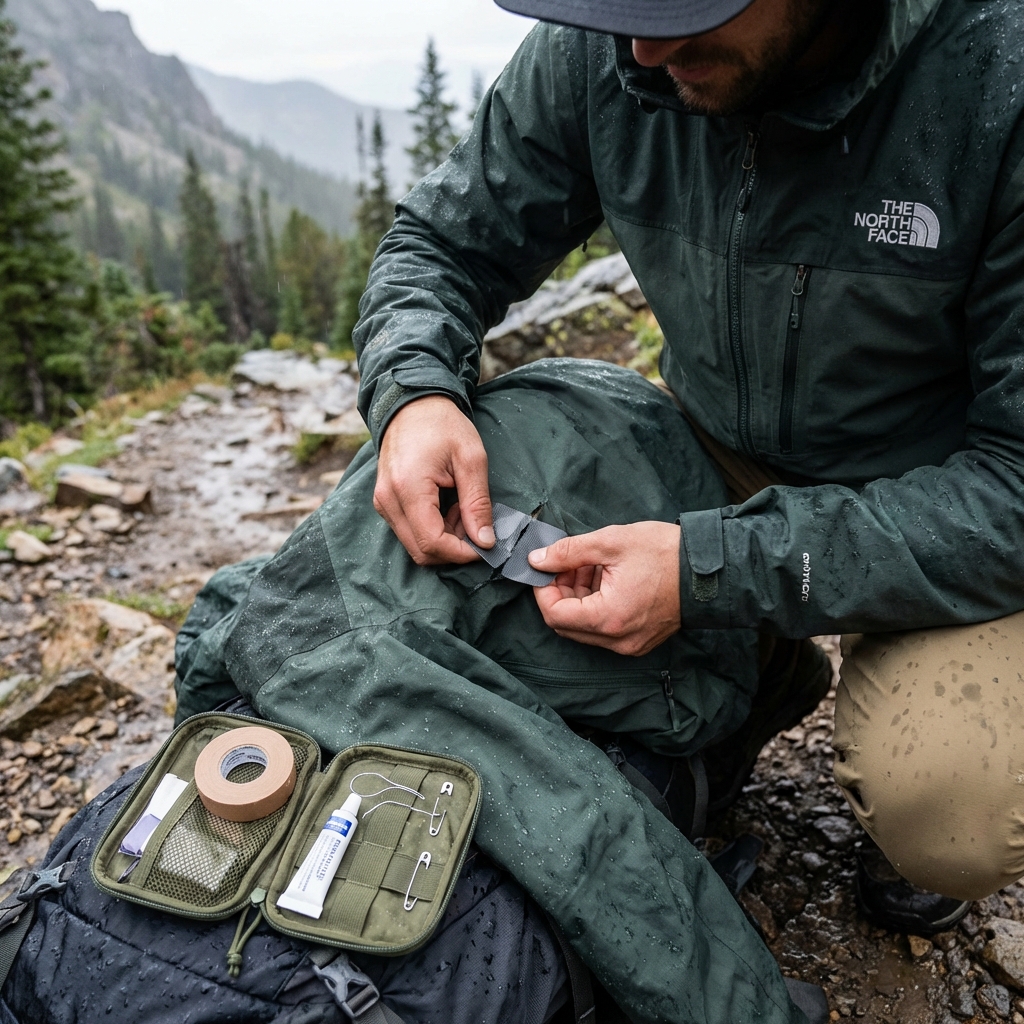
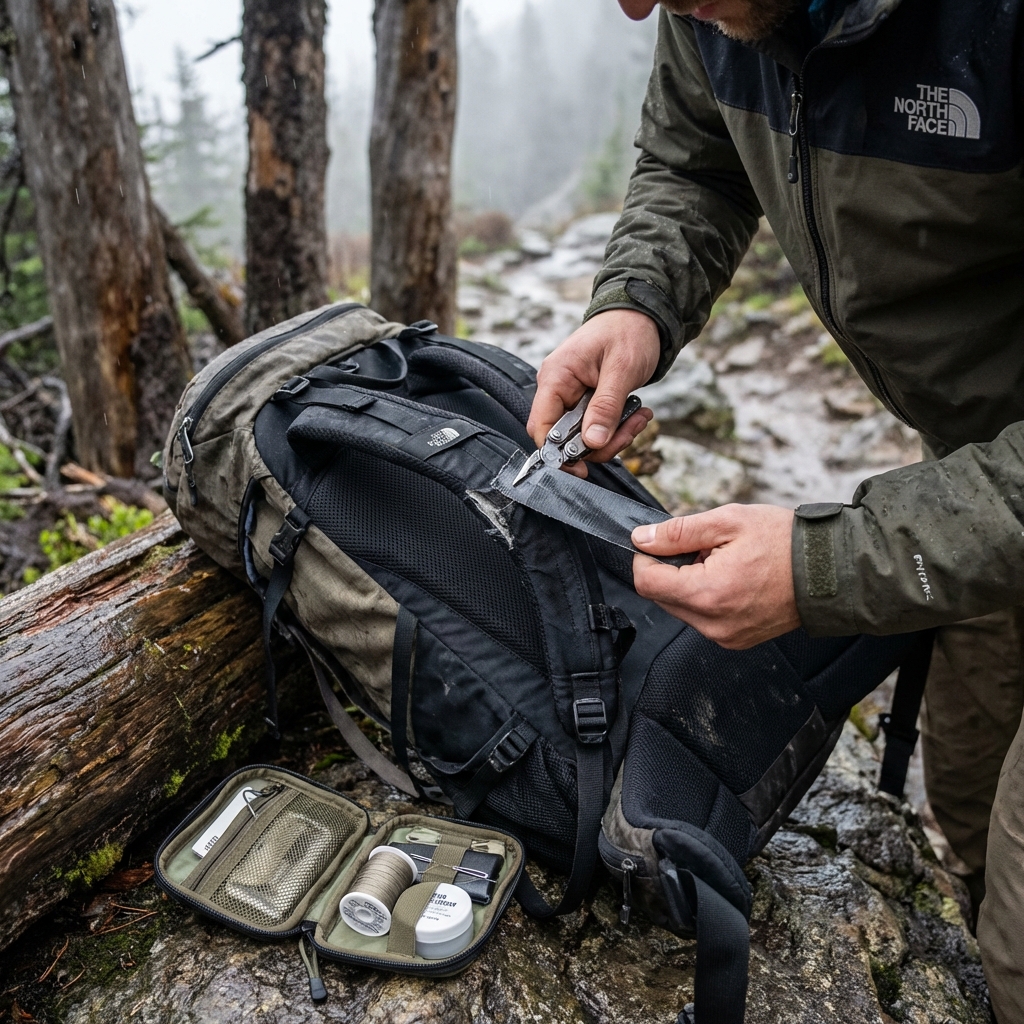
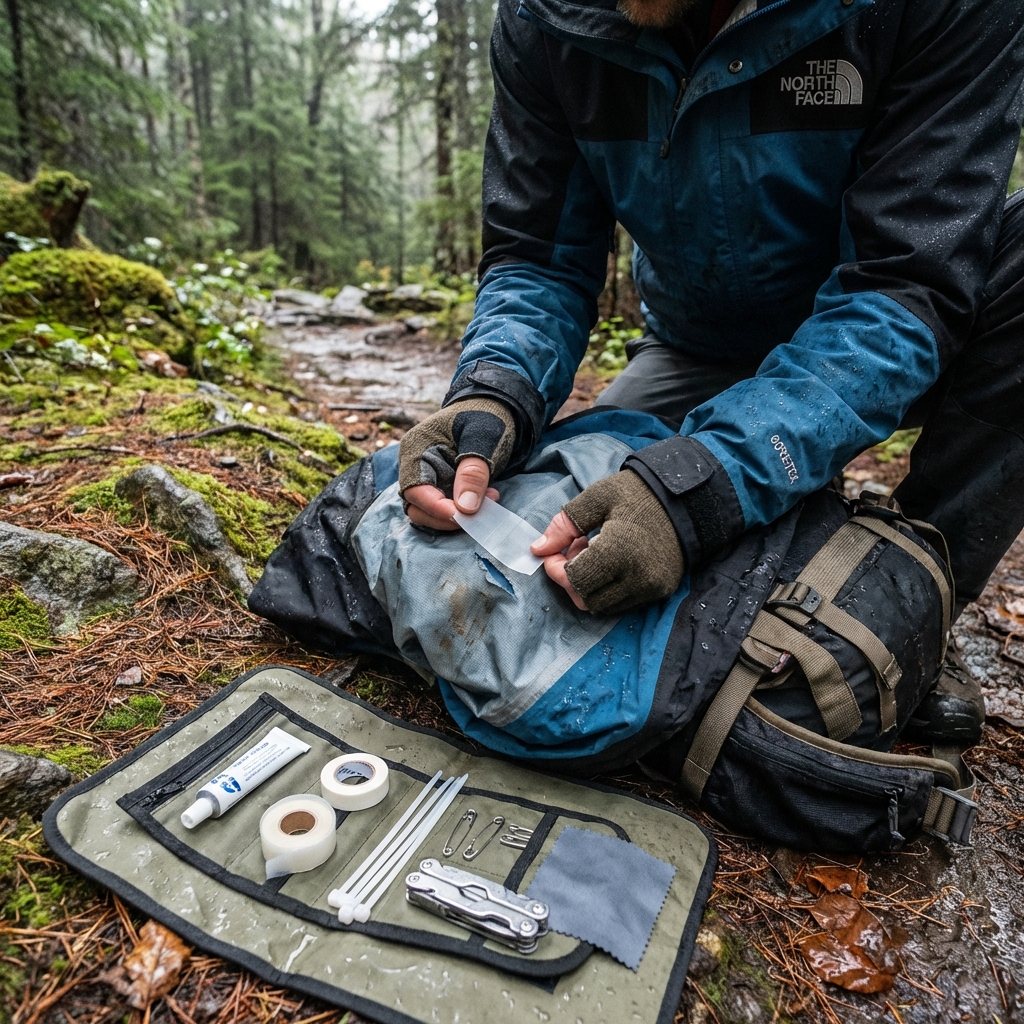
    Field repair tape is non-negotiable. Specialized waterproof repair tape (not standard duct tape) sticks reliably even when damp and doesn’t leave residue. Carry at least two patches roughly 3×3 inches—one for immediate use, one for backup. Roll it around a card or stick to save weight and space.

    Seam sealant comes in small tubes designed for backcountry use. It’s different from construction sealants because it cures quickly, remains flexible when dry, and bonds to synthetic fabrics. A tube the size of a lip balm tube weighs almost nothing and covers multiple seam repairs.

    A patch kit specific to your shell fabric type gives you options. If your shell is Gore-Tex or a similar laminate, you need patches designed for those materials. Standard fabric patches won’t bond reliably to waterproof membranes.

    Needle and thread sound old-school, but they’re essential for seam tears. Heavy-duty thread and a needle with a large eye let you close gaps and reduce water entry. Even rough stitching helps seam sealant work more effectively.

    Consider adding a small tube of flexible fabric adhesive and a lightweight piece of sandpaper (helps roughen surfaces for better adhesion). A small alcohol wipe cleans the repair area before applying tape or sealant, improving contact and bond strength.

    What to do next: Assemble your kit before your next trip. Test each item at home so you know exactly how it works under pressure rather than discovering surprises in bad weather.

    Applying Field Tape for Immediate Leak Sealing

    Field tape is your emergency stop-gap, and speed matters more than perfection here.
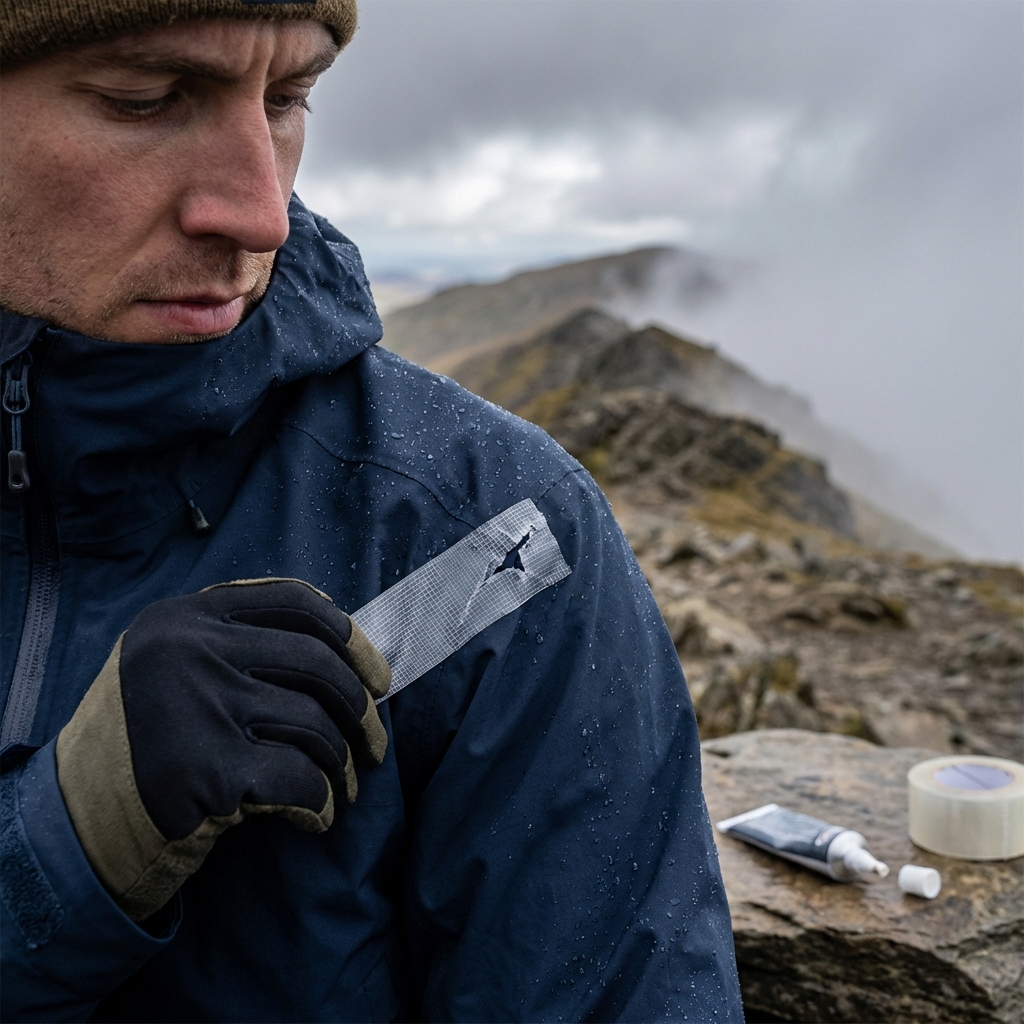
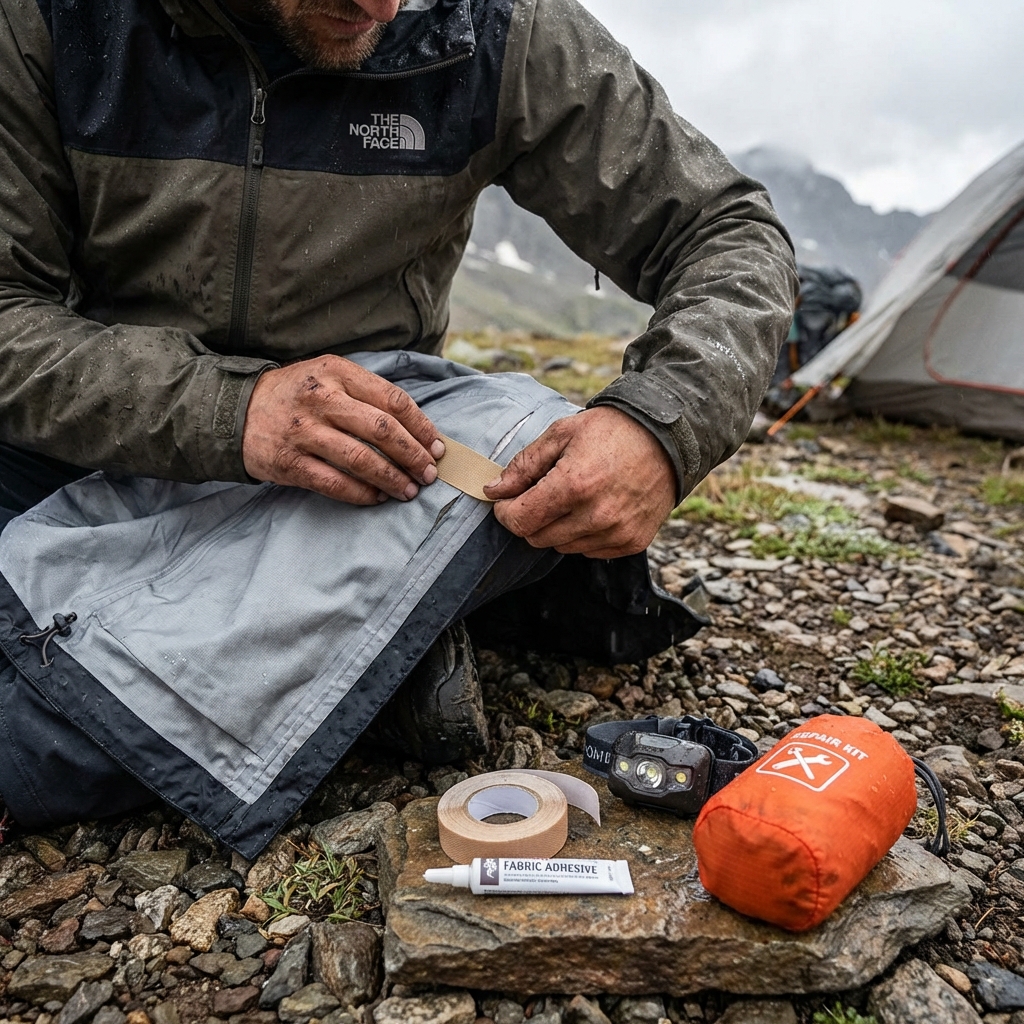
    Illustration 1
    Illustration 1

    First, dry the area as much as possible. Use a shirt sleeve, a lightweight towel, or even your body heat. Waterproof tape bonds poorly to wet surfaces, and moisture underneath reduces adhesion dramatically. If you’re in heavy rain, find any shelter—even a tree overhang—and wait 30 seconds for the surface to dry.

    Clean the area around the damage. Dust, salt residue, and body oils all weaken tape adhesion. A quick wipe with your sleeve or an alcohol pad makes a real difference. If you have sand or grit in the tear, brush it out gently.

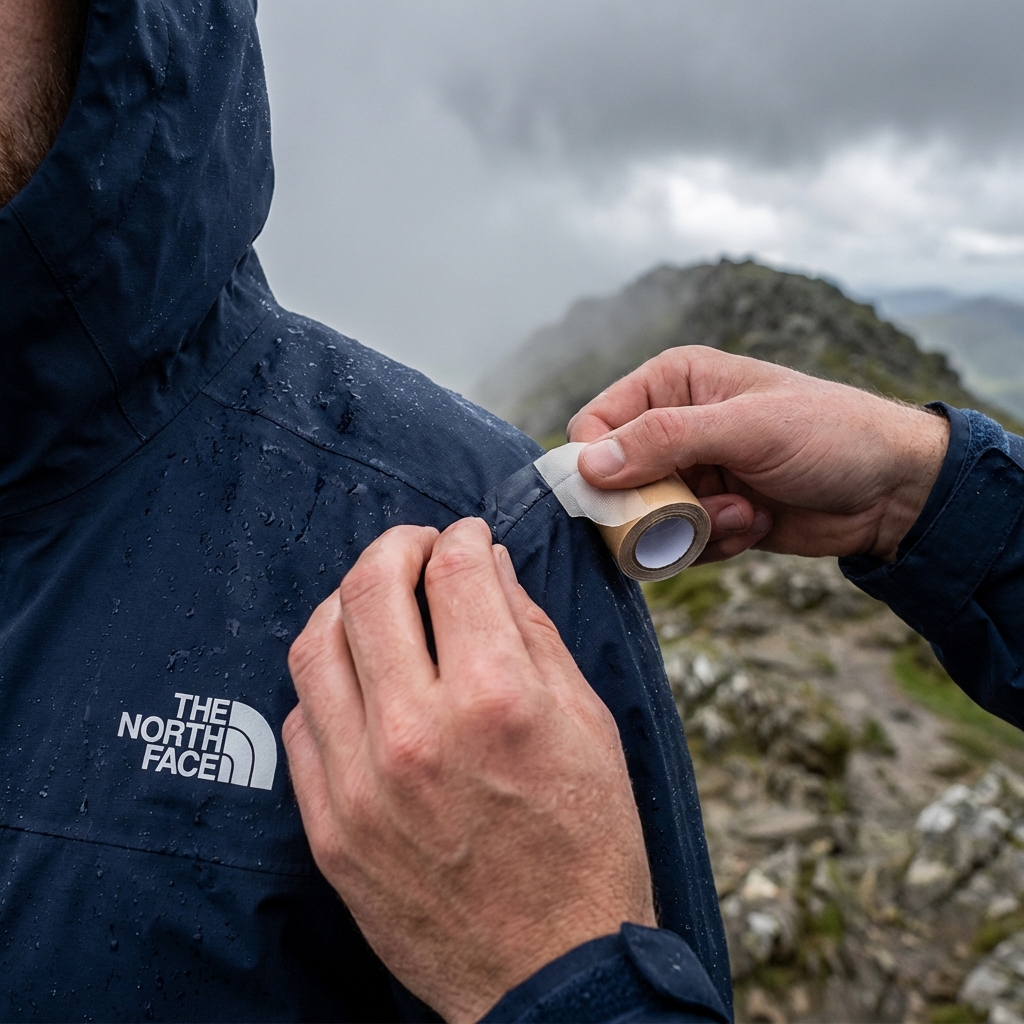
    Cut your tape into a shape that extends at least 1 inch beyond the damage in all directions. Rectangles are easier to apply than complex shapes—aim for roughly 3×4 inches for small tears. Round the corners slightly so they won’t catch and peel.

    Apply the tape starting from one edge and press it down smoothly, working air bubbles out toward the edges. Firm, deliberate pressure—not frantic—ensures good contact. Hold it down for 10-15 seconds. The tape bonds through pressure and time, not through force.

    For seams or edges, you may need to apply tape on both sides. Inner seam leaks especially benefit from an interior patch in addition to exterior tape. Let the tape cure for a few minutes before resuming movement if possible.

    What to do next: Test your repair immediately in light rain or by splashing water on it before committing to hours of hiking. If it’s holding, move on. If water still seeps through, the damage was larger than the tape covered—apply a second patch overlapping the first.

    Using Seam Sealant for Lasting Temporary Patches

    Seam sealant bridges the gap between emergency field tape and permanent shop repairs. It’s particularly effective for thread failures or separated seams because it creates a flexible, waterproof bond that moves with the fabric.

    Clean the seam thoroughly. Any dirt or old sealant prevents new sealant from bonding. Use your knife or fingernail to scrape away loose material. Wipe it clean with an alcohol pad if you have one. Dry the area completely—this is absolutely essential.

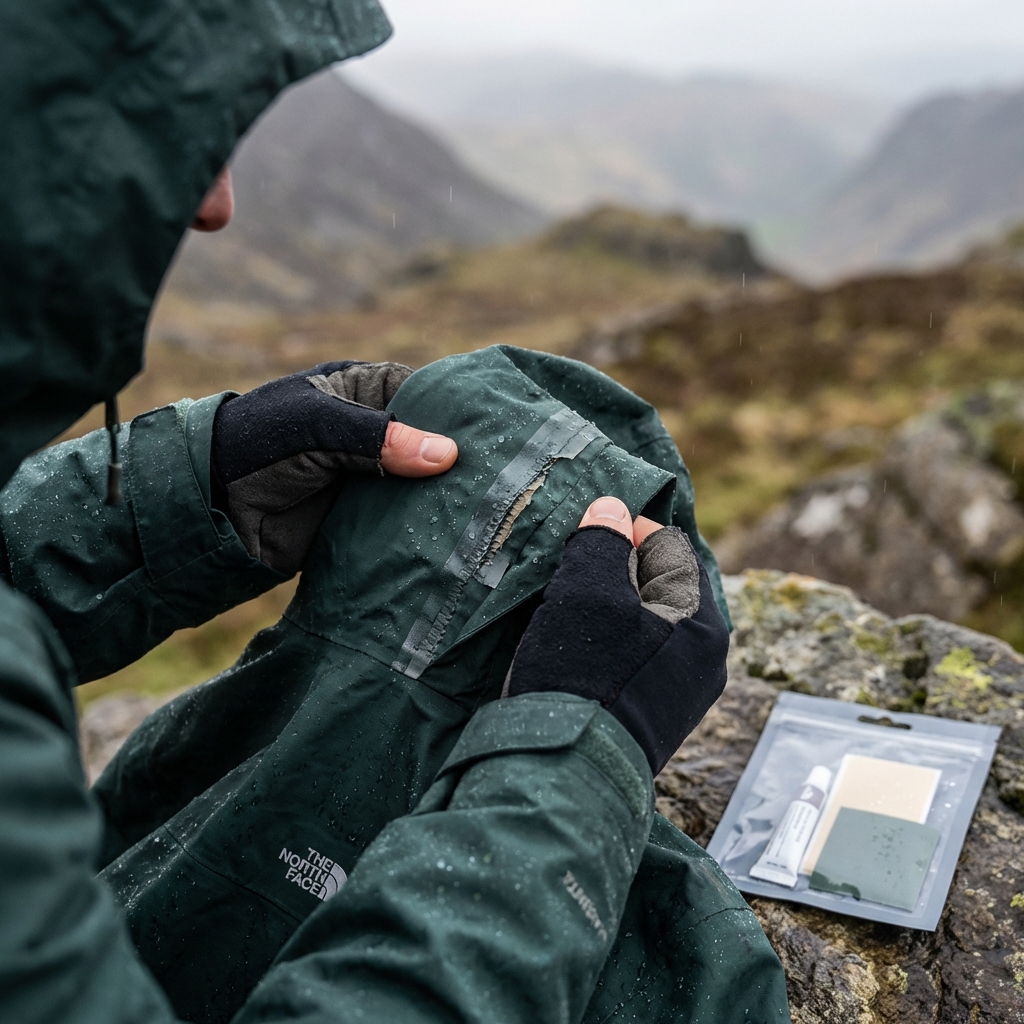
    Apply a thin bead of sealant directly into the seam gap. Don’t glob it on; a line about 1/8 inch wide and 1/4 inch tall is sufficient. The sealant spreads slightly as it cures and creates a waterproof layer. Work it into the gap gently with your finger or a stick. Smooth it out so it sits flush with the fabric.

    Let it cure according to the product instructions. Most field sealants cure in 10-20 minutes, though full hardness takes several hours. Don’t apply pressure to the seam during this time—let gravity and air do the work.

    Seam sealant is particularly useful for weeping seams where water runs along the thread rather than through a hole. It’s also excellent for delamination at the edges of damage. The flexibility of the product means it moves with your shoulder or elbow without cracking like tape might.

    What to do next: If you’re using sealant on a high-stress seam, reinforce it with field tape over top once the sealant has cured. This layered approach handles both flexibility and structural support.

    Multi-Layer Repair Strategies That Work

    The best field repairs often combine multiple techniques because different damage types benefit from different approaches.

    For a small tear in a seam, apply seam sealant first. Once it’s cured, cover it with field tape. The sealant handles the micro-failures in the thread, and the tape provides structural reinforcement. This stops leaks at the source and prevents water from finding alternate routes along the seam.

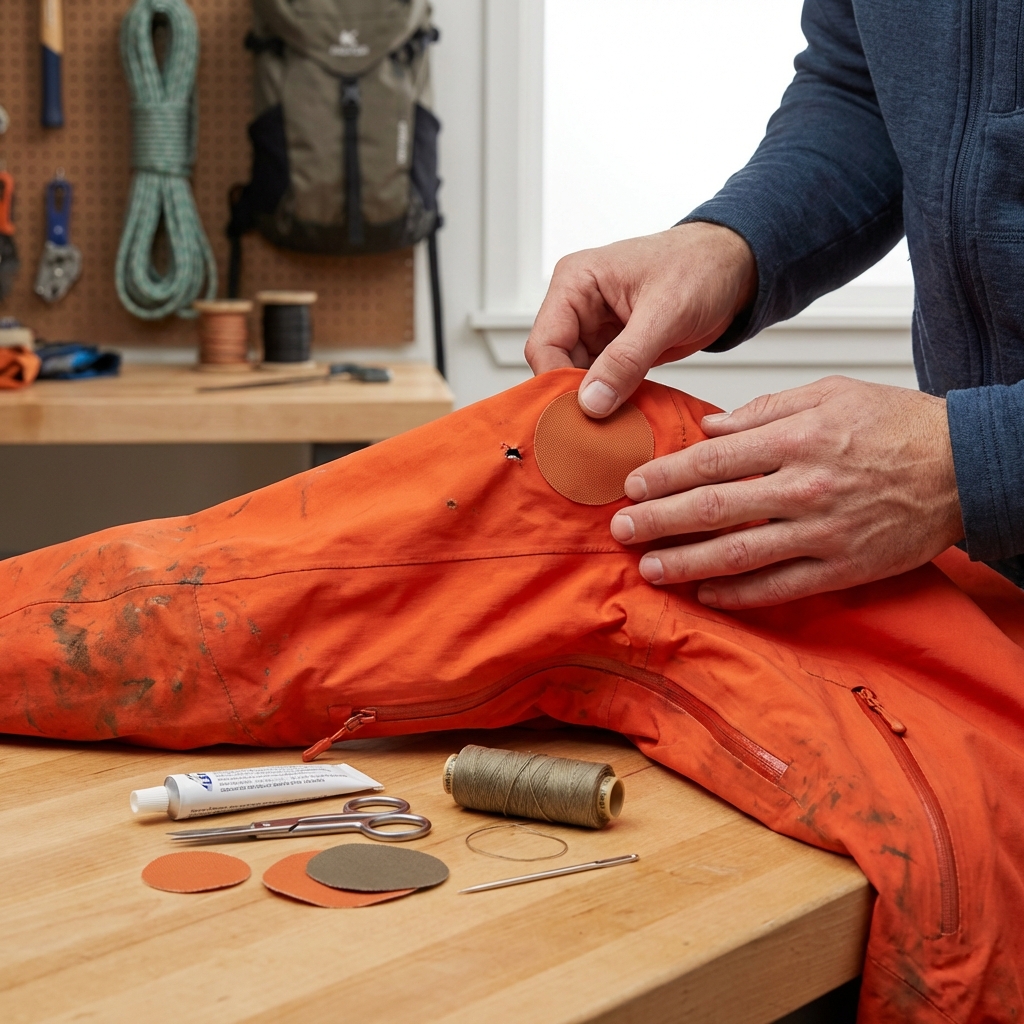
    For larger punctures with separated fabric, start with field tape on the outside. Once that’s secure and cured, apply a second tape patch on the inside if accessible. This sandwiches the damage and prevents water from wicking under the tape edges. For critical areas, some athletes add a small sewn patch using the needle and thread method, then seal around the edges with tape.

    Abrasion areas require a different approach. If the outer coating is compromised but the fabric is intact, apply a flexible waterproof tape that bridges the worn zone. Don’t wait for actual holes to form—seal it when you first notice the texture change. This prevents small problems from becoming big ones.

    Zipper failures are tricky in the field. If the slider is stuck or damaged, attempt to free it gently with a small amount of graphite lubricant or silicone spray if you’re carrying one. If that fails, tape the zipper closed to prevent water from running along the track. This isn’t elegant, but it works in emergency situations.

    What to do next: Practice layering repairs on old shells at home. Get comfortable with the feel of tape, sealant, and stitching before you need these skills under stress.

    How We Design Our Shells for Repairability

    We intentionally design our shells with field repair in mind because we know the trail is unpredictable.

    Our technical shells use bonded laminate construction—that is, a waterproof membrane fused to a protective outer layer. This design handles tape and sealant repair extremely well. The membrane is tough enough to hold patches firmly, and the outer layer provides good surface area for adhesion. Contrast this with some simpler coated shells where the coating is thin and peels easily once damaged.

    We also pay attention to seam construction. Our seams are taped from the inside during manufacturing, but they’re designed so you can apply additional sealant from either side in the field. The thread we use is durable and won’t fray excessively if a seam partially fails. Small repairs are straightforward.
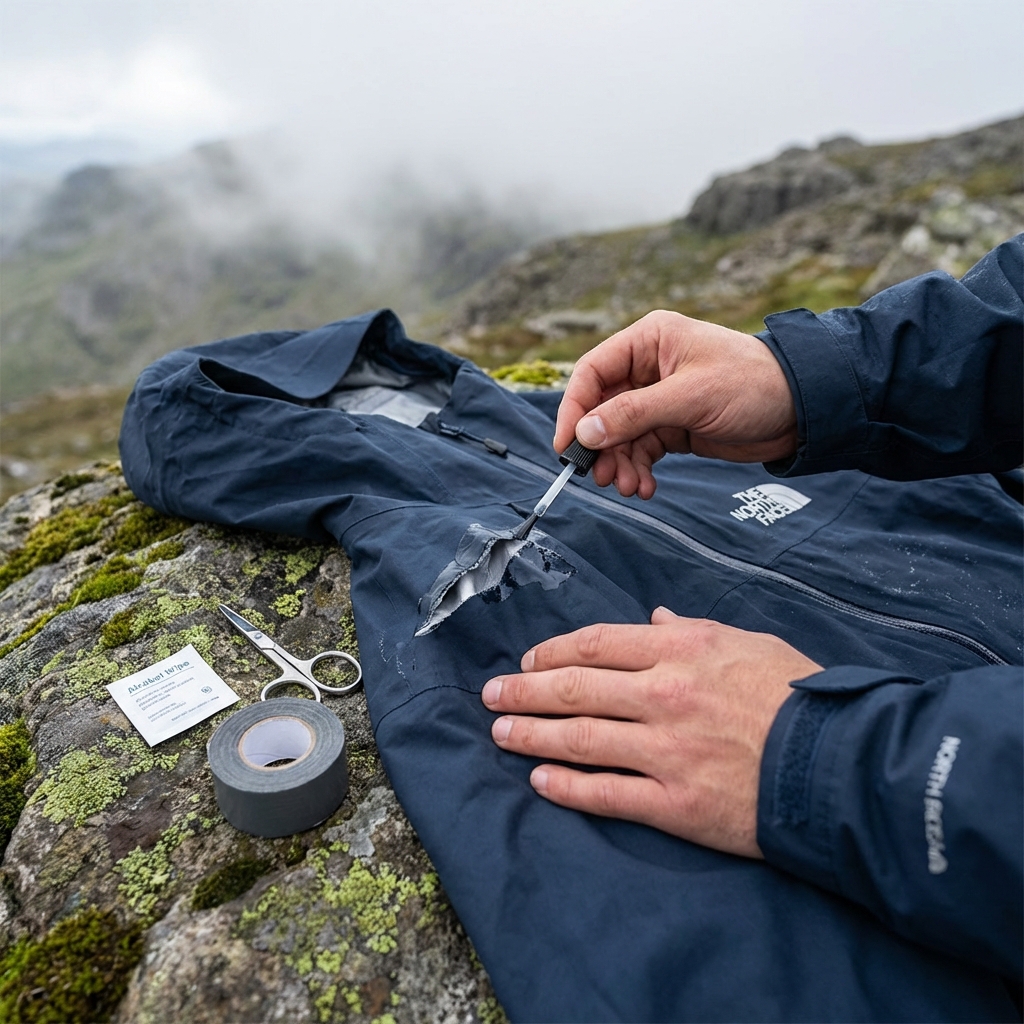
    Illustration 2
    Illustration 2

    Critical stress areas like shoulders, elbows, and armpits receive extra attention. We use reinforced panels in these zones, which means small damage is less likely and larger repairs have more fabric to work with. This is especially important on shells like our FutureLIGHT AMK Jacket designed for extended expeditions where durability and repairability are core requirements.

    We avoid thin, delicate fabrics on high-wear areas and use materials that accept patches without compromising durability. This isn’t just good for field repairs—it means your shell lasts longer overall.

    What to do next: When buying a new shell, check the seam quality and outer layer thickness. Shells designed for technical use are inherently more repairable than ultralight options, a trade-off worth understanding before purchase.

    Testing Your Repair Before Heading Back Out

    Never assume a repair works until you’ve tested it under conditions similar to what you’ll face.

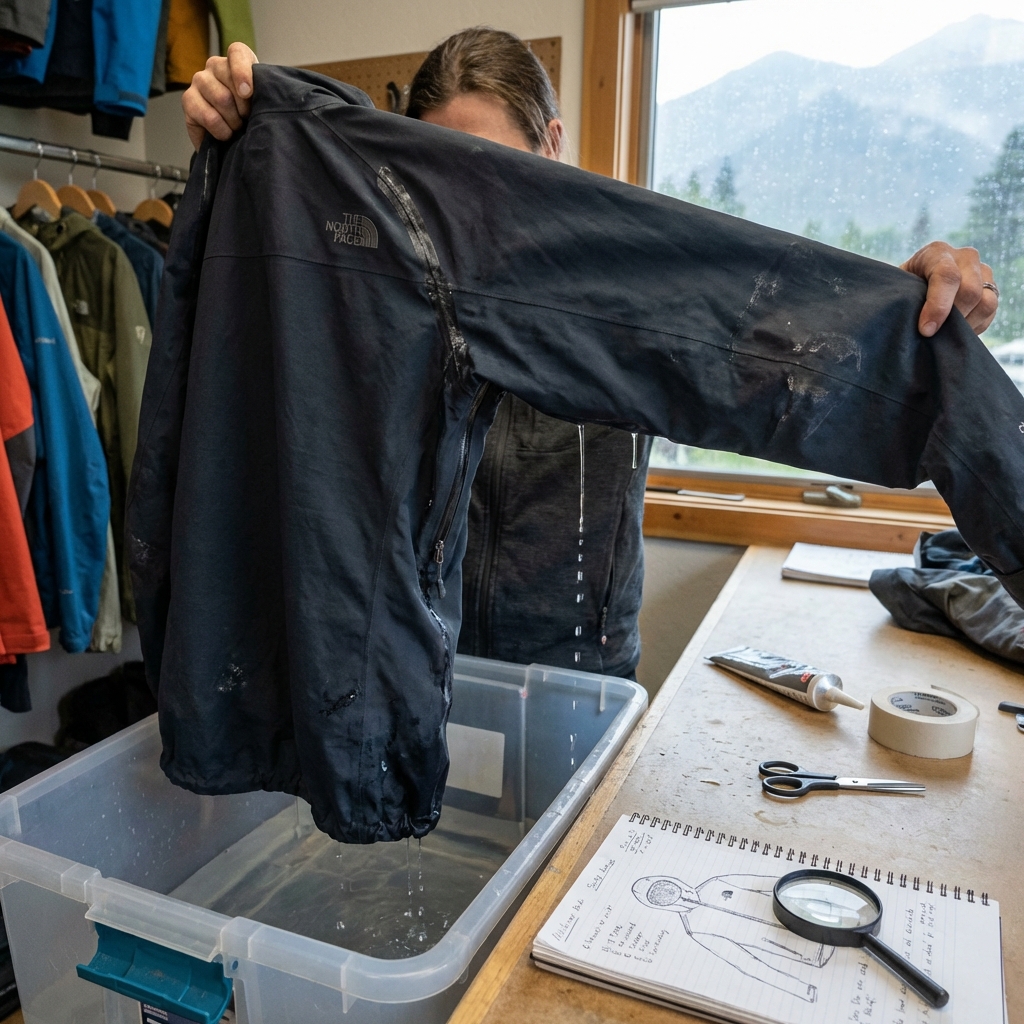
    In light conditions, splash water directly on the repair site. Watch how it behaves. Does water bead and roll away? Does it soak in slowly? Small amounts of water penetration are normal while tape or sealant fully cures, but water shouldn’t stream through the repair.

    If you’re in heavy rain, move under shelter and use your water bottle or a stream to deliberately wet the repair area from the outside. Observe the inside. Wait 30 seconds. Dry the inside surface with your hand or sleeve and look for new dampness. Repeat twice. Persistent moisture means the repair failed.

    For seam repairs, flex the area gently. Does the sealant stay intact or does it crack? If it’s cured properly, it should flex slightly without breaking. If it’s cracking, you applied too much, used incompatible materials, or didn’t let it cure long enough.

    For taped areas, check the edges. Are they lifting? Pressing down on corners and edges—especially if there’s any air gap—ensures adhesion. Smooth any loose spots.

    The test phase typically takes 5-10 minutes and could prevent a worse failure hours down the trail. Time is cheap when weighed against exposure risk.

    What to do next: If the repair fails, don’t be discouraged. Layer another patch over the first or try a different technique. Field repair often takes iteration, and backup patches exist for exactly this reason.

    When to Replace vs. Repair Your Shell

    Not every damaged shell deserves a field repair, and knowing when to replace versus patch saves you money and frustration long-term.

    Small, isolated damage under 2 inches deserves repair. Punctures, small tears, and minor seam failures are repairable if they’re not in locations that receive constant stress. A pinhole on the back of the shoulder? Easy repair. A tear that runs along a high-stress seam under your pack strap? That’s harder and might recur.

    Multiple damage points suggest deeper wear patterns. If you’re finding new damage every trip, the shell has likely reached end-of-life. Repairs on top of repairs eventually fail. The time and expense of repeated patching exceeds the cost of a new shell.

    Widespread delamination—where the membrane has separated from the outer layer across large areas—is difficult to repair in the field and points toward retirement. This happens as shells age or from excessive heat exposure during storage or washing.

    Zipper failures on critical zippers (main front zip, pit zips) are a good replacement trigger. You can repair it temporarily, but zippers see so much use that field repairs are usually temporary. A new shell with functioning zippers is more reliable.

    UV damage and color fading alone don’t indicate the need for replacement. The shell is still waterproof. Repairs work fine on faded shells.

    Consider your shell’s age and usage history. A five-year-old shell with minimal damage is worth repairing. A ten-year-old shell that’s been on dozens of expeditions might be approaching the end anyway. Repairs can extend life by a season or two, but they’re not permanent solutions.

    What to do next: When you do invest in a new shell, register it with us and keep your receipt. We offer repair services for shells within the first few years of ownership—sometimes professionally sealing or patching is more effective than field repairs.

    Maintaining Your Shell to Prevent Future Damage

    The best field repair is the one you never need to make, and preventive care dramatically extends shell life.

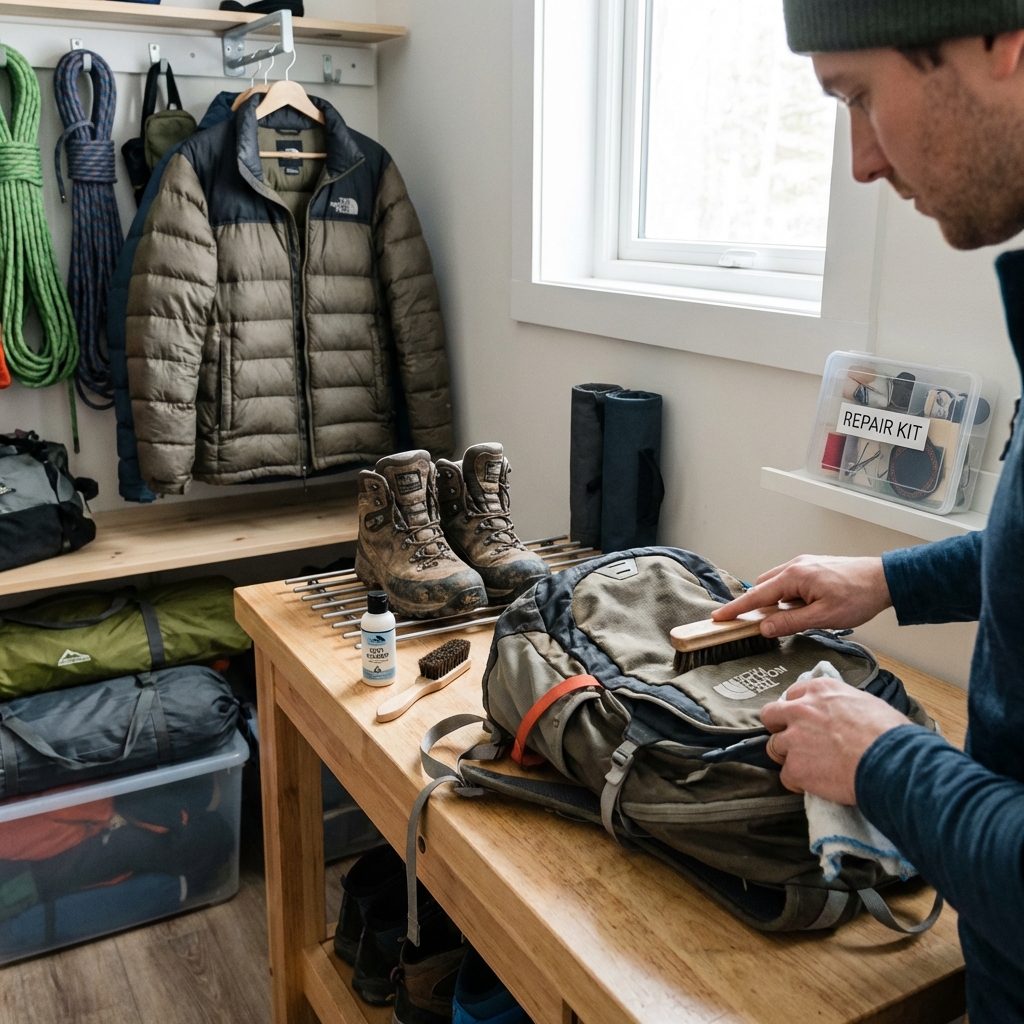
    Store your shell away from direct sunlight. UV exposure degrades the waterproof membrane over time, causing brittleness that cracks easily. Keep it in a cool, dark place—your closet is ideal, your car dashboard is not.

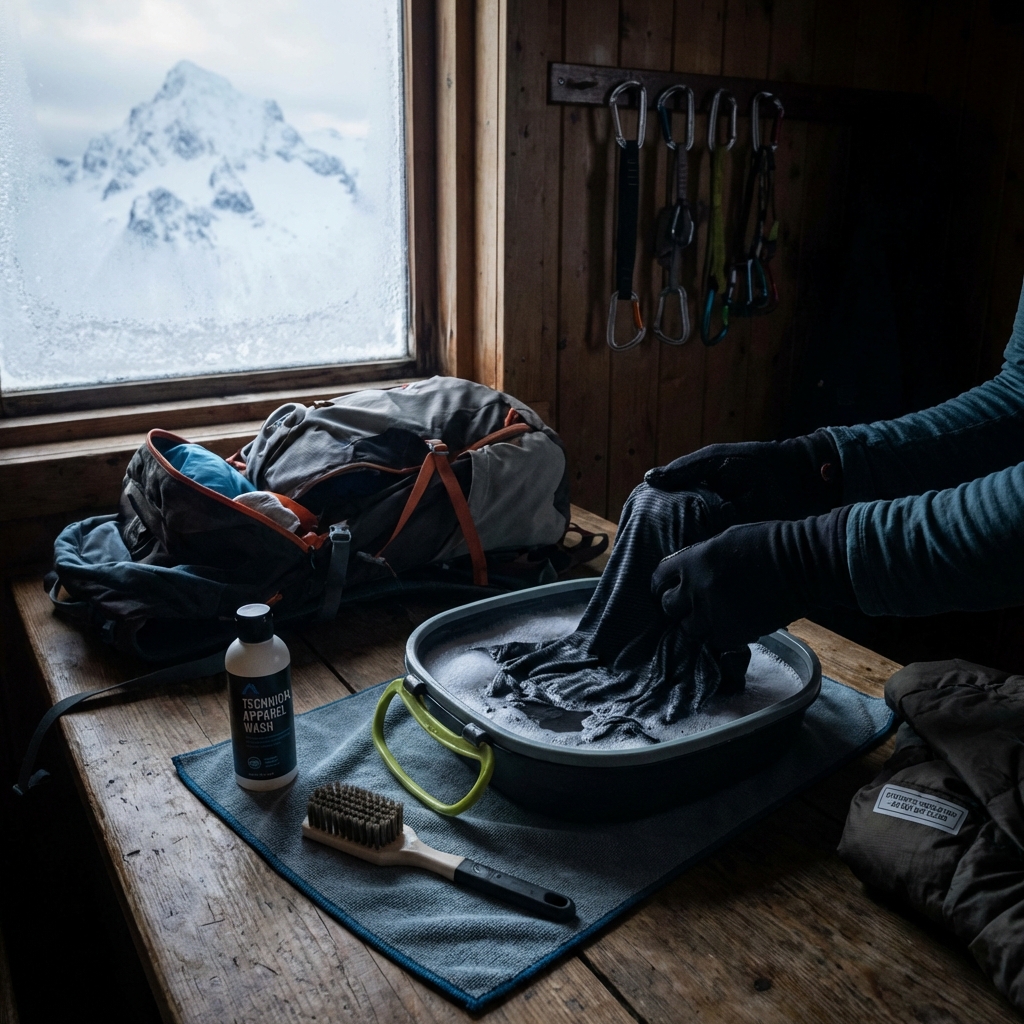
    Wash your shell carefully using cool water and a specialized technical fabric wash. Regular detergent leaves residue that reduces breathability and waterproofing. Never use fabric softener. Dry it gently. If you must use a dryer, use low heat. High heat damages membranes.
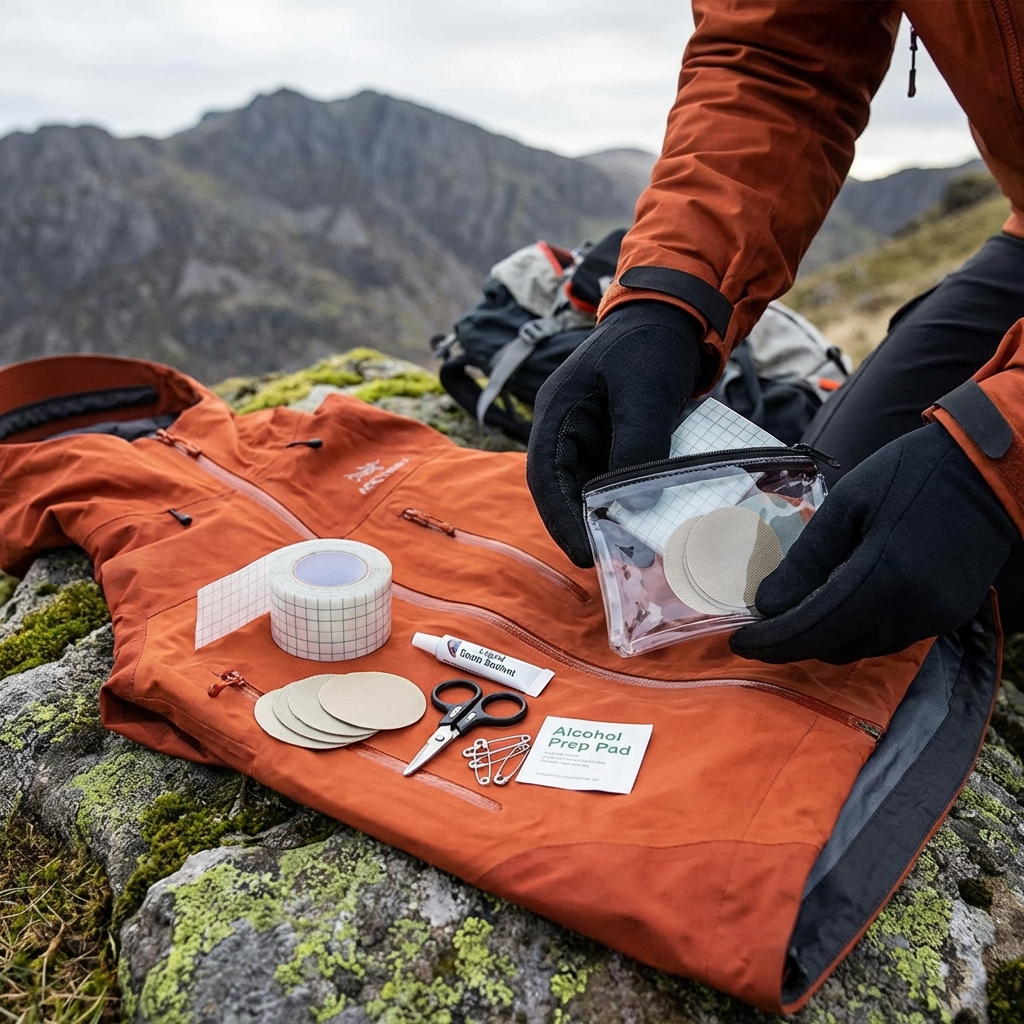
    Illustration 3
    Illustration 3

    Avoid sharp contact. Store shells away from velcro, rough zippers, and abrasive materials that snag fabric. Use your pack’s interior pockets strategically so the shell doesn’t rub against sharp gear.

    Inspect your shell before every trip. Look for small damage, wear patterns, and seam separation. Address minor issues immediately with sealant rather than waiting. A spot of sealant now prevents larger damage later.

    Use your shell appropriately. It’s designed for wet, cold conditions, not for everyday casual wear. Minimize time in direct sun and avoid activities where it will snag repeatedly. This isn’t about bubble-wrapping your gear—it’s about reserving this technical tool for the conditions it’s built for.

    Pay attention to high-wear areas during trips. Your pack straps, zipper pulls, and shoulder seams all take repeated stress. Small damage in these areas accelerates quickly. Check them mid-trip if you’re on longer expeditions.

    What to do next: Create a simple maintenance routine. Wash and inspect your shell seasonally. Apply preventive sealant to any questionable seams before your trips rather than waiting for leaks to appear.

    Building Your Emergency Repair Kit

    A thoughtful repair kit balances completeness with weight. You don’t need a full workshop, but you do need enough tools to handle common problems.

    Start with the essentials: field repair tape (two 3×3 inch patches minimum), a small tube of seam sealant, needle and thread, and a lightweight patch kit. These four items handle 90 percent of field repairs. Total weight is roughly 2-3 ounces. Add a small alcohol wipe for cleaning, and you’re at less than half an ounce more.

    Pack these items in a small zipper pouch in the top of your pack or in a hip belt pocket where you can access them quickly. Don’t bury them in a bottom compartment. The moment you need them is when minutes matter.

    Consider the length of your trip. Day hikes and short overnights benefit from minimal repair supplies. Extended expeditions—especially those involving scrambling or alpine terrain where damage is more likely—warrant more comprehensive kits. For multi-week trips, consider a larger patch kit and extra sealant.

    Organize your kit so you can locate items in low-light conditions. Label small containers. Wrap tape around a card for easy deployment. Familiar tools work faster when you’re stressed.

    Build your kit specifically for your shell type. Gore-Tex laminate shells need patches designed for Gore-Tex. Soft-shell materials need more flexible patches. Check your shell’s technical specifications and match your repair supplies accordingly.

    Test your kit before serious trips. Practice applying tape and sealant on old shells in your garage. Understand what each tool does and how it feels before you’re 5,000 feet up in weather. Confidence matters.

    What to do next: Assemble your kit this week. If you’re planning a trip where weather exposure is a real possibility, invest 15 minutes in a dry run with your repair supplies. You’ll gain confidence and likely discover what you wish you had along.

    Field repairs aren’t a sign your shell failed—they’re proof that quality gear deserves skilled maintenance. We design our shells expecting they’ll take damage and bounce back stronger. Your job is understanding when and how to help them along. Keep your repair kit light, test it before you need it, and don’t hesitate to layer multiple techniques on serious damage. The trail rewards preparation, and nothing prepares you better than understanding exactly how to keep dry when conditions get rough.

    Ready for your next adventure? Gear up with apparel and equipment built for the wild. Explore the collection now.

    Frequently Asked Questions (FAQ)

    What emergency repair tools should we carry for waterproof shell damage?

    We recommend keeping field repair tape and seam sealant patches in your pack because they’re lightweight and handle most common tears and seam failures on the trail. You’ll also want a small piece of sandpaper to roughen the surface before applying tape, which helps it stick better in damp conditions. These items take up minimal space but can keep you dry when a shell fails hours away from camp.

    How do we test a field repair before heading back out?

    After you’ve applied tape or sealant, we suggest pouring water directly onto the repair from your water bottle to confirm it’s holding. Let it sit for a few minutes to make sure the seal is working and water isn’t seeping through. This quick test gives you confidence that your temporary fix will last until you can get home for a proper repair.

    When should we replace our shell instead of repairing it?

    If you’re noticing multiple leaks, damage to the main seams along the back or shoulders, or holes larger than a few inches, it’s time to replace it rather than patch it. We design our shells for repairability, but constant failures mean the fabric has reached the end of its performance life. A new shell will protect you better than a patchwork of repairs ever could.
  • Master Alpine Climbing Layers: Our Technical System for Extreme Mountain Performance

    Master Alpine Climbing Layers: Our Technical System for Extreme Mountain Performance

    Table of Contents

    Why Your Layering System Determines Summit Success

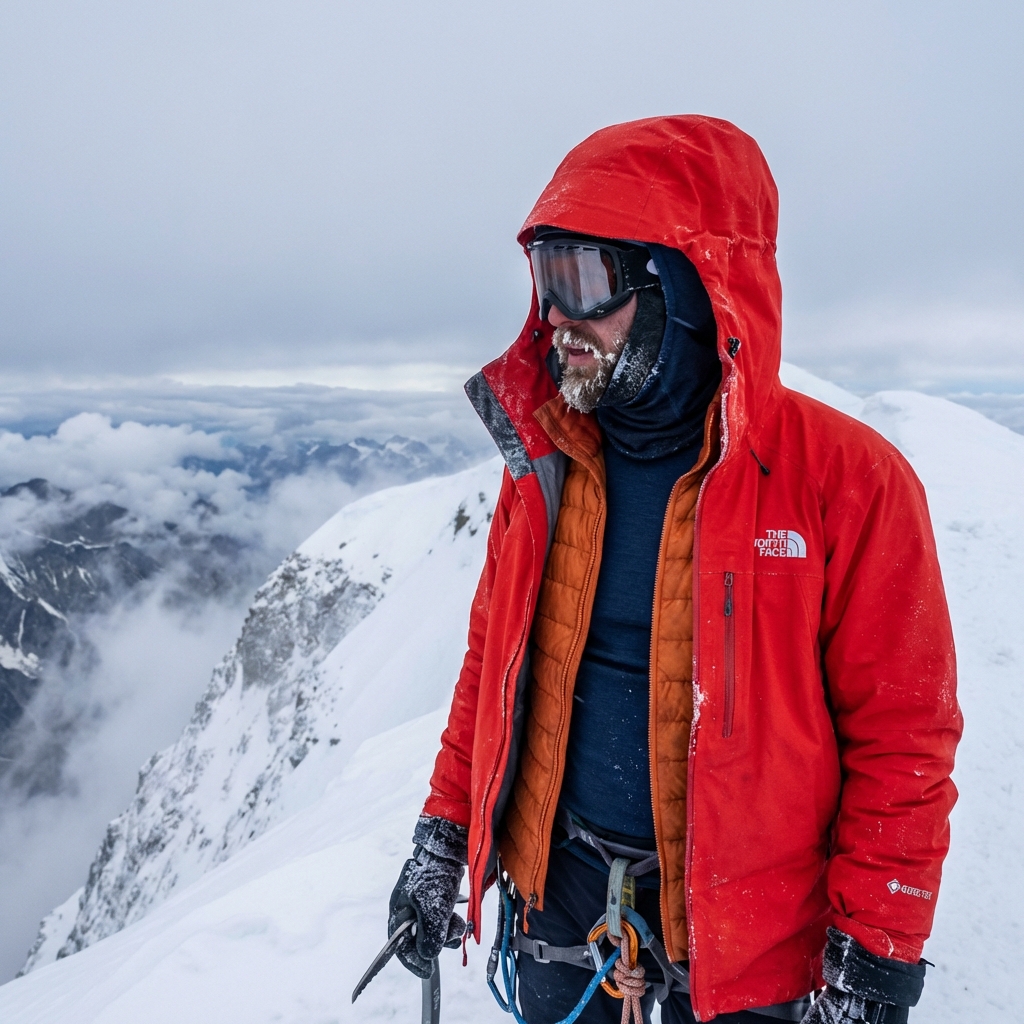
    You’re 18,000 feet high, the wind is shredding at 40 mph, and your core is starting to feel the chill. Your layering system is now the only thing between you and a dangerous situation. This is where theory meets reality on the mountain, and we’ve built our technical apparel around one core principle: every layer has a job, and they only work when stacked deliberately.

    We’ve watched climbers summit in conditions that felt impossible and watched others turn back in milder weather. The difference rarely comes down to toughness or experience alone. It comes down to understanding how moisture, insulation, and wind resistance interact as a system. A single wrong choice in your base layer can cascade through your entire kit, making you colder, heavier, and less able to adapt.

    When you get layering right, your body stays regulated across temperature swings of 40 degrees. You move efficiently. You stay dry from sweat and external weather. You make sound decisions because your energy isn’t burned on fighting discomfort. That’s what we optimize for when we design technical climbing gear.

    What to do next: Think about your last alpine push. Did you feel restricted, overheated, or sluggish? That’s often a layering problem, not a fitness problem. Keep that moment in mind as you read through our system.

    The Three-Layer Foundation We’ve Perfected

    We’ve refined this down to three critical layers, and each one addresses a specific function. Strip any one away, and your performance drops. Add layers without purpose, and you sacrifice mobility or breathing room.

    Our system works like this:

    • Base layer: Moves moisture away from your skin so you stay dry in active phases and don’t cool rapidly at rest
    • Mid-layer: Traps dead air to insulate, with flexibility to compress or remove as output changes
    • Shell layer: Blocks wind and precipitation while allowing trapped body heat to escape so you don’t overheat under exertion

    The beauty of this three-part approach is flexibility. You can climb in base plus shell on a crisp, dry dawn. Add a mid-layer as you ascend into wind. Strip the shell during a steep snow pitch and pull it back on during the traverse. Each adjustment takes five seconds and keeps you in your performance zone.

    We don’t build layers assuming you’ll wear everything at once. We build them assuming you’ll swap, layer, and adjust dozens of times during a single climb. That’s what real alpine work looks like.

    Base Layer Technology: Moisture Management in Extreme Cold

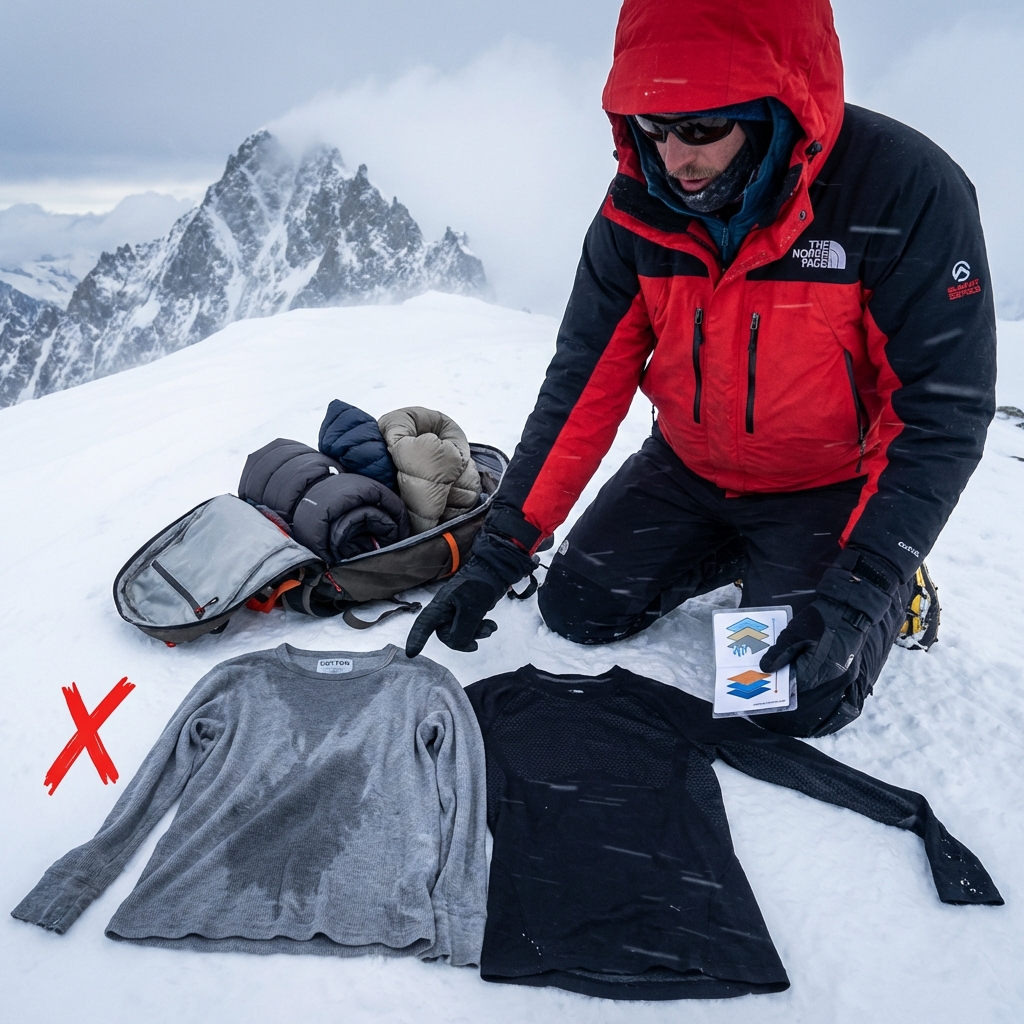
    Your base layer is on the clock the moment you start moving. Sweat is inevitable, and cotton holds moisture like a sponge, dropping your core temperature by 25 degrees when the wind hits. We engineer our base layers from synthetic blends and merino wool that wick moisture away from your skin in seconds, not minutes.

    Synthetic materials like polyester move sweat laterally across the fabric, pushing it toward the surface where air can evaporate it. Merino wool does something different and equally valuable: it absorbs moisture into its fiber structure without feeling wet, then releases it. Both work. The choice depends on your sensitivity to cold and how aggressively you’re climbing.

    On sustained, high-output climbs like steep snow gullies, synthetics tend to outperform. They dry faster if you sweat heavily and cool quickly when soaked. On moderately paced, high-altitude approaches where you’re managing effort carefully, merino’s odor resistance and thermal properties often feel more comfortable.

    Fit matters more than you’d think. A loose base layer doesn’t wick efficiently because the fabric sits away from your skin. Our base layers use a technical fit that hugs without restricting, so sweat moves away consistently across your entire torso and legs. Seams run flat to prevent blisters during multi-day pushes, and our crotch gusset design means you can move freely on steep terrain without chafing.

    Actionable takeaway: Test your base layer on a moderate day hike before committing it to a summit attempt. Climb hard enough to sweat, then sit still for 15 minutes. If you feel warm and dry, you’ve found your match. If you feel clammy or chilled, switch materials.

    Mid-Layer Insulation: Choosing Between Down and Synthetic Performance

    This is where we see the most confusion, and it’s the most consequential choice in your kit. Down insulation compresses to almost nothing and delivers exceptional warmth-to-weight. Synthetic insulation stays warm even when damp and dries faster. Both have their place, and we make both because neither dominates in every condition.

    Illustration 1
    Illustration 1

    Down excels on high, dry mountains where weather is stable and you’ll control moisture carefully. A down mid-layer on Mount Denali or the north face of the Eiger delivers warmth you can’t match elsewhere. It’s light enough that you barely notice it in your pack, and it lasts decades if cared for. The tradeoff: once down gets genuinely wet, it clumps and loses insulation immediately. On wet mountains or during extended alpine traverses where you can’t guarantee drying time, that risk becomes real.

    Synthetic insulation like PrimaLoft and Polartec PowerFill perform differently. They lose some warmth compared to down at the same thickness, but they retain 60 to 80 percent of their insulation value even when damp. They also dry faster between uses and don’t require the careful storage that down demands. If you’re climbing in the Pacific Northwest or trying to climb year-round, synthetic mid-layers handle moisture reality better.

    We also see mixed strategies work beautifully. A synthetic base plus a down mid-layer under a waterproof shell handles massive temperature swings. Start the day in base and shell. Add the down as you approach ridge lines where temperature drops sharply. Strip it during steep climbing if you’re generating heat. This flexibility is why we make both, and why experienced climbers often carry both on long pushes.

    Actionable takeaway: Check your destination’s typical weather patterns. If rain or snow is likely during your climb, synthetic insulation reduces the risk of system failure.

    Shell Layer Protection: Balancing Weight and Weather Resistance

    Your shell layer is your first defense against wind and precipitation, but here’s what surprises many climbers: the best shell isn’t always the most waterproof. A truly rigid, 100 percent waterproof layer can trap heat and moisture if it doesn’t breathe, making you feel clammy even though you’re technically dry from outside water.

    We engineer shells with breathability baked in because managing sweat is as critical as blocking rain. Our FutureLight AMK Jacket uses a textile membrane that allows sweat vapor to escape while still blocking liquid water. The result is a shell that breathes aggressively on long climbs without leaking during storms.

    Weight is secondary but real. On a 12-hour alpine push, every ounce affects your pace and fatigue. We cut unnecessary material, use thin fabrics with reinforced seams, and design pockets that don’t add bulk. A quality alpine shell should compress into a space smaller than a water bottle because you might carry it most of the day but need it suddenly.

    Fit affects function significantly. A shell that’s too tight over your mid-layers restricts movement and compresses insulation. Too loose, and wind channels through gaps. Our alpine shells fit over a full insulation system without excess material, giving you mobility without exposure.

    Actionable takeaway: Before buying a shell, layer it over your planned mid-layer and move through your climbing motions. Can you swing an ice axe freely? Can you reach your pack straps? Does wind seep at the neck or cuffs when you’re in climbing position?

    How Our XPLR Pass Members Optimize Their Kits

    We’ve built XPLR Pass to recognize that gear optimization is an ongoing process. Members get early access to new technical innovations, exclusive discounts on replacement layers as their needs change, and a community of climbers who share what works in real conditions.

    Our most engaged members often build multiple kits rather than one do-everything system. They have a dry-mountain kit optimized for stability and minimal weight, a wet-conditions kit biased toward synthetic insulation and aggressive breathability, and a fast-and-light kit for spring climbing when you’re moving quickly but temperature swings are extreme. XPLR Pass rewards this strategy by giving them accumulated points to refresh layers seasonally.

    Many members tell us they discovered mid-layer preferences through the loyalty program’s exchange process. They bought one insulation type, tested it on real mountains, realized they wanted to try something different, and used their points to explore without guilt. That feedback loop directly shapes which combinations we prioritize in production.

    Actionable takeaway: Join XPLR Pass if you’re serious about refining your system. The points add up quickly on technical gear, and you’ll earn early access to new releases before wider availability.

    Common Layering Mistakes That Cost Climbers on the Mountain

    We see predictable patterns in what holds climbers back, and most are fixable with small adjustments.

    Wearing cotton anywhere near your skin: Even as a mid-layer sleeve or liner, cotton wicks poorly and holds cold. This is the single most common mistake we see, and it takes just one swap to fix it.

    Buying the biggest size to accommodate layering: Oversized layers look forgiving but actually hurt performance. Sweat sits between you and the fabric instead of moving away. Loose shells let wind tunnel through. Size for layering, not for baggy comfort.

    Stacking insulation based on how cold it feels outside: Outside temperature doesn’t tell you what your body needs. A sunny, still day at 20 degrees needs less insulation than a windy, cloudy day at 35 degrees. Watch the sun, wind, and your output level. Adjust layers before you feel cold.

    Skipping the shell on dry days: Clear skies hide risk. Afternoon wind picks up fast in mountains, and a forgotten shell turns a good day into a rescue situation. Carry it always, even if you don’t wear it.

    Illustration 2
    Illustration 2

    Choosing insulation based on a single day’s use: Your kit will see dozens of different conditions. Optimize for your most common or most challenging scenario, not the easiest day you can imagine.

    Dry, high-altitude, stable weather (Denali, Aconcagua): Base synthetic, down mid-layer, waterproof-breathable shell. This prioritizes warmth-to-weight and works beautifully when moisture isn’t a factor. Strip layers aggressively during climbing, add during rests.

    Wet, maritime mountains (Cascades, Pacific Northwest): Base merino or synthetic, synthetic mid-layer PrimaLoft, aggressive breathable shell. Prioritize moisture resistance and quick drying over minimal weight. You’ll appreciate mid-layer warmth even when damp.

    Alpine ice climbing with rapid temperature swings (mixed rock and ice): Base synthetic, two mid-layers (light synthetic plus option to add thin down or fleece), shell. This lets you climb in base plus shell for motion, add insulation for long pitches, and strip aggressively during steep sections to avoid overheating.

    Fast climbing with minimal overnight (spring mountaineering): Base merino, light synthetic mid-layer, minimal shell (or hybrid shell with integrated insulation). Speed matters more than redundancy. You’ll change elevation quickly and manage temperature swings through pace.

    Winter and extreme cold (above 18,000 feet): Base merino, heavy down mid-layer, premium insulated parka (like our Cloud Down AMK Parka), rigid waterproof shell. Stack everything because output is limited, and sitting still creates massive cold exposure.

    Actionable takeaway: Write down your next climb’s elevation gain, expected weather, and climb duration. Match that to one of these templates and build your specific kit from there.

    Sustainability in Technical Layers: Our Resale Program Advantage

    We’ve watched climbers hold onto technical gear longer than they should because replacing it feels wasteful. Our Resale Program flips that script. Sell us your used layers, and we clean them, verify their condition, and resell them at a lower price. You recover value, someone else gets quality gear at an accessible price, and we keep garments in use instead of landfills.

    For layering systems specifically, this means you can experiment with confidence. Buy that mid-layer combination you’re unsure about. Test it for two seasons. If it doesn’t fit your actual climbing pattern, resell it through us and try something different. The economic friction disappears, and you optimize faster.

    Many climbers also use Resale to upgrade systematically. Sell last year’s shells, put that credit toward newer breathable fabrics. Your kit stays current, your obsolete layers find new climbers, and the environmental cost of always buying new gear drops significantly.

    Building Your Complete System with The North Face

    Your complete alpine layering system is specific to your climbing goals, your local weather patterns, and your personal heat regulation. We can’t prescribe it, but we can guide the process.

    Start with your base layer. Choose merino if you climb in cold, dry conditions or prefer comfort on moderate days. Choose synthetic if you’re in wet mountains or plan aggressive output where drying speed matters. Fit should feel snug, not baggy.

    Pick your mid-layer next based on your most challenging condition. If you’re climbing in the Cascades or similar wet mountains, prioritize synthetic insulation. If you’re working toward 18,000-foot peaks with stable weather, down rewards weight optimization. Most climbers working toward higher elevations eventually own both.

    Add your shell third. Prioritize breathability as much as waterproofing. A shell that moves sweat vapor outward will keep you comfortable during movement and protected during rest or storms. Fit it over your planned mid-layers and test mobility.

    Build around those three, then add lighter layers for specific uses: a fleece for around camp, a wind layer for weight-conscious days, extra base layers for extended climbs. Each addition should solve a specific problem you’ve experienced, not hypothetical what-ifs.

    Actionable takeaway: Don’t buy your whole system at once. Buy your base layer, climb in it, learn how your body regulates. Then add mid-layers. Then shells. Each decision is informed by real experience.

    Real Climber Stories: Layering Systems That Worked

    We’ve asked climbers who’ve pushed at high elevation and in brutal conditions what actually worked. Patterns emerge fast.

    Illustration 3
    Illustration 3

    A mountaineer who summited six peaks above 18,000 feet told us she stopped worrying about “the perfect insulation” and started building redundancy instead. She carries a light synthetic and a down layer, choosing what to wear based on real-time conditions. On her final push up Denali, she mixed them, creating total flexibility. She never felt trapped in the wrong system mid-climb.

    An ice climbing guide who works in the Canadian Rockies swears by merino base layers and synthetic mid-insulation. He described a March day when he got soaked crossing a stream but kept climbing for six more hours. His synthetic mid-layer dried while he moved, maintaining enough insulation that he never got dangerously cold. Cotton or down would have been a medical incident.

    A ski mountaineer who does high-speed traverses emphasized shell breathability more than waterproofing. She told us she’d been chased off mountains by internal condensation, not leaking shells. Switching to an aggressively breathable design changed her ability to climb fast without overheating. That single choice fixed a problem she’d been troubleshooting for years.

    These aren’t heroic stories. They’re practical adjustments to technical choices. That’s what real optimization looks like.

    Gear Care Tips to Extend Your Technical Layers

    Your technical layers will outlast seasons if you treat them consistently. We’ve designed them to handle abuse, but maintenance matters.

    Wash your base layers frequently. Merino and synthetics resist odor, but washing after 5 to 10 wears keeps insulation properties intact and prevents buildup. Use cold water and gentle detergent. Skip fabric softener, which coats fibers and kills breathability.

    Dry insulation carefully. Down and synthetic insulation can handle the dryer on low heat, but hang-drying is safer. High heat damages the fibers that create dead-air insulation. After mountains, let wet insulation dry fully before storing, or it can develop odor and mildew.

    Treat your shell with care during storage. Seam tape is durable but benefits from dry storage. Folding shells rather than hanging prevents stress on shoulders. If your shell gets a small tear, repair it immediately with a patch kit. Small leaks become big problems.

    Compress down insulation in stuff sacks, not in tight compression bags. Tight compression bags permanently strain down clusters. Stuff sacks let it breathe and maintain loft while staying compact.

    Inspect seams and zippers before every climb. Zippers fail on multi-day pushes when it matters most. Run them smoothly, ensure alignment, and consider a zipper repair kit for remote climbs.

    The reality is simple: technical gear costs real money. Washing your base layer and drying your insulation correctly adds years of life and keeps your system reliable when it counts.

    Building your alpine layering system is an ongoing conversation with the mountain. You’ll refine your choices as you climb, discover what your body actually needs versus what you assumed, and gradually build a kit that’s uniquely optimized for your style. We’re here to make that process smoother by building gear that performs across conditions and communities where you learn from experienced climbers. Start with a quality base layer, climb in it, and build from there. The best system is the one that keeps you warm, dry, and efficient on every push.

    Ready for your next adventure? Gear up with apparel and equipment built for the wild. Explore the collection now.

    Frequently Asked Questions (FAQ)

    Why does our three-layer system work better than wearing one heavy jacket?

    We’ve found that our three-layer approach gives you flexibility and performance that a single jacket can’t match. Each layer serves a specific purpose: our base layers wick moisture away from your skin, our mid-layers trap warmth, and our shells protect you from wind and precipitation. This system lets you adjust your insulation as conditions and your effort level change during your climb, preventing overheating and the dangerous sweat that leads to hypothermia.

    How do we help you choose between down and synthetic insulation for alpine climbing?

    We recommend down when you’re climbing in dry, cold conditions because it compresses more efficiently and gives you the best warmth-to-weight ratio for your pack. However, we suggest synthetic insulation when conditions are wet or variable because our synthetic materials perform better when damp and dry faster than down. Most of our experienced climbers carry both options and swap them based on the forecast and their specific route.

    What makes our XPLR Pass members better equipped for alpine expeditions?

    Our XPLR Pass members get early access to new technical gear releases and exclusive discounts that let them upgrade their systems more affordably. They also gain priority sizing during peak seasons when our most advanced climbing layers sell out quickly, ensuring they have the exact combination we recommend for their conditions.

  • Best Guide to Assessing Insulation Loft in Used Puffers and Winter Jackets

    Best Guide to Assessing Insulation Loft in Used Puffers and Winter Jackets

    Table of Contents

    Why Insulation Loft Matters for Your Winter Performance

    When you’re looking at a pre-owned puffer jacket, you’re making a bet on warmth. That jacket might have another decade of reliable cold-weather performance ahead of it, or it might be past its prime. The difference often comes down to one thing: how much loft it still has. Loft is the air trapped within your insulation, and it’s what actually keeps you warm. Lose the loft, and you lose the warmth—no amount of shell fabric or design will compensate.

    We’ve spent decades refining how we build insulation systems that last, and we’ve learned what separates a jacket that will serve you for seasons to come from one that’s already heading toward the donation pile. This guide walks you through exactly how to assess insulation integrity in used puffers, so you can buy with confidence or refresh what you already own.

    Think of loft as the heartbeat of your puffer. When insulation material sits fluffy and thick, it traps countless tiny pockets of dead air. That air doesn’t move, doesn’t conduct heat away from your body, and creates a barrier between you and the cold. When loft compresses and collapses, those air pockets disappear. The jacket might still exist as a garment, but it’s lost its core function.

    We see this happen in real time on the trail. A climber wearing a jacket that’s lost half its loft feels 30 to 50 percent colder, even though the jacket looks relatively normal from the outside. That’s the difference between turning back at camp and summiting safely. For everyday explorers, it’s the difference between being comfortable at the bus stop and shivering through your commute.

    Here’s what you need to know: loft directly determines warmth rating. The same jacket fresh from our factory at 700-fill-power down will maintain better warmth retention over five years than one that’s spent that time compressed in a duffel bag. Assessing what loft remains tells you what you’re actually buying.

    Action step: Before you evaluate any used jacket, establish a baseline. Take a new puffer from our current collection and compress it gently in your hand. Release it and watch how quickly it re-expands. That recovery speed and fullness is what you’re comparing against.

    Understanding Down vs Synthetic Insulation in Our Products

    We work with two primary insulation types, and they age quite differently. Down insulation—the soft plumage from duck and goose—compresses easily but also recovers beautifully if it hasn’t been stored poorly. Synthetic insulation, engineered polyester or nylon-based materials, resists compression better but can mat down permanently over time and lose loft more rapidly if exposed to moisture repeatedly.

    Down has inherent advantages for used gear assessment. A down jacket that’s been stored dry and worn regularly will often bounce back to near-original loft. Down is also repairable; a damaged baffle can be professionally re-sewn and re-filled. Synthetic jackets, by contrast, are harder to refresh once the fibers begin to mat.

    That said, synthetic insulation excels in wet conditions. If a jacket has been worn frequently in damp climates or stored with moisture exposure, synthetic actually holds up better. Down loses insulating power when wet and takes forever to dry. Our Nuptse jacket uses premium down for alpine performance, while many of our resort and urban puffers lean synthetic for practicality.

    Understanding which you’re evaluating is step one. Check the care tag or product documentation. Then adjust your expectations. A synthetic jacket that’s five years old in a humid climate should raise more flags than a down jacket used in the same timeframe in a dry mountain environment.

    Key Indicators We Use to Measure Loft Quality

    When we receive jackets for our resale program, we check four core indicators before they’re approved for resale. You can apply the same assessment yourself.

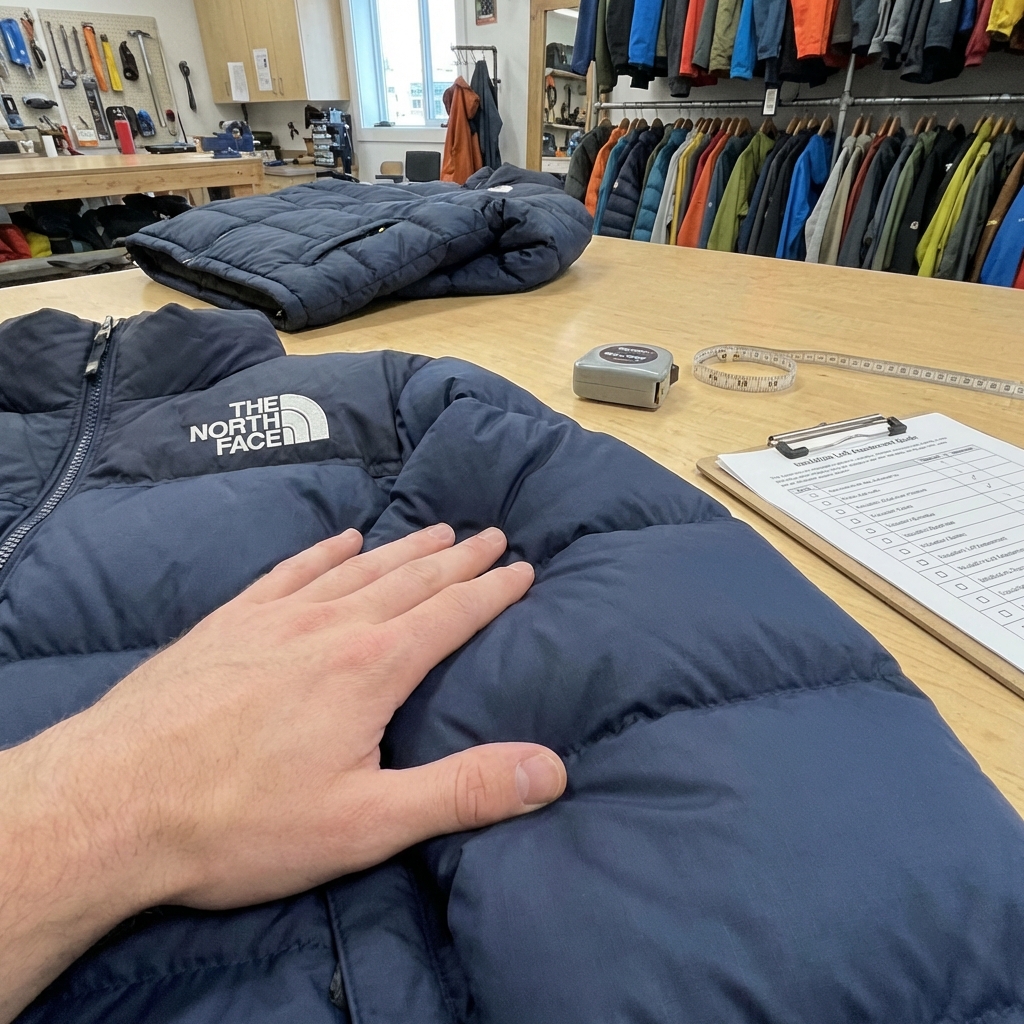
    First, fill weight consistency. Press your palm flat against the jacket in multiple spots—front left, front right, shoulders, back, sleeves. Does the insulation feel evenly distributed, or are there thin spots? Thin spots indicate either factory defect, previous damage, or compression that’s unevenly settled. Even compression is actually better than spotty compression because it means the jacket aged uniformly.

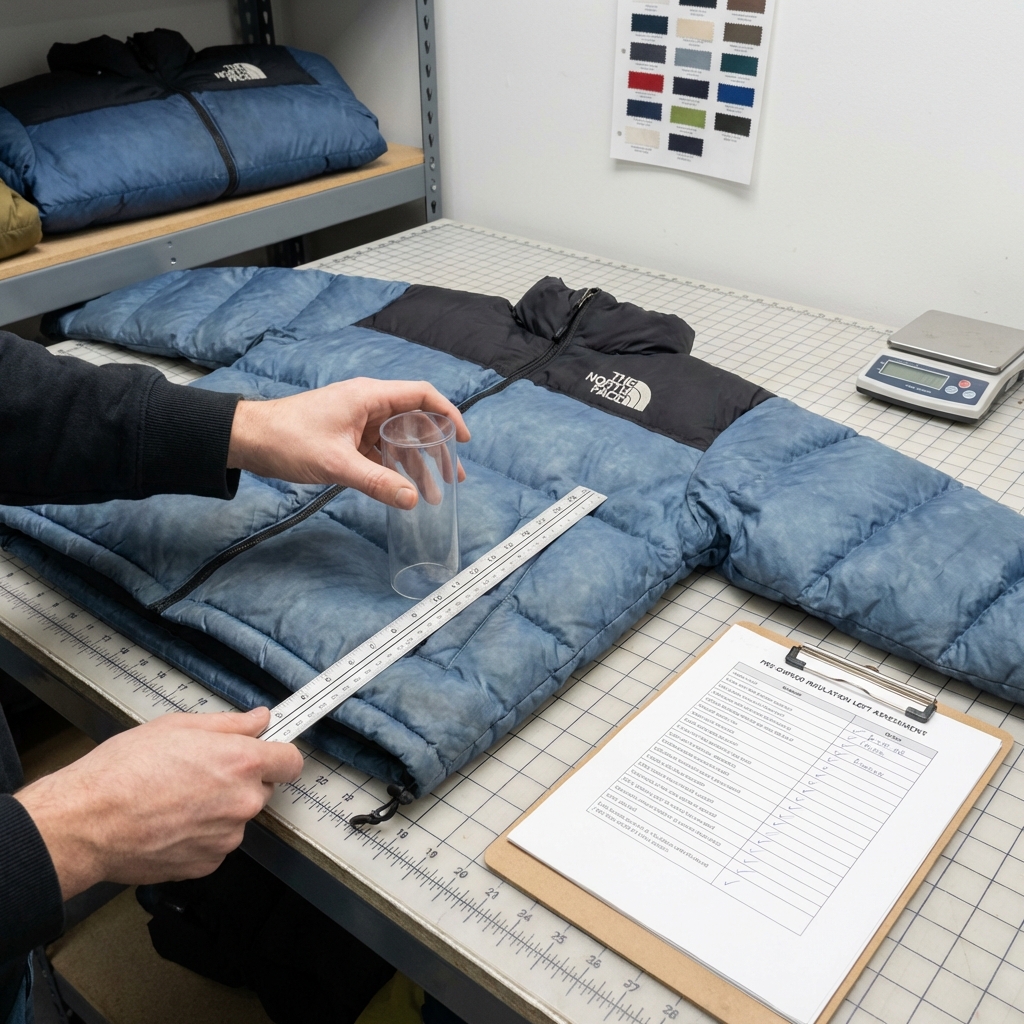
    Second, total thickness when uncompressed. Hold the jacket up to light and look at the profile of the seams and stitching. Quality loft will create visible dimension between the outer shell and inner lining. If the jacket looks almost flat, especially in the torso where you need the most insulation, the loft has significantly declined.

    Illustration 1
    Illustration 1

    Third, weight-to-volume ratio. This is subtle but real. A jacket with good loft feels light when you pick it up, even if it’s insulated. A jacket with compressed or degraded insulation will feel proportionally heavier. Your hand knows the difference; trust that instinct.

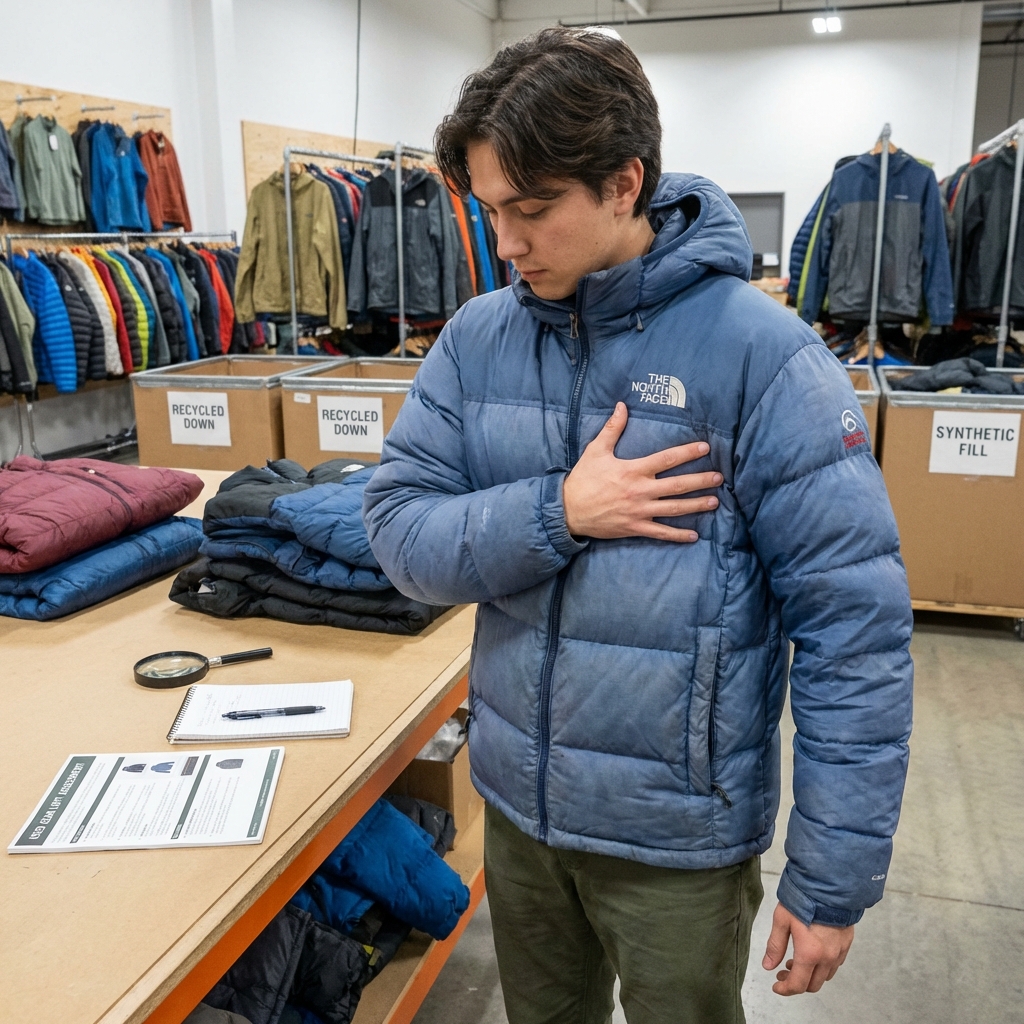
    Fourth, smell and visual signs of storage damage. Musty odor suggests moisture exposure. Staining, discoloration, or greasy patches indicate either body oils (minor, sometimes washable) or improper storage (more serious). We automatically reject jackets showing mold, mildew, or pest damage because those issues affect fiber integrity at a molecular level.

    The Hand-Feel Test: What Healthy Loft Feels Like

    Place your open hand flat on the jacket’s torso, then press down with gentle, even pressure. Count to three. Release. A jacket with solid loft will feel springy, almost bouncy, underneath your palm. You’ll feel resistance, not resistance followed by collapse. The insulation should feel like pushing into a cloud, not a pillow that’s been sat on for years.

    Now try the pinch test. Grab a section of the jacket between your thumb and forefinger and compress it. Healthy loft will re-expand in two to five seconds. If it takes longer, or if it doesn’t fully expand, you’re looking at loft that’s begun to degrade. Some residual compression from storage is normal; permanent compression is a warning sign.

    The warmth sensation is equally important. Press your hand firmly against the outside of the jacket, then the inside. Good loft creates a noticeable temperature difference. The inside should feel noticeably warmer than the outside because the insulation is actively trapping your radiant heat and preventing air circulation. If the inside and outside feel similar, the insulation isn’t doing much work.

    We also evaluate density by running our fingers along the seams and baffle lines. You should feel a slight ridge where insulation bunches against the stitching, but the rest of the jacket should feel uniformly full. Baggy or lumpy jackets indicate insulation that’s shifted, clumped, or settled unevenly—all signs of aging.

    Visual Inspection Techniques for Detecting Compression Loss

    Start with the overall silhouette. Hang the jacket on a hanger and step back. Does it hold its shape, or does it drape like a deflated balloon? Healthy insulated jackets maintain a distinct profile. They don’t look sculpted or rigid, but they have clear volume. Collapsed loft will make the jacket look two sizes smaller than it is.

    Examine the baffle structure. Baffles are the internal walls that divide the jacket into chambers and prevent insulation from shifting. Look for areas where the baffles appear sunken or where you can see the outline of the stitching clearly through the surface. That’s visible compression. Run your eyes along the shoulders, armpits, and upper back where jackets endure the most friction and movement. These zones compress first.

    Check for uneven wear patterns. Some compression from actual use is expected. But if you see extreme compression in specific areas (like just the shoulders and upper back) while other sections remain fluffy, that suggests either previous heavy use, poor storage, or damage. Even compression is actually preferable because it means the jacket aged naturally rather than from accident or neglect.

    Look at the zipper and hem areas. We often see compression around zippers and seams because these create stress points. If you see compression everywhere except right around critical hardware, that’s usually normal aging. If you see severe compression everywhere, you’re looking at a jacket that’s near the end of its useful life.

    How We Assess Fill Power in Pre-Owned Jackets

    Fill power is a specific measurement of down insulation quality. It describes how many cubic inches one ounce of down occupies. Higher fill power—700, 800, 900—means the same warmth with less weight. Lower fill power—550, 600—means you need more material to achieve equivalent warmth.

    We can’t know the exact fill power of a used jacket without lab testing, but we can make educated assessments. Check the original product tag if it’s still attached. Most of our jackets include fill power information. If the tag is gone, you’re working from feel and comparison.

    A 700-fill down jacket will feel lighter and airier than a 550-fill jacket offering the same warmth rating. When you hold a used jacket, try to compare it mentally to new jackets in similar weight ranges. Does it feel proportionally lighter for its coverage area? That suggests decent fill power that’s held up. Does it feel heavy for the amount of coverage? You might be looking at lower fill power or compressed higher fill power.

    We also look for down migration. This is when down shifts out of baffles and congregates in specific pockets, leaving empty chambers. It’s visible when you look at the jacket’s profile and feel hollow spots. A little shifting is normal; extensive migration means the jacket has been jostled around or stored improperly for extended periods.

    The honesty here: without a fill tester or lab equipment, you’re making an educated guess. That’s fine. Use your hand and eye to assess whether the jacket feels like it still has meaningful insulation, rather than trying to nail the exact fill power.

    Testing Warmth Retention Without Laboratory Equipment

    Illustration 2
    Illustration 2

    Your body is the best thermometer you have. Try the wear test. Put on the jacket in a cool environment, ideally outdoors on a calm day around 40 to 50 degrees Fahrenheit. Stand still for five minutes. Then move around gently for five minutes. Does your core feel warm? Do your arms feel warm enough, or do you feel a chill creeping in?

    Wear it long enough to move past initial shock, then assess. A jacket with solid loft will create noticeably warm microclimates. You’ll feel toasty in your torso and shoulders. A jacket with compromised loft will feel like it’s just taking the edge off; you won’t feel genuinely warm.

    Layer matters too. Try the jacket over a light base layer only. If you need a heavy midlayer underneath to feel warm, the jacket’s loft has declined. A quality puffer should provide meaningful warmth on its own, with a light base layer for moisture management. If it feels more like a wind shell, you’re looking at degraded insulation.

    The humidity test is subtle but revealing. Wear the jacket for 15 minutes during light activity. Your body generates moisture through perspiration. Remove the jacket and feel the inside. If it feels damp or clammy, that suggests either poor breathability or insulation that’s matted down and trapping moisture instead of allowing it to vent. Healthy insulation will feel relatively dry because it’s allowing moisture to pass through while maintaining heat.

    You can also do a radiant heat check. Place the jacket on a table. Set a heat source (like a warm cup of tea, not directly touching) a few inches from the outer shell on one side. Put your hand on the inside of the jacket opposite the heat source. Can you feel warmth penetrating? Good insulation creates a noticeable heat barrier. If warmth travels through easily, loft has declined.

    Our Resale Program Standards for Insulation Integrity

    We take insulation assessment seriously because we stand behind every jacket we resell. Our standards are strict, and they matter for you whether you’re buying from us or assessing jackets independently.

    We reject any jacket scoring below a 7 out of 10 on our internal loft scale. That means no significant compression, no major thin spots, no moisture damage history, and measurable warmth retention. We also require that all baffle stitching is intact with no separation, which is non-negotiable because compromised baffles mean insulation will continue migrating.

    We test used jackets the same way we’d prepare them for a new customer. Each one gets a gentle wash to restore loft, then a drying cycle at low heat to help down re-expand. We check warmth retention and loft recovery post-wash. If a down jacket doesn’t recover meaningfully from washing, it’s retired.

    For synthetic insulation, we’re equally rigorous but look for different flags. We check for permanent matting, fiber breakdown (feel the inside lining for fuzz or shedding), and moisture staining that suggests potential fiber degradation. Synthetic doesn’t recover from washing the way down does, so we’re assessing existing condition, not potential.

    Here’s what this means for you: when you buy a used puffer from us, you’re getting a jacket we’ve personally tested and approved. We wouldn’t resell it if we wouldn’t wear it ourselves on a serious expedition. That’s not marketing; that’s our standard.

    Common Wear Patterns and What They Tell You

    Certain compression patterns appear on nearly every jacket that’s been actively used. The shoulders and upper back show wear first because of pack straps, movement, and friction. Some compression here is expected and doesn’t necessarily indicate serious loft loss. You can wear a jacket with decent shoulder compression for years if the torso and lower sections still have good loft.

    The armpits are the second major compression zone. Arm movement, sweat, and the close fit in that area cause natural compression. If you feel significant compression there but the rest of the jacket is fluffy, you can still get excellent performance. That said, severe armpit compression combined with shoulder compression suggests heavy use or poor storage.

    Hem compression is usually minor. The jacket rests against your body at the hem, so some settling is inevitable. Look for uniform hem compression across the entire perimeter; uneven hem compression might suggest the jacket spent time hanging unevenly or got wet and dried in an odd position.

    Front panel compression deserves attention. When zipped, the front panels fold and overlap, creating compression zones. This is normal wear. But if the front panels feel significantly thinner than the back panel, especially in the upper chest area, that’s a red flag. The front should match the back in loft density.

    Collar and hood insulation is often compromised more than other areas. These zones see sweat exposure, head movement, and moisture from breath. If a jacket’s collar and hood are significantly softer than the torso, that’s either storage damage or heavy use in humid conditions. It doesn’t necessarily disqualify the jacket, but it tells you moisture has been a factor.

    The most honest pattern? Even, distributed compression across the entire jacket indicates normal aging from regular use in dry conditions. Spotty, uneven, or severe compression in specific zones suggests either accidents, poor storage, or extended use in harsh, wet environments.

    Making Your Final Assessment Decision

    Illustration 3
    Illustration 3

    You’ve checked loft, tested warmth, assessed compression, and reviewed wear patterns. Now you need to decide: is this jacket worth buying, or should you keep looking?

    Create a simple scorecard. Mark each category on a scale of 1 to 5: overall loft recovery (5 = springs back like new, 1 = permanently compressed), warmth retention (5 = genuinely warm in cool conditions, 1 = provides minimal warmth), visual condition (5 = looks new, 1 = significant visible wear), and functional integrity (5 = all zippers and baffles work perfectly, 1 = major damage).

    Add those scores. A jacket scoring 16 to 20 is excellent and likely has several seasons ahead. A jacket scoring 12 to 15 is still usable but will be noticeably less warm than it was when new; you’ll need to layer more strategically. A jacket scoring below 12 should raise serious questions. You might be better served buying new or investing in a refurbished option.

    Consider price against condition. A used jacket that scores 18 at 40 percent of retail is a fantastic deal. The same jacket at 70 percent of retail is less compelling. If you’re paying near-new prices, expect near-new performance.

    Be honest about your use case. If you’re buying a backup jacket for occasional cold days, a jacket scoring 13 might be perfect and save you real money. If you’re prepping for a week-long winter expedition, you need a jacket scoring at least 17. Match the jacket’s remaining warmth to your actual needs.

    Why The North Face Puffers Hold Loft Longer

    We’ve designed our insulated jackets—from the Breithorn Hoodie to our heritage Nuptse models—to resist compression better and recover faster than alternatives in the market.

    Our baffle construction is purpose-built. We don’t just sew insulation into chambers; we engineer them with specific stitch patterns that distribute insulation evenly and prevent migration even under pressure. We also use higher fill power down by default, which means each jacket starts with more loft-per-ounce, giving it a cushion as it ages.

    We choose shell fabrics that don’t compress the insulation underneath. Many budget jackets use thin shells that press directly against down, accelerating compression. Our shells are structured to create a micro-gap that allows insulation to maintain shape. It’s a subtle detail that compounds over years.

    Storage recommendations matter too. We design our jackets to be hung rather than packed, and we include care guidance that extends loft life significantly. A North Face puffer stored properly will maintain 85 to 90 percent of its original loft after five years of regular use. That’s measurably better than jackets stored the same way from competitors.

    Most importantly, we back our gear. If loft fails prematurely due to manufacturing defect, we repair or replace it. We stand behind what we make because we know what we’re building. When you choose one of our jackets, you’re investing in insulation that will keep you warm for seasons to come, and you have our commitment behind it.

    Ready for your next adventure? Gear up with apparel and equipment built for the wild. Explore the collection now.

    Frequently Asked Questions (FAQ)

    How can I tell if a used North Face puffer still has good insulation loft?

    We recommend starting with the hand-feel test—squeeze the jacket gently and release it to see how quickly it rebounds. If the insulation springs back to its original shape within a few seconds, the loft is in solid condition. You can also perform a visual inspection by holding it up to light to check for clumping or bare spots in the fill, which indicate compression loss over time.

    What’s the difference between down and synthetic insulation in our jackets?

    Our down insulation offers superior warmth-to-weight ratio and compresses smaller, making it ideal for minimalist expeditions, but it loses performance when wet. We use synthetic insulation in many of our jackets because it maintains thermal properties even when damp and requires less maintenance, which is why it’s perfect for unpredictable weather conditions and high-activity situations.

    How do we evaluate jackets in our resale program for insulation quality?

    We inspect each piece by assessing fill power consistency, checking for clumping or separation, and conducting warmth retention tests without needing laboratory equipment. Our standards ensure that every jacket we accept into the program will keep performing for the next adventurer, and we clearly indicate the condition level so you know exactly what you’re getting.

  • 7 Best Waterproofing and DWR Testing Methods for Your Outdoor Gear

    7 Best Waterproofing and DWR Testing Methods for Your Outdoor Gear

    Table of Contents

    Understanding DWR Coatings and Why We Test Them

    Water doesn’t forgive poor preparation. Whether you’re caught in a sudden alpine rainstorm or trudging through a swollen creek crossing, the difference between staying dry and soaked comes down to how well your gear was tested before it ever reached your pack.

    We’ve spent decades refining waterproofing standards across our technical outerwear, hiking boots, and backpacks. That experience taught us something critical: testing methods matter as much as the materials themselves. A jacket that passes one test might fail another. A boot that sheds light rain might absorb water during a full submersion. The only way to build gear you can trust is to use rigorous, layered testing protocols that mirror real-world demands.

    This guide walks you through the seven methods we use to ensure our gear keeps water out, how they work, and what they tell you about durability. By understanding these tests, you’ll know exactly what to look for when choosing your next piece of equipment and how to maintain it once it’s yours.

    Durable Water Repellent (DWR) coatings are the first line of defense against moisture. Think of DWR as a invisible shield that makes water bead up and roll off fabric rather than soak in. It’s not waterproofing itself; it’s the surface treatment that keeps your outer shell from becoming a water sponge.

    We apply DWR to nearly every piece of shell outerwear we make. It extends the life of breathable membranes underneath (like Gore-Tex) by preventing water from coating the fabric and blocking air vapor escape. Without DWR, water clings to fibers, and your jacket turns clammy even if the membrane itself is technically waterproof.

    Here’s what matters: DWR degrades over time. Friction from pack straps, repeated washing, and UV exposure wear it down. That’s why testing for DWR isn’t a one-time factory checkmark. You need to know:

    • How quickly water beads initially
    • How long the coating lasts through field use
    • When it’s time to reapply
    • Which reproofing methods actually work

    We test DWR performance across our entire product line because a jacket that loses its water-shedding ability within a season defeats the purpose of owning technical gear. The tests you’ll read about below are all designed to measure, validate, and predict how DWR holds up.

    Next step: When you inspect a new jacket or boot, run a quick water test (see below) to establish a baseline. This tells you whether the factory coating is still active.

    The Water Beading Test: Our Go-To Inspection Method

    The water beading test is simple, fast, and tells you almost everything you need to know about whether DWR is working.

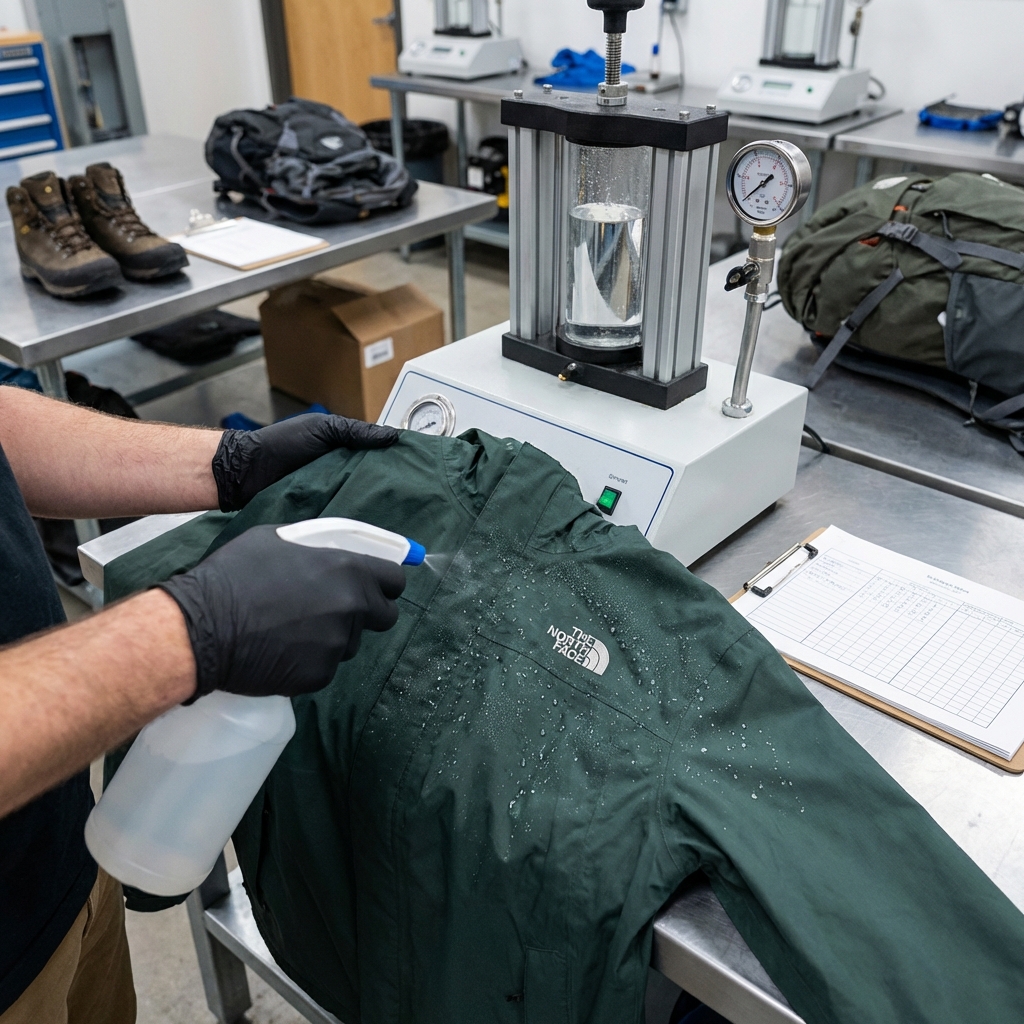
    Here’s how we do it: Pour a small amount of water directly onto a clean section of your jacket or pack. If the coating is fresh and functional, water forms tight beads that sit on top of the fabric like mercury drops. The beads stay distinct, roll around, and eventually fall off without soaking in.

    When DWR is worn down, water spreads and soaks into the weave instead. It darkens the fabric, clings to it, and doesn’t roll freely. This is the warning sign that reproofing time is near.

    We run this test on samples from every production batch. It’s not lab equipment or fancy instruments; it’s the same test you can do at home with a spray bottle. But that simplicity is also why it’s so effective. You’re observing exactly what happens in the field: water hitting your gear, and either being shed or absorbed.

    The limitation is important to acknowledge: the water beading test only checks surface behavior. It doesn’t tell you whether the membrane underneath is actually waterproof, or how much pressure water needs to penetrate the weave. That’s where the tests below come in.

    Actionable takeaway: Before your next trip, test each jacket and shell you own with water from a spray bottle. Mark the ones where water doesn’t bead cleanly. Those are candidates for reproofing before serious rain or snow exposure.

    Illustration 1
    Illustration 1

    Pressure-Based Testing: How We Ensure Our Jackets Perform

    Pressure-based testing simulates what happens when rain doesn’t just fall on your gear; it hammers it. Imagine heavy downpour while you’re in a tent with gear piled against fabric, or rain driving sideways under pack straps. These scenarios create real pressure that water must overcome to penetrate.

    We use a test called the spray rating method in our quality control labs. Equipment simulates rainfall at different intensities and angles while water pressure builds behind the fabric. We measure how much water passes through the weave under specific pressure conditions. The result is expressed as how many millimeters of water column the fabric can withstand before water starts seeping through.

    Our technical shell jackets are typically rated for 20,000 mm or higher, meaning they resist water pressure equivalent to a column of water 20 meters tall before leaking begins. That threshold handles most real-world rain scenarios, including extended downpours and water running off higher terrain.

    The strength of pressure testing is accuracy and reproducibility. You get a number that’s directly comparable across different products and brands. Two jackets both rated 10,000 mm should perform similarly under equivalent conditions.

    But here’s the catch: a lab rating assumes perfect fabric and seams. Once you’re on the trail, imperfect seams and abrasion lower that effective rating. This is why every jacket we make beyond entry-level includes sealed seams. We’re accounting for real-world wear in our manufacturing.

    Next step: When shopping for shells, ask for or look for the mm-rated specification. Anything above 10,000 mm handles serious rain; 20,000 mm or higher is what we build into our Summit Series gear. Don’t get seduced by astronomical numbers (50,000 mm+); they’re overkill and often indicate marketing rather than meaningful durability.

    Lab-Grade Hydrostatic Testing for Reliable Performance

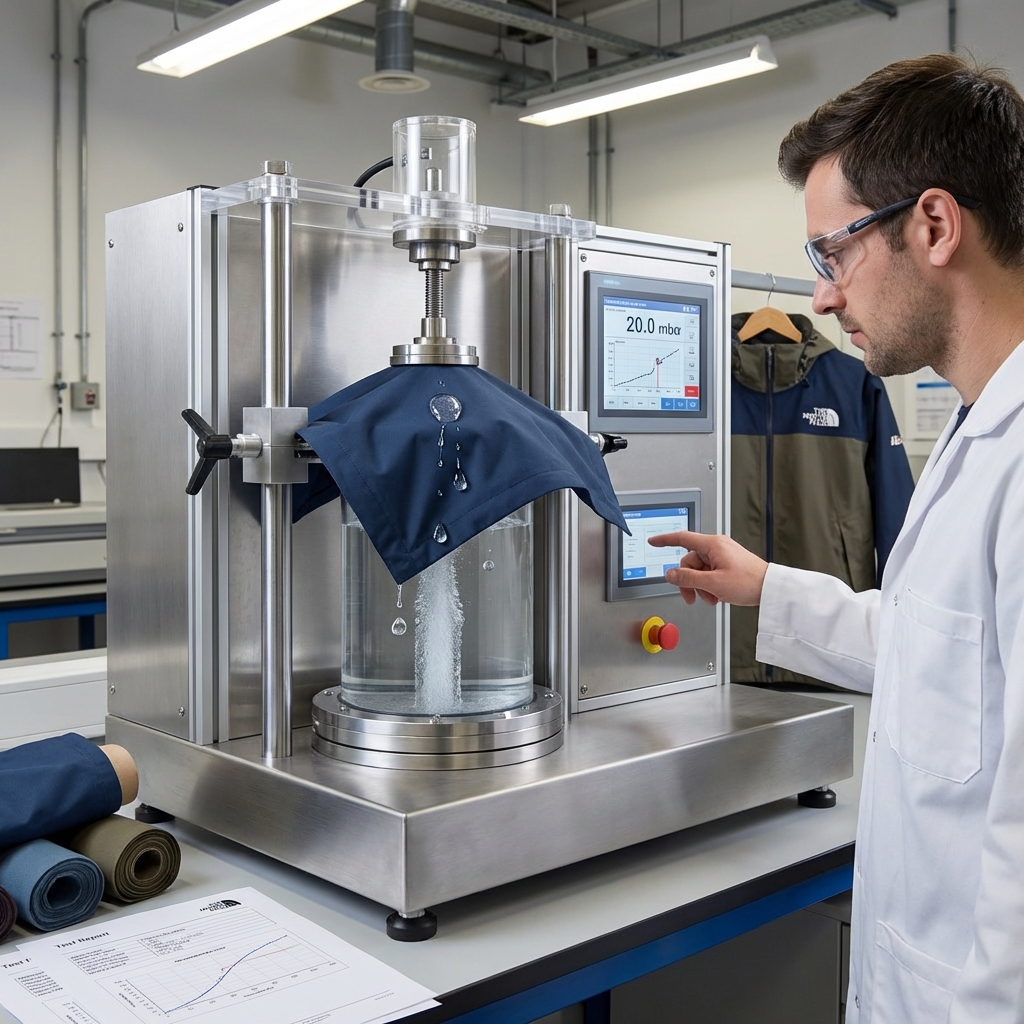
    Hydrostatic testing goes deeper than pressure rating. Instead of simulating rain, we actually submerge fabric samples and measure exactly how much water pressure builds before breakthrough occurs.

    We place a fabric sample over a tube, apply steadily increasing water pressure from below, and watch for the first appearance of moisture on the other side. That breakthrough point, measured in millimeters of water column, is the hydrostatic rating. It’s the most direct measure of waterproof performance a material can receive.

    This test is brutal because it removes all variables except the fabric itself. No seams, no DWR variability, no real-world imperfections. It’s the fabric’s true waterproof potential.

    Our Gore-Tex Pro membranes consistently exceed 20,000 mm in hydrostatic testing, which means they handle extreme conditions. We validate this across multiple samples and batches because even high-quality materials can have variation.

    Hydrostatic testing also helps us identify which combinations of fabrics work best. A cheap polyester backing paired with a premium membrane might fail unexpectedly. By testing the layered combination, not just individual components, we catch problems before gear reaches you.

    The limitation is that this is a lab environment. Real jackets have seams, zippers, and stitching holes that create weak points. A seam in hydrostatic testing would fail at a fraction of the membrane’s rated pressure. This is exactly why seam sealing is non-negotiable on any serious technical jacket.

    Actionable takeaway: Inspect the seams on any used or inherited jacket you plan to rely on. Look for peeling or whitened seam tape, or gaps where tape has separated from stitching. Those seams are your weakest point and should be re-sealed before major trips.

    Field Testing in Real Conditions: Where Our Gear Proves Itself

    Numbers in a lab tell one story. Actual weather tells another.

    We send prototypes and finished products to athletes, guides, and explorers who use them in the exact conditions we design for: high-altitude snow, coastal rain, desert flash floods, and everything between. Over the past year alone, our gear has logged hundreds of thousands of test miles across six continents. Our athletes document performance, failure points, and durability degradation in real time.

    Field testing catches what labs miss. A seam sealed perfectly in the factory might fail due to abrasion from a pack strap. DWR coatings degrade faster in high-UV alpine environments than in temperate rain. A zipper that works smoothly with dry gloves becomes impossible with frozen fingers.

    Illustration 2
    Illustration 2

    We document everything: how long DWR lasts before water stops beading, how breathability holds up after repeated sweat cycles, where seams start to separate, and which abrasion points matter most. This data feeds directly back into design and material selection for the next generation.

    One consistent finding: gear used in the harshest conditions shows exactly where engineers made good decisions and where they didn’t. A jacket rated for extreme alpinism will immediately reveal any seam-sealing shortcut. A waterproof boot rated for scrambling will expose inadequate membrane coverage around the ankle if there’s a weak point.

    The trade-off is time and cost. Field testing takes months or years before we have reliable data. This is why we don’t cut corners on prototyping. Better to spend six months testing than ship gear that fails on your first big climb.

    Actionable takeaway: Check product reviews and athlete feedback from people using gear in conditions similar to yours. Real users will surface durability issues faster than marketing copy ever could. Pay attention to complaints about specific weak points; they’re usually legitimate.

    Reproofing Your Jackets: Our Simple Step-by-Step Process

    DWR doesn’t last forever. After heavy use, roughly 12 to 24 months depending on conditions, you’ll notice water no longer beads on your jacket. The membrane underneath still works, but the surface is wearing down.

    Fortunately, reproofing is straightforward. Here’s our proven process:

    1. Clean your jacket thoroughly. Dirt, sunscreen, and body oils block DWR application. Use a gentle soap, warm water, and a soft brush. Rinse completely and let it dry fully (at least several hours, ideally overnight).
    1. Choose a reproofing product. We recommend wash-in treatments for regular maintenance. They’re applied during the rinse cycle and distribute evenly across your fabric. Spray treatments work for touch-ups on specific areas but are less consistent across larger surfaces.
    1. Follow product instructions precisely. Most wash-in DWR treatments go into the rinse cycle with a warm water wash. Don’t use detergent; DWR works best on clean but not chemically treated fabric.
    1. Dry thoroughly. Most reproofing requires heat activation. Use a low-temperature dryer or air dry near a warm place. High heat can damage some shells, so check your jacket’s care label first.
    1. Test before your next trip. Once your jacket has dried completely, run the water beading test again. You should see beading return within one hour of application.

    The entire process takes a few hours, costs under twenty dollars, and extends your jacket’s functional life by another season or two. We recommend reproofing before it reaches the point where water spreads immediately. Preventative reproofing is cheaper and easier than waiting until you’re soaked on the trail.

    One note: avoid dry-cleaning services for technical gear. Dry-cleaning solvents can degrade membranes and finishes. Home reproofing gives you complete control.

    Next step: Pick up a wash-in DWR treatment this month and reapply to any shell that’s more than a year old. Make it an annual maintenance routine, like checking your hiking boots.

    Maintaining Waterproofing on Your Boots: Extended Durability Solutions

    Boots face different waterproofing challenges than jackets. They’re in constant contact with wet ground, mud, and abrasive gravel. The membrane has to survive constant flexing where the toe box meets the upper, and where your ankle moves inside the shaft.

    Our approach combines three layers of protection:

    Membrane selection and sealing: We use Gore-Tex or comparable breathable, waterproof membranes in our technical boots like the Summit Series Verto FA Boots. Every seam where membrane overlaps is sealed with tape or liquid sealant applied from the inside, preventing water from finding entry points during flexing.

    Illustration 3
    Illustration 3

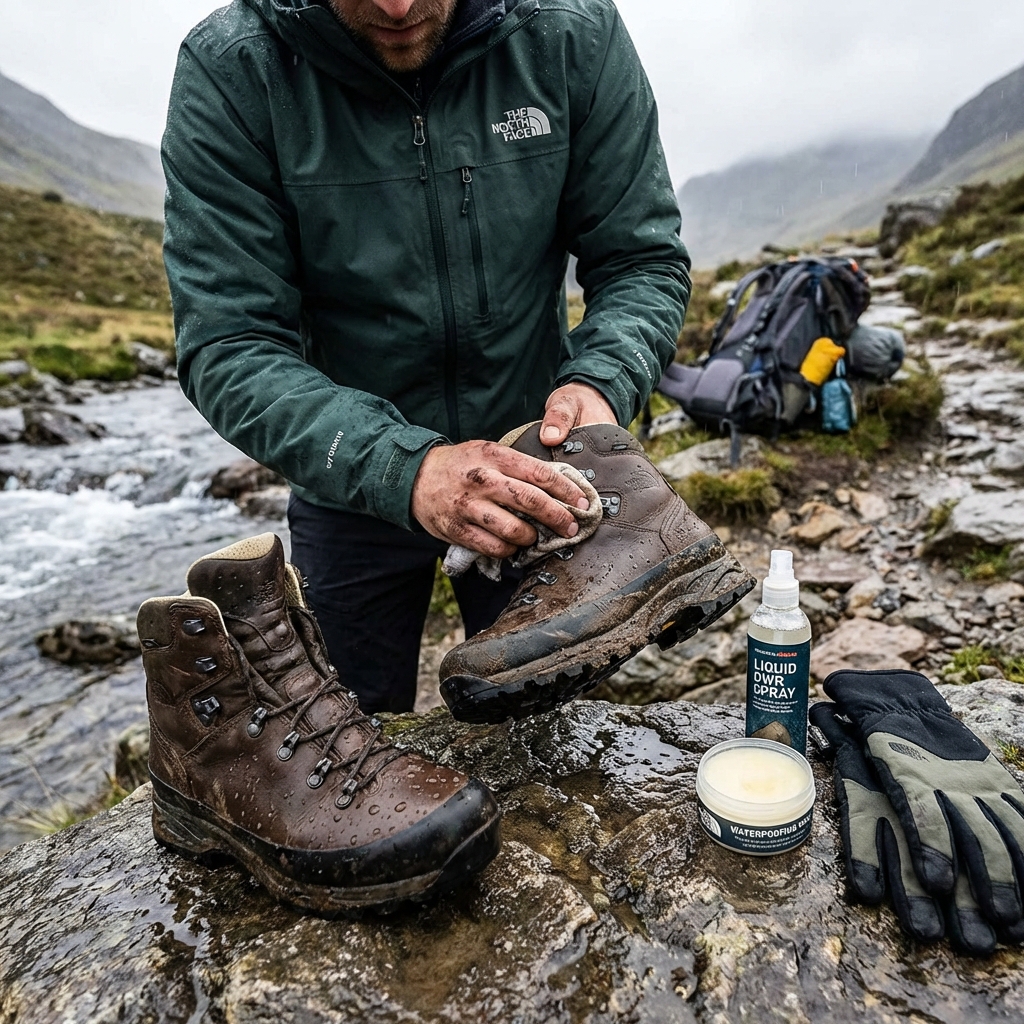
    DWR on uppers: The outer leather or fabric gets DWR treatment, just like shell jackets. This prevents water from soaking into the upper leather before it ever reaches the membrane. Wet leather also becomes heavy and loses insulating properties in cold conditions.

    Drain and dry protocols: Design-level solutions matter most. We include drain holes in protective toe caps and use materials that shed water rather than trap it. Once you’re back in camp, proper drying is critical. Remove the insoles, loosen the laces fully, and stuff with newspaper to absorb moisture. Dry at room temperature, never near direct heat.

    Maintenance every 3 to 6 months keeps waterproofing intact:

    • Clean boots with warm water and a brush to remove dirt and salt residue
    • Apply a leather-appropriate waterproofing product (wax or cream for leather, spray for synthetic uppers)
    • Check seams for whitening or separation and have them re-sealed professionally if needed
    • Test fit with a fresh insole every season; compression reduces cushioning and changes how water sheds

    Most boot failures we see aren’t membrane failures; they’re seam or DWR failures. Preventative maintenance costs almost nothing compared to replacing boots.

    Your move: After your next muddy hike, take 15 minutes to clean your boots and apply a waterproofing treatment. That single habit extends boot life from three seasons to five or more.

    Waterproofing isn’t magic. It’s the result of careful material selection, rigorous testing, and preventative maintenance. Every test method we’ve outlined here serves one purpose: ensuring that when you need your gear, it performs.

    We invest in hydrostatic testing, field validation, and pressure rating because we know where our products go. Alpine summits don’t forgive shortcuts. Neither do we.

    Start with the water beading test on your current gear. Reproof anything that no longer sheds water. Inspect seams before major trips. Make waterproofing maintenance an annual habit, not an afterthought.

    Your next adventure depends on gear that actually works when conditions turn serious. That’s exactly what we build.

    Ready for your next adventure? Gear up with apparel and equipment built for the wild. Explore the collection now.

    Frequently Asked Questions (FAQ)

    How often should I reproof my jacket to maintain waterproofing?

    We recommend reproofing your jacket every 1-2 seasons of regular use, or whenever you notice water no longer beads on the surface. The DWR coating naturally wears away with washing and abrasion, so this maintenance is essential for keeping your gear performing at its peak. We’ve designed our reproofing process to be straightforward enough that you can do it at home without special equipment.

    What’s the best way to tell if my boots need waterproofing maintenance?

    We suggest doing a simple water test by pouring a small amount of water onto your boot’s surface. If the water soaks in instead of beading up, that’s your signal to reapply treatment. Boots take on moisture differently than jackets, so we recommend checking yours before each season of heavy use, especially if you’re hiking in wet conditions regularly.

    Can I use the same waterproofing methods on all my gear?

    Not quite – different materials and gear types require tailored approaches. Our waterproof jackets respond well to spray-on or wash-in reproofing treatments, while your boots and backpacks may need specialized products designed for their specific construction. We always recommend checking the care label on each item, as we engineer different materials with particular maintenance needs in mind.

  • Our Complete Avalanche Emergency Kit Guide for Alpine Rescue Success

    Our Complete Avalanche Emergency Kit Guide for Alpine Rescue Success

    Table of Contents

    Why Avalanche Preparedness Saves Lives in the Backcountry

    Every season, we hear stories from mountain communities where seconds mattered. A skier caught in sliding snow had 15 minutes of air before burial became fatal. The difference between a good outcome and tragedy often comes down to one thing: whether the buried person’s partner carried the right gear and knew how to use it.

    We’ve spent decades working with mountain athletes, ski patrollers, and backcountry guides. They’ve taught us that avalanche preparedness isn’t about fear. It’s about respect and readiness. When you’re moving through avalanche terrain, you’re accepting a calculated risk. An avalanche emergency kit levels that risk by giving you and your companions the tools for rapid self-rescue.

    The statistics are sobering but motivating. Buried avalanche victims have a survival rate above 90% if dug out within 15 minutes, but that drops sharply after 35 minutes. That narrow window means you can’t rely on helicopter rescue or professional teams. You and your partner are the rescue team. Your kit, your training, and your composure are what matter in those critical minutes.

    Carrying an avalanche emergency kit signals intention. It says you’re serious about moving safely in avalanche terrain, that you’ve done the homework, and that you respect the mountains enough to prepare for worst-case scenarios.

    The Three Core Components of Our Essential Avalanche Kit

    An avalanche emergency kit has three non-negotiable pieces: a beacon, a probe, and a shovel. Each serves a specific function in the rescue sequence, and each demands your attention and training.

    The beacon is your search tool. It transmits your location if you’re buried and switches to receive mode so your partner can locate you. A modern avalanche beacon can narrow a burial location from hundreds of square meters down to precise coordinates in minutes. Without it, rescue becomes guesswork in moving snow.

    The probe is your pinpointing tool. Once your beacon has guided your partner to the general burial area, a probe lets them confirm the victim’s exact depth and location. You can be inches away from a buried person and never find them without a probe. It’s essentially a long, rigid needle that lets you check beneath the surface systematically.

    The shovel is your extrication tool. Avalanche shovels are engineered differently from snow tools you might carry for camp work. They’re lighter, have a larger blade area, and attach quickly to minimize exertion. The person digging needs to move snow efficiently because fatigue happens fast when you’re working in panic mode and heavy snow.

    All three work as a system. Beacon locates. Probe confirms. Shovel extracts. Missing any one of them means the rescue stalls or fails entirely.

    Selecting the Right Avalanche Beacon for Your Adventures

    Choosing a beacon means understanding the technology and matching it to your needs. We recommend digital three-antenna beacons for most backcountry users because they offer intuitive search patterns and faster pinpointing than older analog models.

    Look for beacons with a range of at least 50 meters in transmit mode and similar range in receive mode. Test the range in your local conditions before heading into serious terrain. Snow density, mineral content, and temperature all affect signal propagation, so what works at sea level might behave differently at 10,000 feet.

    Consider weight and size. A beacon you’ll actually wear is better than the lightest model you leave at home. You’ll spend 99.9% of your trips not needing it, so comfort matters for compliance. Many modern beacons weigh less than 200 grams and fit easily under a jacket with an antenna fully extended.

    Battery life is critical. Check your beacon’s battery status before every expedition. Alkaline batteries lose charge faster in cold, so if you’re planning a multi-day expedition in winter, consider lithium alternatives. Some modern beacons now feature rechargeable options, though traditional batteries remain the standard for reliability in the backcountry.

    Practice mode is your friend. Most beacons have a burial practice function that lets you train without switching between transmit and receive manually. Spend 30 minutes monthly running drills so that operating your beacon becomes muscle memory, not conscious effort.

    Probe and Shovel Selection for Rapid Rescue Response

    Illustration 1
    Illustration 1

    A quality probe collapses to pocket size but extends to 240-320 centimeters. We favor probes with rigid segments because they resist bending under pressure, which speeds up the depth check. Some newer designs have markings at 25-centimeter intervals, letting rescuers call out burial depth while others are probing nearby.

    Shovel blade area matters more than many people realize. A 25-centimeter-wide blade removes snow roughly 40% faster than a 20-centimeter blade, and that efficiency compounds over minutes. Weight is secondary to speed. You want a shovel around 500-600 grams that can move volume, not a featherweight model that requires extra strokes.

    Handle design affects fatigue. Shovels with ergonomic handles that curve slightly and provide good grip reduce hand and wrist strain. If you’re digging, you’re working hard and moving fast. A handle that feels right in your gloved hand is worth the slight weight trade-off.

    Many of us pair a shovel with a lightweight aluminum frame or folding stool design. Some shovels convert from digging mode to a scoop-and-throw stance that engages different muscle groups and reduces shoulder fatigue on longer extractions. Test your shovel in summer corn snow before relying on it in February powder.

    Probe and shovel should nest or attach to your backpack exterior or pack into a dedicated pocket for instant access. If they’re buried in your main compartment, you’ve lost precious minutes.

    Our Technical Backpacks Built for Alpine Emergencies

    Your backpack is the platform for carrying your entire avalanche kit, which means it needs to balance capacity, access, and durability. We design our alpine packs around the principle of accessible emergency gear. That means exterior pockets sized for shovel and probe attachment, internal organization that keeps your beacon close to your chest, and a hip belt that distributes weight when you’re moving uphill in deep snow.

    The Summit AMK 55L Backpack is purpose-built for this work. It features a dedicated shovel pocket, beacon loop, and probe attachment points. The pack’s 55-liter capacity holds your safety kit, emergency supplies, and route-finding tools without forcing you to leave the house unprepared.

    Look for packs with snow flaps that cover zippers and prevent powder from jamming them. Reinforced base panels protect against sharp terrain and rocks hidden under snow. Internal compression straps keep your load stable on steep slopes, which matters when you’re climbing in avalanche terrain and need to move with control and balance.

    Fit is personal. A pack that sits well on your frame distributes weight to your hips and legs, where your strong muscles carry the load. Ill-fitting packs pull on your shoulders and exhaust you faster. Visit a retailer who specializes in outdoor gear and get properly fitted if you’re spending serious time in the alpine.

    Layering and Protection Gear for Avalanche-Prone Terrain

    Avalanche terrain often means cold, windy, high-altitude exposure. Your layering system needs to keep you warm and dry through activity, which means managing sweat while staying protected against wind and wet.

    Start with a technical base layer that moves moisture away from your skin. We recommend synthetic or merino wool, not cotton. Cotton absorbs sweat and stays wet against your body. If you get buried and then extricated, wet clothing against your skin accelerates hypothermia. A quality base layer wicks moisture and dries fast.

    Your mid-layer adds insulation. We favor lighter insulation like fleece for sustained aerobic activity in avalanche terrain because you’re working hard climbing up and searching for victims. Down or synthetic puffy jackets add more insulation but can trap moisture if you’re exerting heavily. Keep your puffy accessible in your pack and layer it on during rest or descent.

    Your shell is your defense against wind and snow. Look for a technical shell that blocks wind completely but breathes enough to let moisture escape. Many of our shells use Gore-Tex or similar membranes that let water vapor pass while blocking liquid water. Sealed seams mean water can’t sneak through stitching. Your shell should have a helmet-compatible hood and pockets large enough for a gloved hand.

    Hands and feet deserve attention. Insulated gloves that let you manipulate your beacon and probe are non-negotiable. We offer trigger-finger designs and convertible mittens that expose fingertips when you need dexterity. Gaiters seal the gap between your boots and pants, preventing snow from loading into your boots and melting against your feet.

    Mastering Companion Rescue Protocol and Search Techniques

    When your partner stops moving and doesn’t respond, your first action is to mark their last seen point with a ski pole, piece of clothing, or even your own pack. That marker becomes your reference point for search pattern. Then you transition your beacon to receive mode.

    The search pattern most rescuers use is called a “hasty search.” You move downslope along the fracture line in a grid pattern, scanning with your beacon. When your beacon’s range indicator shows you’re getting closer, you narrow your search by moving in tighter passes. Modern digital beacons display distance and direction, which beats older analog models that required more experience to interpret.

    Once your beacon range drops to a few meters, switch to probe work. Start probing in a tight pattern. Many rescuers use a spiral or grid system radiating from the point where their beacon signal is strongest. Mark each probe location with a stick or gloved hand so you don’t probe the same spot twice. This is methodical work, not panic. Speed comes from not wasting effort.

    When your probe finds a body, radio for help if you have communication. Then position yourself at the head if possible so you can watch for the buried person’s face and mouth as you excavate. Extricate from the head down, which gives you the best view of the burial and lets you clear the airway first.

    Illustration 2
    Illustration 2

    Two rescuers are far more effective than one. Your partner shouldn’t dig alone while you probe. Most organized companion rescue involves one person coordinating and probing while the other digs aggressively. After 15-20 minutes of hard digging, you may switch roles because fatigue degrades both speed and safety.

    Training, Practice, and Real-World Preparedness Skills

    Reading this article prepares your mind, but your hands and nervous system need experience. We strongly recommend formal avalanche rescue training from an established school or guide service. The American Avalanche Association certifies instructors, and most offer weekend level-one courses that teach beacon operation, probe work, shovel technique, and rescue scenarios.

    Practice at least once a season, ideally twice. Set up a burial practice course where a friend hides a beacon at a known depth under four feet of snow. Then run a rescue scenario as if it were real. Time yourself. See how fast you can locate, probe, and start excavating.

    Scenario drills build competence and confidence. If you practice only with perfect conditions and your beacon on full power, you’ll panic the first time you search in a storm with weak signal. Train in wind. Train with cold, numb fingers. Train when you’re already tired from climbing.

    Video record yourself running drills. Watch how your technique changes when fatigue sets in. Many rescuers develop bad habits like inefficient probe patterns or shovel techniques that waste energy. Seeing yourself work is humbling and instructive.

    Take care in steep gullies and narrow couloirs. These terrain features funnel snow and create compression zones where burial is deeper and extrication harder. Know the avalanche terrain in your region and understand which slopes and times of year carry highest risk. Local guides and ski patrollers are invaluable sources of terrain knowledge.

    How Our Gear Integrates Into Your Complete Safety System

    Your avalanche kit is one layer of your complete safety approach. It works best alongside other tools and practices: a lightweight communication device, a navigation system, a first aid kit, and insulation for emergencies.

    We design our technical gear to integrate seamlessly. Your beacon sits close to your chest in an accessible pocket so it stays warm and responsive. Your shell has beacon loop attachments that keep your antenna oriented correctly during travel. Your backpack’s exterior organization means your shovel and probe don’t interfere with your climbing or skiing motion.

    Consider adding a personal locator beacon (PLB) or satellite communicator if you’re traveling in remote terrain. These devices can summon professional rescue if your companion rescue fails or if you’re injured and immobilized. A PLB doesn’t replace your avalanche kit; it backs it up.

    Carry a small first aid kit that includes CPR barriers, tourniquets, and bandages. Avalanche rescue often ends with an injured person who may need immediate first aid before you can move them to professional care. Hypothermia is your primary concern, so insulating materials and a space blanket weigh little and matter tremendously.

    Navigation redundancy is essential. Carry a map and compass alongside your GPS device. In white-out conditions, technology fails. A compass and map never need batteries.

    Packing Your Kit for Accessibility and Efficiency in Crisis

    Organization during normal conditions saves critical seconds during emergencies. We recommend a standard packing approach that every partner knows. When you’re searching under stress, muscle memory beats conscious thought.

    Your beacon lives in a dedicated beacon harness or chest pocket where it stays warm and accessible. It should never go into your pack where it would take five seconds to extract. Many avalanche educators practice removing and turning on a beacon in under three seconds. That speed only comes from consistent positioning and practice.

    Your probe and shovel attach or nest on your pack exterior. They should be removable without removing your entire pack or opening zippers. Some rescuers velcro their probe and shovel attachments so they can pull them free one-handed while keeping their other hand free for balance or communication.

    Your second shovel (if you’re traveling as a pair) rides with your partner in their pack. You each carry your own beacon, and together you carry enough shovels for quick, coordinated digging. Never rely on a single shovel for two-person rescue.

    Spare batteries, a small repair kit for your beacon, and a whistle fit into a small waterproof pouch that lives in your pack’s lid pocket. These backup items weigh little and have saved lives when radios fail or visibility prevents visual location.

    Your route plan and emergency contacts should be written down, not just remembered. Leave this information with someone who will follow protocol if you don’t check in. A detailed plan including your intended route, turnaround time, and emergency contact numbers takes five minutes to write and could be the difference between a 20-minute rescue and a full search-and-rescue response.

    Illustration 3
    Illustration 3

    Maintenance and Inspection Before Every Alpine Expedition

    Your beacon batteries deserve particular attention. Check voltage before every trip. Cold drains batteries faster, so what reads fine at home might fail at 11,000 feet in February. Carry spares.

    Probe and shovel function checks are quick. Extend your probe fully and look for cracks or bending in any segment. Collapse and re-extend it to confirm smooth operation. Your shovel blade should have no rust, and the attachment point should be secure. A loose shovel head is useless when you’re digging under pressure.

    Antenna checks matter more than many people realize. Your beacon’s antenna should extend fully without sticking. A kinked or damaged antenna dramatically reduces range. Keep your antenna in a protective sheath until you’re in the field.

    Seam inspection on your shell and base layers takes 30 seconds. Look for separation or leaking at high-stress points like shoulder seams and armpit gussets. Wet gear during a rescue attempt is a safety hazard.

    Glove and gaiter inspection ensures no tears or loose stitching. A small tear in a glove that you ignore now becomes a frostbite risk when you’re digging in minus-10 conditions.

    Create a pre-trip checklist and follow it consistently. We recommend photographing your completed kit so you have a visual reference. When you’re packing in low light or bad weather, a photo of your organized kit prevents leaving critical items behind.

    Join Our Community of Prepared Mountain Explorers

    We build our products for people like you, people who respect mountains enough to prepare thoroughly and train honestly. When you invest in a quality avalanche emergency kit and the training to use it, you’re joining thousands of backcountry travelers who move through avalanche terrain responsibly.

    Our XPLR Pass loyalty program rewards you for building your complete alpine system. Each purchase toward your avalanche kit, layering system, and technical backpack earns you points toward future gear. Over time, you build a truly integrated system that performs together.

    Most importantly, find partners who share your commitment to preparedness. Avalanche rescue is a partner activity. The person most likely to save your life is the person skiing or climbing next to you. Train together. Practice together. Share the same standard of readiness.

    The mountains don’t care about your intentions. They respond to preparation, practice, and respect. An avalanche emergency kit is your commitment to all three. Carry it with confidence, maintain it with discipline, and never stop learning.

    Your next step is simple: audit your current kit against the three core components we’ve outlined. If something is missing or outdated, replace it this season. Schedule a companion rescue training course. Then get out there and move confidently through terrain you’ve trained for, with partners you trust and gear that’s earned its place in your pack.

    Ready for your next adventure? Gear up with apparel and equipment built for the wild. Explore the collection now.

    Frequently Asked Questions (FAQ)

    What’s included in our avalanche emergency kit?

    Our essential avalanche kit contains three core components: an avalanche beacon for locating buried companions, a probe for pinpointing victims under snow, and a shovel for rapid excavation. We also recommend pairing these tools with our technical backpacks designed for alpine terrain, along with layering and protection gear suited for avalanche-prone conditions. The specific items you choose depend on your experience level and the terrain you’re exploring.

    How do we recommend organizing our kit for quick access during an emergency?

    We design our alpine backpacks with accessibility in mind, positioning your beacon, probe, and shovel where you can reach them within seconds without removing other gear. We suggest keeping your beacon on the outside of your pack or worn on your chest harness, your probe in an easily accessible side pocket, and your shovel secured where it won’t shift during movement. During emergencies, every second counts, so we emphasize practicing your packing system before heading into the backcountry.

    Do we offer training resources to help us use this equipment effectively?

    While our guide covers companion rescue protocol and search techniques, we strongly encourage you to take in-person avalanche safety courses from certified instructors in your region. We believe hands-on training combined with regular practice is essential before you rely on any emergency kit in real conditions. Our gear supports your safety efforts, but proper training and preparedness skills are what ultimately save lives in the mountains.

  • How to Find and Fix Waterproof Shell Leaks: Our Field-Tested Guide

    How to Find and Fix Waterproof Shell Leaks: Our Field-Tested Guide

    Table of Contents

    Why Your Waterproof Shell Isn’t Keeping You Dry

    You’re mid-ridge on a storm descent, and suddenly there’s water trickling down your ribs. Your shell promised waterproof protection, so what gives? The answer usually isn’t that the material itself failed—it’s that one of several vulnerable points in the jacket’s construction or maintenance broke down under real-world stress.

    We’ve studied failure patterns across thousands of shells returned for repair and learned that most leaks stem from preventable issues rather than material defects. A compromised seam, worn coating, or overlooked maintenance gap can transform reliable gear into a liability. The good news: understanding what fails and why lets you catch problems early and extend your shell’s life significantly.

    Most leakers we see fall into three camps: construction issues from day one, deterioration from use and weather exposure, and damage from improper care. Identifying which category your shell belongs to determines whether you’re looking at a field fix, professional repair, or a upgrade path.

    Understanding How Our Shells Actually Work

    Our shells use a three-layer defense system to keep you dry while letting moisture escape. The outer fabric (usually nylon or polyester) sheds water. The middle membrane—typically Gore-Tex or similar technology—blocks liquid water but allows water vapor through. The inner lining protects that critical membrane from sweat, body oils, and abrasion.

    This layering only works when all three components stay bonded and intact. Think of it like a roof: a missing shingle matters less than a failed seal at the corner where water funnels inward. In our shells, seams are those vulnerable corners. Every stitch creates a potential entry point if not properly sealed.

    Breathability depends on this membrane staying unobstructed and active. When you clog the membrane with sweat buildup or damage the outer layer, it can no longer release moisture effectively. You end up soaked from the inside—a problem that feels identical to a leak from the outside, but requires a completely different fix.

    The Most Common Places Shells Fail

    Seams are the obvious culprit, but they’re just the beginning. We’ve identified predictable weak points across our product line and others we’ve tested:

    • Pit zips and underarm vents: High-friction zones that flex constantly, breaking seals and creating gaps where water pools
    • Shoulder seams: Backpack straps apply directional force that stresses tape and stitching
    • Zipper runs: Zippers channel water if the waterproof flap deteriorates or if stitching pulls the tape away
    • Pocket corners: Stress points where seams terminate; they’re easy to overlook during maintenance
    • Membrane pinholes: Tiny punctures from sharp brush, rock, or ice that look invisible but leak steadily

    We’ve also observed that shells fail faster in high-movement activity zones. A climbing shell takes different stress than a winter insulated parka, which is why we engineer our shells with activity-specific reinforcement. Your hiking shell might handle ten seasons of trail use; a climbing shell used for scrambling and exposed movement might show seam degradation in three to four seasons of regular use.

    Step-by-Step Leak Detection Techniques

    Diagnosing where water enters is half the battle. Start indoors with simple water tests:

    The bathtub method: Fill your shell with water inside the tub and watch for drips on the outside. This works for pinhole leaks and major seam failures but won’t catch slow, intermittent leaks. Move the fabric around, flex seams, and check pit zips open and closed.

    Illustration 1
    Illustration 1

    The spray test: Use a hose or spray bottle with a friend helping. Have them spray one section while you’re inside with your hands tracing seams. This reveals exactly where water traces a path inward. It’s slower but more precise than the tub method.

    The light test: Hang your shell in a dark room and shine a flashlight from the inside, looking for light leaking through (indicating pinholes). This only catches holes that go all the way through, but it’s fast and free.

    Once you narrow down a suspect zone, examine it closely under good light. Look for stitching separating from the seam tape, visible cracks in the membrane beneath, or zipper tape peeling. Feel the seams for hard spots (where tape is intact) and soft, flexible spots (where it’s failing).

    Check your pit zip and zipper flaps next, since these move constantly. Flex them while observing for gaps. Then dry the shell completely and look at the lining for stains or discoloration around suspected areas—these mark where water has been traveling.

    How We Design Our Shells to Prevent Failures

    Our engineering team starts with a simple principle: every seam gets sealed, and every zip gets a waterproof flap. We don’t treat these as nice-to-haves; they’re non-negotiable.

    On our higher-end shells, we use wider, more robust seam tape and stitch through all three layers simultaneously, creating a mechanical lock that prevents tape from ever separating. Our standard shells use sealed seams as the baseline, then add reinforced stress points at pit zips, shoulders, and the back where packs sit.

    We also test shells in conditions you’ll actually encounter: rain while moving, rain while wet and compressed in a pack, and rain followed by intense sun exposure. We’ve learned that UV damage degrades seam tape over time, which is why we use UV-resistant formulations in our tape. Similarly, flex testing ensures that movement and pressure don’t break seals—a concern most brands underestimate.

    One thing we’ve changed over time: we’re more conservative with pocket placement. Some of our earlier designs had pockets that looked good but created complex seam geometries that were hard to seal properly. Our recent releases consolidate pockets and minimize seam count without sacrificing function. Fewer seams mean fewer potential leak points.

    Seam-Sealed Construction: Our Standard Advantage

    Every shell we make leaves our factories with taped seams. This isn’t a premium feature; it’s foundational. We apply tape to seams before the lining goes in, then again after assembly. This double-seal approach means even if outer tape degrades, the inner seal can still protect you for a time.

    The quality of that tape matters enormously. We use polyurethane tape that flexes with the fabric rather than cracking as temperatures change. Cheaper alternatives use rigid adhesive that becomes brittle in cold and separates when you flex the seam. When you’re comparing shells, run your fingers along seams and feel for flexibility and adhesion. Tape should be smooth and firmly bonded, with no curling edges or hard creases.

    We also extend tape beyond where the actual stitching ends. This creates a water-shedding zone that catches moisture trying to migrate along the thread itself. It’s a small detail, but it’s the difference between a seam that lasts five years and one that starts leaking in two.

    If your shell’s seam tape is peeling or curling at edges, that’s your first repair target. In the field, we use adhesive-backed waterproof tape (we carry this in our repair kits). At home, professional resealing involves removing the failed tape and applying fresh, professional-grade seam sealer. Most of our retail locations offer this service, and we can also handle it through our warranty program if your shell qualifies.

    The Role of Membrane Technology in Our Designs

    The membrane is your shell’s MVP. Ours are mostly Gore-Tex products, which use expanded polytetrafluoroethylene (ePTFE)—a material with billions of tiny pores. Those pores are small enough to block water droplets but large enough for water vapor molecules to pass through. It’s the engineering that makes breathable waterproofing possible.

    What damages a membrane? Physical punctures, obviously. But also chemical degradation from salt sweat, sunscreen, or insect repellent; and clogging from body oils and dirt buildup. The membrane itself might be fine, but if the outer layer is compromised—scratched, abraded, or waterproof coating worn away—water saturates the outer fabric and backs up against the membrane, overwhelming it.

    This is why we insist on gentle washing and regular maintenance. Harsh detergents and high heat can degrade the membrane’s finish and reduce breathability. We recommend lukewarm water, mild soap, and air drying. It takes longer, but it preserves the membrane’s function for years longer.

    Illustration 2
    Illustration 2

    One advantage we’ve built into our recent designs: we use membranes with enhanced durability coatings. These resist scuffing and salt degradation better than standard Gore-Tex. If you’re buying a new shell today, this is worth asking about. The investment in a more durable membrane pays off over the shell’s lifetime.

    Quick Field Fixes When You’re Out There

    You’re soaked, you’re cold, and you need to stop the leak now. Here’s what actually works in the field:

    Waterproof tape: Carry a small roll of Seam Seal tape or equivalent. Dry the area as best you can, then apply tape over the leak. It won’t last forever, but it’ll get you through the day and the next morning. Press hard and work out air bubbles.

    Zipper slider lubricant: If your zipper leak comes from the slider itself, apply dry lubricant (silicon-based, not water-based). Work the slider up and down to distribute it. This reduces the gap where water enters.

    Pit zip adjustment: If your pit zip is leaking where the fabric meets the slider, sometimes tightening the stitching by flexing the zip repeatedly can reseat the tape temporarily. This is a Hail Mary, but we’ve seen it work.

    Sweatband adjustment: If breathability is the problem (you’re soaked from inside), repositioning your backpack straps or adjusting your layers can improve airflow and reduce condensation. It’s not a fix, but it buys time.

    The reality: field fixes are temporary. Plan to get professional repairs done at your earliest opportunity. Carrying seam seal tape and knowing these tricks keeps you from being stranded, but they don’t solve the underlying issue.

    Professional Repair Options We Recommend

    We handle shell repairs at our service centers through our Gear Repair program. This includes full seam resealing, zipper replacement, and membrane patching for holes. We assess your shell’s condition and give you honest feedback about whether repair or replacement makes sense.

    For seam leaks, our techs remove the failed tape and apply professional-grade sealer designed for the specific membrane in your shell. This typically takes two to three weeks and costs between $40 and $100 depending on the extent of work.

    Zipper replacement is more involved—we source matched hardware and rebuild the zipper run entirely. This runs $75 to $150 but essentially gives you a new closure system.

    Membrane patches for small punctures cost $20 to $40. We use adhesive patches from inside, which means the repair is invisible and doesn’t interrupt the outer surface where it might snag on branches.

    Beyond our in-house service, most outdoor retailers and local repair shops can handle seam resealing using standard polyurethane tape. If you’re in a remote area, this is your option. Just make sure they’re using waterproof seam sealer, not general adhesive.

    We also recommend exploring our Resale Program if your shell has reached the end of its useful life. We refurbish returned gear and sell it at a discount, which gives you an exit path while helping another explorer get reliable equipment at lower cost.

    Maintaining Your Shell for Long-Term Performance

    Treat your shell like the technical tool it is. After every wet trip, air-dry it completely before storing. Moisture trapped inside promotes mildew and degrades the membrane. Hang it in a shaded area with good airflow; direct sun can degrade seam tape over time.

    Wash your shell every six months or after extensive use in salty, sweaty conditions. Use cool water, mild soap (we recommend products designed for technical gear), and gentle agitation. Avoid fabric softeners and harsh detergents, which clog the membrane. Rinse thoroughly and air-dry completely.

    Illustration 3
    Illustration 3

    Inspect seams and zippers seasonally. Look for curling tape edges, discolored spots, or separated stitching. Catching these early means a small repair rather than a shell-wide resealing later.

    Store your shell loosely in a cool, dry place. Don’t hang it on a coat hook for months—it stretches the shoulders and stresses seams. Fold it or lay it flat. Keep it away from direct sunlight and heat sources.

    Avoid prolonged contact with high-intensity heat (car seats in summer, heaters during storage prep). Heat degrades seam tape adhesive and can damage the membrane coating.

    When It’s Time to Upgrade to Newer Technology

    Shells don’t fail suddenly in most cases—they degrade gradually. If your five-year-old shell needs frequent resealing, is noticeably less breathable, or requires field repairs to stay functional, an upgrade might be smarter than continued patching.

    Our current membrane technology is more durable, more breathable, and more resistant to damage than shells from just three years ago. Our newer puffer shells also use hybrid constructions that combine insulation with waterproof panels, eliminating the need for a separate insulated layer. These represent genuine performance leaps, not just marketing.

    Cost-wise, if repair expenses approach 60% of a new shell’s price, replacement becomes the better choice. A $300 shell that needs $180 in repairs might not be worth fixing. A $120 shell that needs $40 in seam resealing absolutely is.

    We’re also moving toward more sustainable materials. Our recent shells use recycled nylon and environmentally responsible membrane technology. If durability and lower environmental impact matter to you, this is a good time to check out what we’ve released this season.

    When you’re ready to replace an old shell, we offer trade-in credit toward new purchases through our XPLR Pass loyalty program. This gives your old gear a second life while helping you upgrade to current technology at a discount.

    What to do next: Inspect your shell this weekend. Run the light test, check seams under magnification, and assess whether you’re looking at a maintenance issue or a structural failure. Carry our seam seal tape kit on your next trip as insurance. Schedule a professional inspection at a service center if you’re unsure, or reach out to us directly—we’re happy to help you make the right call about repair versus replacement.

    Ready for your next adventure? Gear up with apparel and equipment built for the wild. Explore the collection now.

    Frequently Asked Questions (FAQ)

    How can I tell if my North Face shell jacket actually has a leak or if it’s just condensation?

    We find that most folks confuse condensation with actual leaks, especially when they’re moving hard on the trail. The easiest way to test this at home is to take your jacket to a sink and run water from the inside out onto a seam or suspect area while wearing it inside-out, then check the outside for dampness. If water passes through, you’ve got a real leak; if it beads up and stays dry, you’re dealing with condensation buildup from your body heat, which is totally normal and manageable with better ventilation.

    Where do waterproof shells most commonly fail, and can I repair these spots myself?

    We see most failures happen at seams, zippers, and pit zips because these areas get the most stress and flexing during use. You can absolutely handle minor issues yourself using our seam sealer for small gaps or waterproof tape as a temporary field fix, but if the actual fabric membrane is punctured or if your seams are compromised, we recommend sending it to our professional repair team to ensure it gets properly sealed and won’t fail you on your next big trip.

    How often should I be maintaining my shell jacket to keep it waterproofing?

    We suggest a gentle refresh every season or two depending on how hard you use it: rinse it in cool water without detergent, let it air dry completely, and then run it through a warm tumble dryer on low heat, which helps reactivate the DWR coating we apply. This simple routine keeps the fabric breathable and water-shedding without damaging the membrane underneath, and it’s honestly the best investment you can make to extend your jacket’s life.

  • Extend Your Gear’s Life: Our Guide to DIY Outdoor Equipment Repairs

    Extend Your Gear’s Life: Our Guide to DIY Outdoor Equipment Repairs

    Table of Contents

    Why Your Favorite Gear Deserves a Second Life

    That jacket has earned every scuff mark. The backpack’s patched pocket holds memories of ridge lines and river crossings. We get it. Your gear isn’t just equipment—it’s a trusted partner that’s proven itself in the field. When damage happens, the instinct to retire a beloved piece and buy new is tempting. We’re here to help you fight that urge, because the best gear is the gear you already know.

    Gear breaks down with use. A zipper catches. A seam splits from the stress of a full pack. A sharp rock punctures fabric during a scramble. These aren’t failures—they’re marks of a tool that’s been put to work. We design our outerwear and packs to handle punishment, but we also design them to be repairable.

    There’s real value in keeping a jacket or pack in rotation longer. You’ve already shaped it to your body and hiking style. You know how it breathes, how it sheds water, how the straps sit on your shoulders. A piece of gear that fits your movements and your needs is worth 10 hours of break-in time with something new.

    Beyond the personal connection, repairing gear you already own keeps you exploring sooner. You don’t wait for shipping or spend time researching replacements. You grab your repair kit, fix the problem, and hit the trail again the next weekend.

    What to do next: Before retirement, assess whether the damage is cosmetic or structural. Cosmetic wear—fading, scuffs, fraying—doesn’t affect performance. Structural damage like broken zippers, separated seams, or punctures in critical areas is what we’ll address in this guide.

    The Real Cost of Replacing Damaged Outdoor Equipment

    A quality puffer jacket or technical rain shell costs real money. Our insulated outerwear and four-season gear represent genuine investments. Replacing a damaged pack or winter coat isn’t just a purchase transaction; it’s lost budget for future adventures.

    Consider the full math. A new technical shell runs $200 to $400. A premium backpack costs $300 to $500. Down booties, climbing harnesses, and specialized gloves add up quickly. If you rotate between two or three jackets and packs per year—as serious explorers do—annual equipment spending without repairs can exceed $1,500 easily.

    A basic repair kit costs under $50. Seam sealer tubes run $5 to $12. Replacement zippers, patches, and adhesives total maybe $30. One successful repair pays for your entire kit multiple times over. More importantly, it buys you another season or two with gear that’s already dialed in.

    There’s also the sustainability angle. Manufacturing new gear requires raw materials, energy, and shipping. A jacket repaired at home stays out of the landfill and keeps its carbon footprint from doubling. We created our XPLR Pass loyalty program and our resale marketplace partly to extend the life of gear already in the world, and DIY repairs are an extension of that same philosophy.

    What to do next: Calculate what you’d spend replacing one jacket or pack. That’s your baseline ROI for learning basic repairs. Keep that number in mind as you build your repair skills.

    Tools and Materials Every Explorer Should Keep on Hand

    You don’t need a workshop to maintain gear. A small kit that lives in a dry bag or closet is all it takes. We recommend building around these essentials.

    Start with the core:

    • Heavy-duty needle and thread (upholstery grade or waxed cord for seams)
    • Patch tape or adhesive-backed fabric patches
    • Seam sealer (we recommend products that cure waterproof and flexible)
    • Small scissors or cutting tool
    • Zipper lubricant or graphite pencil
    • Replacement zippers in black and silver (common sizes for jackets and packs)
    • Tweezers for handling small repairs

    Add these as you gain confidence:

    • Sewing awl for thick materials
    • Fabric glue designed for outdoor gear
    • Down patch kit (if you own winter insulated pieces)
    • Vinyl patches for punctures in waterproof fabrics
    • Fine-grit sandpaper for prepping patch surfaces
    Illustration 1
    Illustration 1

    Store everything in a small waterproof container or zippered pouch. Include a printed instruction sheet for your most common repairs. We’ve all stared at a broken zipper at 11 p.m. and wished we had a quick reference guide handy.

    What to do next: Source a basic kit this week. You can assemble it yourself or buy pre-made repair kits designed for outdoor gear. The investment is under $50 and will last years.

    Mastering Zipper Repairs: From Stuck to Smooth

    Zippers fail more than any other gear component. They stick, slip, or refuse to budge. The good news: most zipper problems are solvable without replacement.

    A stuck zipper usually means dirt or corrosion in the teeth. Try this first: spray a tiny bit of silicone lubricant on the teeth, work the slider gently back and forth, then wipe away excess. If you don’t have silicone, a graphite pencil works almost as well—just rub the pencil tip along the zipper track. Avoid WD-40 or oil-based products; they attract dirt over time.

    A slipping slider—one that slides open without you moving it—needs a different approach. The slider has worn inside and no longer grips the teeth tightly. Pinch the slider slightly with pliers, just enough to squeeze the metal or plastic housing tighter against the teeth. Test frequently so you don’t over-tighten and snap the slider. This is a five-minute fix that restores 90% of slipping zippers.

    Complete zipper failure—teeth missing, slider broken beyond tightening—calls for replacement. This sounds intimidating but becomes routine with practice. Remove the old zipper by carefully cutting stitches along the seam. Source a replacement zipper of the same length and slider type. Stitch the new zipper in place using a needle and strong thread, following the old stitch holes as a guide. The first replacement takes an hour. By your third, you’re down to 20 minutes.

    What to do next: Test your jacket zippers this weekend. Pick one that’s slightly sluggish and practice the graphite-pencil trick. You’ll build confidence before tackling a major replacement.

    Fixing Torn Seams Without Losing Performance

    A split seam is a serious repair because seams bear massive stress. A fully loaded backpack pushing against your shoulders, a winter jacket stretching across your chest, a climbing harness taking body weight—all of these concentrate force along seam lines.

    Inspect the damage first. If only the thread is broken but both fabric pieces are intact, you can re-stitch without losing performance. If the fabric itself has torn, the repair becomes more complex. Start by cleaning the area. Remove any old thread fragments and wipe away dirt. This takes two minutes and makes a huge difference in stitch quality.

    For a split seam, use a needle with heavy-duty thread—upholstery thread or waxed dental floss work well. Knot the end and push the needle through the fabric starting just past the end of the tear. Use a tight running stitch or a backstitch (the strongest option). Aim to stitch through both fabric layers and follow the original stitch line. Space stitches every quarter-inch. Once you reach the other end of the tear, backstitch three or four times to lock the thread.

    If the fabric itself has torn along the seam, reinforce the repair with a patch on the inside. Cut a patch of matching or complementary fabric (we often use nylon repair tape or ripstop fabric) and glue or stitch it over the torn area from the inside. This distributes stress and prevents the tear from spreading again.

    What to do next: Inspect the seams on your pack’s shoulder straps and your jacket’s underarm gussets. These high-stress areas show wear first. Practice restitching on a piece you don’t rely on before tackling critical seams.

    Patching Fabric Punctures That Don’t Compromise Durability

    A hole in your jacket or pack shell is fixable but requires the right technique to maintain waterproofing and durability. Size matters. Small punctures (under a half-inch) respond well to adhesive patches. Larger tears need stitching plus patches.

    For punctures in waterproof fabrics like nylon, vinyl patches work best. Clean the area thoroughly with a dry cloth—any dirt reduces adhesion. Roughen the fabric slightly with fine-grit sandpaper to help the patch stick. Cut your patch at least an inch larger than the hole on all sides. Apply fabric adhesive according to the product instructions, press the patch firmly, and let it cure fully (often 24 hours) before use.

    For non-waterproof areas or when you want extra strength, combine stitching and patches. Stitch a tight running stitch around the perimeter of the tear, drawing the torn edges together. Then apply a patch over the repair on the inside. This creates a three-layer defense against further damage and distributes stress.

    Illustration 2
    Illustration 2

    If the puncture is near a seam or a high-stress area, make your patch larger—two inches beyond the tear at minimum. The extra coverage prevents stress from concentrating at the patch edge, which is where patched repairs typically fail.

    What to do next: Check your outerwear for small punctures during the off-season. These are easiest to fix and lowest-stakes for practicing your patching technique.

    Restoring Down Baffle Integrity in Winter Gear

    Down insulation moves when baffles—the fabric walls inside your jacket that compartmentalize the down—develop holes or weak spots. When down shifts out of its chamber, insulation becomes uneven and loses effectiveness.

    Repairing a down jacket requires care because the insulation is delicate and can escape easily. Small holes in the outer shell are your main concern; down won’t leak unless the inner baffle is also damaged.

    For a hole in the outer shell only, repair it with a vinyl or nylon patch using the method described above. No need to worry about down escaping if the inner baffle is intact.

    If you suspect baffle damage (down clumping in one area, bunching toward the patch), you’ll need to reach the inner layer. This is more involved: carefully open the outer shell near the damaged baffle, seal the baffle hole with a small patch from the inside, then reseal the outer shell. It’s a two-layer repair. Given the precision required, this is one repair where professional service often makes sense unless you’re experienced with sewing.

    What to do next: After heavy use or seasonal storage, squeeze your down jacket in different areas. Feel for uneven insulation that suggests down migration. Catch these problems early before they spread.

    Our Commitment to Sustainable Outdoor Exploration

    Repairs aren’t just practical—they’re part of our larger mission to keep explorers in gear longer and keep gear out of landfills. We’ve built sustainability into our design philosophy. Our packs and jackets use materials rated for years of use and abuse, making them worth repairing.

    We also created our resale marketplace and XPLR Pass rewards program to extend gear lifecycles. When you repair a jacket instead of replacing it, you’re living that same principle. You’re choosing durability over convenience, and that choice compounds over time.

    Our newest outerwear lines use recycled insulation and recycled fabric shells. These materials repair just as well as virgin materials, and the environmental case for repair only strengthens when your gear already contains recycled content.

    We’re continuously researching better adhesives and patch materials that hold longer and work in extreme conditions. If you run into a repair challenge we haven’t solved yet, we want to hear about it. Feedback from explorers in the field shapes what we research next.

    What to do next: When you repair a piece of our gear, share the story with us. Tag us in a photo of your repaired jacket or pack. We use these stories to improve our designs and repair resources.

    When Professional Repair Makes Sense

    Not every damage scenario calls for a DIY fix. Complex repairs often justify professional attention. We offer repair services through our retail locations and authorized repair partners. Here’s how to decide.

    Choose professional repair when:

    • The damage involves multiple systems (seams, shells, insulation)
    • You’re repairing gear worth $400 or more
    • The damage is near critical stress points (harness attachment points on packs, shoulder seams on jackets)
    • You’ve already tried a repair and it didn’t hold
    • The damage includes down leakage or baffles you can’t safely access

    Professional repair typically costs $40 to $150 depending on severity. It’s money well spent on high-value pieces because a mistake on a $500 jacket is expensive. We guarantee our professional repairs and will refinish a failed repair at no charge.

    Illustration 3
    Illustration 3

    For routine maintenance repairs—patching, zipper replacement, seam restitching on non-critical seams—DIY is almost always the right call. You’ll save money, and you’ll understand your gear better.

    What to do next: Keep the contact information for your nearest authorized repair center. Many of us have it bookmarked but never use it because we’re focused on DIY. Having it ready removes friction when a repair does exceed your skill level.

    Protecting Your Gear Between Adventures

    The best repair is the one you never need. Thoughtful storage and maintenance extend gear life dramatically. We’ve tested our products in extreme conditions, but proper care between expeditions makes a real difference.

    Store jackets and packs in cool, dry spaces away from direct sunlight. UV light degrades fabrics over time. Remove any wet gear from packs immediately after use and let it dry fully before storing—moisture invites mold and corrosion. If your pack or jacket gets wet in the field, hang it to dry when you get home, even if it’s late.

    Zipper maintenance is preventative. Wipe zippers dry and run a graphite pencil along the teeth quarterly, even on gear in storage. This keeps slides smooth and prevents stuck zippers from becoming your first problem when you need the gear.

    Inspect seams and fabric before each season. Small tears are easier to fix than large ones. A 10-minute walkthrough of your gear prevents emergency repairs mid-trip.

    For down-insulated pieces, store them lofted in a large mesh bag, not compressed in a stuff sack. Down regains full loft when it can breathe during the off-season. Compressed storage permanently reduces insulation value.

    What to do next: Schedule a 30-minute gear inspection this month. Sort pieces into three piles: ready to go, needs minor repair, needs professional service. Address the minor repairs immediately. You’ll start the season fully equipped and confident.

    We designed our gear to last, and we built it to be repairable. A torn seam or stuck zipper isn’t the end of the road. It’s an opportunity to understand your equipment better and extend the partnership another season. Grab your repair kit, find quiet time on a weekend evening, and bring your trusted piece back to full performance. The trail will thank you.

    Ready for your next adventure? Gear up with apparel and equipment built for the wild. Explore the collection now.

    Frequently Asked Questions (FAQ)

    What tools and materials do we recommend keeping on hand for basic gear repairs?

    We suggest starting with a quality repair kit that includes a small sewing needle set, thread in neutral colors, fabric patches (both adhesive and sewn varieties), a seam sealer, and a zipper repair tool. For down jackets specifically, we recommend adding a down-safe patch kit and beeswax thread to your collection. These basics will handle most common issues you’ll encounter on the trail or back home.

    How do we know when it’s time to seek professional repair instead of DIY fixes?

    If your gear has extensive seam separation, structural damage to the frame (like a broken backpack stay), or if the damage affects waterproofing across large areas, we’d encourage you to bring it to us for professional assessment. We’ve trained our repair specialists to handle complex restoration work that can extend your gear’s life by years, especially for pieces you’ve invested heavily in or rely on for serious expeditions.

    Why does our company encourage gear repair and longevity over constant replacement?

    We believe your favorite pieces deserve multiple seasons of adventure, and extending their life reduces waste in our environment. Every repair you make saves resources and keeps trusted gear performing where it matters most rather than in a landfill.

  • How We Test and Restore Waterproof Shells to Peak Performance

    How We Test and Restore Waterproof Shells to Peak Performance

    Table of Contents

    Why Your Technical Shell Needs Regular Waterproofing Checks

    Your shell jacket has carried you through surprise summer downpours, high-alpine sleet, and countless soggy trail mornings. Over time, the relentless cycle of water, sun, and pack straps takes its toll. What once shed rain like glass begins to bead inconsistently. Seams that were sealed tight now let moisture creep in. The good news: we’ve spent decades perfecting how to test, identify, and restore waterproof apparel to perform like new.

    We understand that a compromised shell isn’t just uncomfortable. It’s a broken promise on the trail. That’s why we’ve built a rigorous restoration program and want to share what we’ve learned about keeping your technical outerwear dependable for years to come.

    Water doesn’t ask permission before it finds a weakness. Every shell we design is built to repel moisture, but waterproofing is not a permanent coating. It’s a system: a tightly woven fabric, protective treatments applied to the surface, and sealed seams working together. When one element degrades, your jacket’s performance drops fast.

    Think of your shell like a roof. A single compromised shingle might not matter in light rain, but under a heavy downpour, water finds its way inside. We’ve learned this lesson testing gear from Nepal to Patagonia. The sooner you identify performance loss, the easier and more affordable restoration becomes.

    Regular waterproofing checks matter because minor damage spreads. A pinhole in a seam can expand into a crack. A worn water-repellent finish invites deeper saturation into the fabric weave. We recommend checking your shells at the start of each season and especially after heavy use or storage. A quick visual inspection takes five minutes and can save you from a wet, miserable backcountry experience.

    What to do next: Inspect your shell’s most stressed areas: seams around the shoulders, underarm panels, and pocket edges. If water beads on these zones like it used to, you’re in good shape. If it soaks in flat, it’s time to think about restoration.

    Understanding How Water Breaches Occur in Outdoor Apparel

    Water is patient and relentless. It doesn’t break through your shell in one catastrophic moment. Instead, breaches develop through a combination of mechanical wear, chemical breakdown, and design stress points.

    Our testing teams have identified three primary failure modes. The first is seam degradation. Seams are stitched holes in the fabric, which is why we tape them on the inside. Over years of movement, those tapes peel at the edges, or the adhesive loses grip. Sunlight and heat accelerate this breakdown. We’ve seen shells lose 30% of their waterproof performance in seams alone after two seasons of heavy use.

    The second failure mode is surface coating breakdown. Most technical shells use a durable water-repellent (DWR) finish that makes water bead and roll off rather than soak in. This coating eventually wears away from friction, washing, and UV exposure. When it’s gone, water penetrates the outer fabric fibers and wicks down into the insulation or lining. You feel wet even though the shell itself isn’t torn.

    The third mode is mechanical damage: small holes, scuffs, or tears that don’t seem serious. A single millimeter puncture or a thread-wide tear won’t keep water out if it reaches your seams. We’ve found that many outdoor enthusiasts are surprised by how little damage it takes. You might catch your jacket on a branch or rock and never notice, but water will find that weakness within a few hours of rain.

    Understanding these modes changes how you care for your gear. It’s not just about avoiding major damage. It’s about routine maintenance before small issues compound.

    Our Advanced Testing Methods for Seam Integrity

    When you bring a shell to us for restoration, we don’t guess about what needs repair. We have dedicated testing protocols that pinpoint exactly where waterproofing has failed.

    Our primary test is a hydrostatic pressure test. We fill a chamber with water and apply increasing pressure to a sample section of your jacket, measuring the exact point where water begins to penetrate. This tells us if the problem is in the DWR coating, the fabric weave, or the seams themselves. A shell that fails at low pressure needs surface treatment. One that fails only at high pressure likely has compromised seams.

    Illustration 1
    Illustration 1

    We also run tape adhesion tests. We mechanically stress the seam tape in our lab to measure how well it’s still bonded to the fabric. Some jackets have tape that’s already 70% degraded even though they look fine from the outside. Catching this early means we can re-tape seams before they fail in the field.

    For spotting micro-damage, we use wet inspection: we submerge sections of your jacket in dyed water and look for dye penetration under magnification. This reveals pinholes, stress cracks, and delamination that are invisible to the naked eye. On average, we find 3-5 defect areas per jacket that the owner had no idea about.

    We also measure DWR performance using water droplet tests and contact angle measurement. If your jacket’s DWR is below our performance threshold, we know it needs re-treatment before any seam work. There’s no point in sealing a seam if water is still soaking through the fabric face.

    What to do next: When you’re ready to restore a jacket, detailed testing saves money by preventing unnecessary repairs. We prioritize the damage that actually matters most.

    Signs Your Favorite Rainwear Needs Restoration

    You don’t need expensive equipment to know when restoration time has arrived. Trust your instincts and these clear signs.

    The most obvious indicator is water saturation in areas that used to stay dry. If your underarms feel damp after an hour of rain, or your shoulders are soaked while your torso is dry, seams have likely failed. Water always takes the path of least resistance, so it pools at structural stress points first.

    Watch for uneven water beading on the shell face. New shells shed water uniformly across the entire surface. If you’re seeing flat, dull water absorption on some panels while others still bead nicely, your DWR coating is patchy. This usually means it’s starting to fail overall.

    Check the seam tapes by looking at the inside of your jacket in good light. If the tape edges are peeling, curling, or showing adhesive separation, that’s a clear sign seams are coming loose. Even if water hasn’t leaked through yet, you’re living on borrowed time. The same goes for any visible tape delamination or white chalking, which indicates adhesive breakdown.

    Listen to your jacket too. If it makes a plastic-like noise when you move (rather than a whisper), the fabric coating may be cracking or separating from the base weave. This cracking causes water to wick between layers.

    Finally, trust the smell test. A musty or damp odor that doesn’t fade after drying means moisture is being trapped inside and staying there. This usually indicates failed seams or compromised lining, and it’s a sign that restoration should happen before mold takes hold.

    What to do next: If you notice even two of these signs, get your shell evaluated. Early intervention costs a fraction of replacing the jacket.

    The North Face Restoration Process Explained

    When your shell arrives at our restoration center, it begins a multi-stage evaluation and repair process. We’ve designed this to maximize the jacket’s remaining lifespan while being transparent about what’s repairable and what might warrant replacement.

    First comes documentation and non-destructive testing. We photograph the jacket’s condition, record any owner-reported issues, and run the hydrostatic and tape adhesion tests mentioned earlier. This assessment determines the restoration scope and cost before we make any changes.

    Next, we carefully clean the shell using techniques that don’t further degrade the fabric or existing treatments. We use low-pressure rinses and mild surfactants designed specifically for technical textiles. This removes dirt, salt deposits, and mildew that interfere with proper sealing and re-treatment.

    From there, we move into targeted repair. If seams are failing, we carefully remove the old tape, clean away old adhesive residue, and apply new seam tape designed for the specific fabric weight and weave of your jacket. This isn’t a quick patch. Each seam gets reinforced with the same hot-press adhesion process we use on new jackets.

    If the DWR coating is worn, we apply a new water-repellent treatment. We have several options depending on whether you prioritize maximum durability or environmental responsibility. Our eco-conscious re-treatment uses fluorine-free compounds that perform almost as well as traditional options but break down more readily in the environment if accidentally released.

    For punctures or small tears, we patch them from the inside with fabric patches sealed with the same tape and treatment system. The goal is invisible, durable repair that restores structural integrity without visible cosmetic change.

    Illustration 2
    Illustration 2

    Finally, we run the full test suite again to confirm performance meets our standard. A restored shell must pass hydrostatic testing and tape adhesion testing at nearly the same level as new production. If it doesn’t, we revisit those areas.

    What to do next: Bring your shell in for testing. Many jackets people think are done are actually great candidates for restoration at a fraction of replacement cost.

    How We Seal and Reinforce Compromised Seams

    Seam sealing is where technical precision meets practical durability. This is the work that determines whether your restored shell performs as promised.

    We begin by carefully removing the old seam tape. This is manual work. A technician uses specialized tools to peel away the degraded tape without damaging the underlying fabric. If tape was glued poorly originally, this can take patience. We’ve found that rushing this step compromises the foundation for new sealing.

    Once the old tape is removed, we clean the seam using compressed air and light abrasive methods to ensure the fabric surface is absolutely clean and slightly roughed. Dust, lint, or any adhesive residue creates weak spots in the new bond.

    We then apply new seam tape using our hot-press system. This equipment applies heat and pressure simultaneously, fusing the new tape to both the outer and inner fabric layers. The temperature and pressure are precisely calibrated for each fabric type. A shell fabric needs different parameters than a lightweight rain jacket. Getting this right is what separates reliable restoration from repairs that fail again after a few months.

    For heavily stressed seams, we sometimes double-tape: applying a base layer of tape and then overlapping it with a second layer that extends further across the fabric. This distributes stress and dramatically increases durability in areas like shoulder seams and hood attachments.

    We also reinforce seam corners and branching points where multiple seams meet. These areas collect stress and are common failure points. We use slightly wider tape and sometimes apply short patch reinforcements at these critical junctions.

    The entire process is then validated with pull tests that measure the shear strength of the new tape bond. A properly sealed seam should hold under forces that would tear the surrounding fabric before the tape gives way.

    What to do next: Ask your restoration service about the specific tape material and adhesive type they’re using. Quality tape makes the difference between a repair that lasts two years and one that goes five.

    Preventative Care to Extend Shell Lifespan

    Your shell’s lifespan is determined as much by how you care for it between adventures as by how hard you use it in the field.

    The simplest maintenance step is proper washing. Wash your shell every 5-10 outings, or whenever it’s visibly dirty. Use cool water and a mild detergent formulated for technical fabrics. Avoid standard laundry detergent, which can build up in the weave and degrade waterproofing. Machine washing on a gentle cycle works fine, but hand washing is gentler on seams if you’re being especially careful. Never use fabric softener or bleach.

    After washing, dry your shell on low heat or air dry it fully. This matters because residual moisture accelerates mildew and degrades adhesives. Make sure it’s completely dry before storing.

    Storage location matters surprisingly much. Keep your shell in a cool, dry place away from direct sunlight. Closets are ideal. UV light breaks down fabric coatings and can cause colors to fade. Heat accelerates all degradation processes. We’ve seen jackets stored near heating vents age twice as fast as those stored properly.

    Between washes, refresh the DWR finish with a spray-on water repellent. These treatments are inexpensive and can be applied at home. Spray the dry jacket lightly and let it air dry or follow the product instructions. This extends the life of the original finish and keeps beading performance sharp. Many of our customers do this once a season and see dramatically extended intervals between professional re-treatment.

    Inspect your shell regularly for new damage. A quick monthly look can catch a small hole before it becomes a major problem. Small punctures can often be sealed with temporary patch kits available at outdoor retailers, which buys you time before professional repair is necessary.

    Illustration 3
    Illustration 3

    Avoid harsh chemicals, sunscreens on the fabric, and unnecessary friction. Backpack straps create wear patterns over time, so rotate how you wear your pack or use a pack cover to reduce direct rubbing.

    What to do next: Add a once-monthly visual inspection to your routine and refresh DWR spray every season. These two habits alone extend shell life by 30-40% in our experience.

    Getting Your Gear Ready for Your Next Adventure

    Your restored shell is now ready to perform, but getting it fully dialed for your next adventure takes a bit more than just unpacking it.

    First, test the restoration in controlled conditions before you head into serious terrain. Wear it around town in light rain. Check that seams stay dry, that the fit still feels right, and that the DWR coating is working. You’ll gain confidence knowing exactly what your restored jacket can do.

    Layer strategically beneath your shell. We design shells to work with insulation layers underneath. A thin insulating layer wicks moisture away from your skin while the shell repels water from above. If you wear cotton or heavy sweatshirts under your shell, you lose most of its benefit. Our lightweight insulation options and moisture-wicking base layers are built to work with shells for maximum performance.

    Know your shell’s limits. A restored shell performs like new, but it’s still one layer. In extended heavy rain, every jacket can eventually transmit some moisture through the fabric face if the coating isn’t quite perfect. Pair your shell with good layering strategy and accept that in truly extreme conditions, you manage moisture through layering and taking breaks to let things dry.

    Store your shell correctly at your destination. Hang it to dry fully if it gets wet. Don’t stuff it into a compression sack when it’s still damp. Give it time to breathe, and it’ll stay ready for the next push.

    Consider our XPLR Pass loyalty program if you’re a regular user of technical gear. Members get priority restoration turnaround, exclusive discounts on repair services, and first access to new technical products. If you’re investing in quality shells and keeping them in rotation, XPLR Pass pays for itself quickly.

    Finally, remember that restoration extends life but isn’t permanent. Plan for regular maintenance. A shell that gets proper care and occasional professional restoration can stay with you for a decade or more. That’s better for your wallet and better for the environment than cycling through new jackets every few years.

    What to do next: Schedule your restoration assessment today. We’ll test your shell thoroughly, give you an honest appraisal of what’s repairable, and get it back to you ready for miles ahead.

    Ready for your next adventure? Gear up with apparel and equipment built for the wild. Explore the collection now.

    Frequently Asked Questions (FAQ)

    How often should I have my shell jacket’s seams inspected for waterproofing issues?

    We recommend having your technical shell professionally inspected annually if you use it regularly in wet conditions, or every two years for occasional use. However, if you notice water seeping through seams during storms or see visible wear around the stitching, bring it in for testing right away rather than waiting for your scheduled check. Our seam integrity testing can pinpoint exactly where water breaches are occurring before they become major problems.

    What’s the difference between re-sealing and full restoration for a compromised rainwear shell?

    Re-sealing is our targeted fix when specific seams have failed, where we apply fresh waterproof tape and sealant to those areas to restore performance. Full restoration is a more comprehensive process we use when your shell has multiple compromised seams or general wear patterns, involving deep cleaning, seam inspection throughout the entire jacket, and reinforcement where needed. The choice depends on what our testing reveals about your jacket’s condition.

    Can I restore the waterproofing on my shell at home, or do I need to bring it to you?

    While we provide guidance on preventative care like gentle washing and drying, restoring seam integrity really requires our specialized equipment and testing methods to ensure lasting results. Our restoration process involves pressurized water testing and precision seam sealing that’s difficult to replicate without professional tools, so we recommend letting us handle the restoration work to get your gear back to peak performance.

  • Emergency Field Repairs: Keep Dry With Our Step-by-Step Temporary Fixes

    Emergency Field Repairs: Keep Dry With Our Step-by-Step Temporary Fixes

    Table of Contents

    When Your Gear Fails in the Field: Why Quick Fixes Matter

    You’re eight miles into a backcountry push when you hear the unmistakable sound of fabric tearing. A seam splits on your jacket. Water starts seeping through within minutes. In that moment, you need a solution that works now, not a plan to get home and sew it properly.

    We’ve designed our gear to withstand incredible punishment, but we also know that the unexpected happens on every expedition. A sharp rock, a branch catching your pack, a worn zipper finally giving up after seasons of use. The difference between turning back and pushing forward often comes down to having the right repair knowledge and tools on hand.

    Emergency field repairs aren’t about permanent fixes. They’re about buying time, staying dry, and protecting the integrity of your gear long enough to reach your destination safely. A temporary patch applied correctly can mean the difference between a mild inconvenience and a dangerous situation. We’ve learned this through thousands of field reports from athletes and explorers who trust us with their adventures.

    What to do next: Before your next trip, assess which of your gear pieces are most vulnerable. An older jacket? Well-loved boots? That backpack you’ve carried through multiple seasons? Those are your repair priorities.

    Essential Repair Kit Items We Recommend Carrying

    A field repair kit doesn’t need to be heavy or complicated. We recommend thinking of it in three categories: patching, sealing, and securing. Together, they weigh less than a granola bar but can save your trip.

    Start with adhesive-backed repair patches designed specifically for technical fabrics. Look for patches that work on both nylon and polyester without requiring heat application. A small square of Seam Grip or similar flexible fabric glue is essential; it bonds instantly without a press or iron. Add a few pieces of waterproof tape (the kind climbers use for blister prevention works well on fabric too). For seams, carry a small tube of waterproof silicone sealant that cures without UV light.

    On the securing side, include several spare zipper sliders sized to match your gear. A small roll of duct tape wrapped around a pencil saves space. Pack 2-3 heavy-duty sewing needles and at least 20 feet of heavy-duty thread in a color that matches your most-used jacket. A thin wire or paracord serves double duty for fastening and emergency repairs. Finally, carry a small pair of scissors or a knife sharp enough to cut fabric cleanly.

    Many of our customers ask us what we actually carry. Honestly, we keep it minimal: adhesive patches, Seam Grip, waterproof tape, spare zipper sliders, needle and thread, duct tape, and paracord. That’s it. Everything fits in a ziplock bag the size of your hand.

    What to do next: Assemble your kit this week and test each item at home. Practice applying a patch to scrap fabric so you know how it feels when it’s actually working.

    Patching Tears and Holes in Our Technical Fabrics

    A clean tear in a jacket or pack is often easier to repair than a ragged hole. The key is understanding what you’re working with. Most of our technical outerwear uses nylon or polyester with a durable water repellent finish. Patches adhere best when you’ve cleaned the area thoroughly and dried it completely.

    Start by assessing the tear. If it’s small (under an inch), an adhesive-backed patch applied to both sides usually holds. If it’s larger or involves a seam, you need a two-step approach. First, use Seam Grip or similar fabric adhesive to close the tear as tightly as possible. Hold it together for the time specified on the product (usually 30 seconds to a minute). Then reinforce with patches on both the inside and outside.

    For our shell jackets and weather-resistant gear, apply the patch to the inside first if possible. This preserves the water-repellent finish on the exterior. Press firmly for at least 30 seconds. If you’re in wet conditions, find any sheltered spot, even under a rock overhang, and let the adhesive set for a few minutes before moving on.

    Holes are trickier because there’s no material to bond together. Your patch becomes the material. We recommend using a patch that’s at least one inch larger than the hole on all sides. Again, clean, dry, and press. If the hole is in a load-bearing area (like a backpack pocket or a section that touches your body), reinforce with a second patch on the opposite side.

    What to do next: Before your trip, identify any existing damage on your gear and practice patching it at home. This teaches you how the materials respond when you’re calm and dry.

    Sealing Seams and Waterproof Coatings on the Trail

    Seams are where water loves to find its way in. We seal every seam in our premium jackets from the factory, but field stress, UV exposure, and hundreds of miles of movement can break down that seal. A weeping seam often looks fine until you’re getting soaked.

    Illustration 1
    Illustration 1

    To repair a leaking seam in the field, you need waterproof sealant that doesn’t require heat or special equipment. Silicone-based products designed for outdoor gear work best. Clean the seam with a dry cloth or bandana. Apply a thin, consistent bead of sealant along the entire seam, working on the inside if possible. Use your finger or a small stick to work it into the seam. The key is consistency; an uneven application leaves gaps.

    This repair needs time to cure properly. If you can wait 20-30 minutes, even better. If not, keep moving but be mindful of that seam until you can stop and let it set. Silicone will be tacky for hours but does provide water resistance even while curing.

    The water-repellent finish on the outer shell can also degrade. If you notice water beading up less than it used to, the DWR (durable water repellent) coating is wearing down. In the field, this is harder to address, but you can apply a thin layer of waterproof wax or specialized DWR refresh product to critical areas. Let it dry completely before packing.

    What to do next: Inspect your current gear for seam condition. Run your finger along seams on your jacket and pack. If you see missing sealant or dark spots indicating moisture penetration, this is your first repair priority before the next trip.

    Fixing Broken Zippers and Fasteners in Remote Locations

    Few things are more frustrating than a zipper that won’t budge when you need to access your gear or seal yourself in against the weather. Most zipper failures fall into one of three categories: stuck, misaligned, or completely separated.

    A stuck zipper often just needs lubrication. In the field, graphite from a pencil works surprisingly well. Run the pencil tip lightly along both sides of the zipper teeth, then work the slider gently back and forth. Don’t force it. Graphite is dry, so it won’t trap moisture or attract dirt like oil would. If you have a dry bar of soap, that works too.

    Misaligned zippers happen when one side of the track rides up over the other. Stop immediately and gently tap the slider back into position using a rock or the heel of your boot. Don’t pull hard. Work it back and forth slowly until it catches properly. Once it’s tracking correctly, the pencil lubricant trick prevents it from jamming again.

    A completely broken slider is the hardest problem. This is where spare zipper sliders matter. If you know the size of your zipper (usually stamped on the slider), you can remove the broken one by carefully cutting a few stitches and sliding it off the track. Install the replacement the same way, then sew the stitches back or use thread and a needle to create a simple lock stitch. This isn’t elegant, but it works until you can replace the zipper properly.

    Many modern zippers on our gear are two-way sliders, meaning you can separate them completely. If one slider fails, you can sometimes remove it and use the other. For three-season use, one slider is often enough, though it’s less convenient.

    What to do next: Check every zipper on your pack and jacket right now. Open and close each one several times. If any stick, misalign, or feel rough, treat them to the pencil graphite method before your next adventure.

    Reinforcing Backpack Straps and Load-Bearing Components

    Backpack straps carry enormous stress, especially on multi-day trips. A strap failure can mean leaving gear behind or forcing an early exit. The good news: strap damage is often preventable and repairable.

    Fraying edges are the earliest sign of trouble. Use stitching or waterproof tape to seal the edges before they progress. If you’re carrying heavy loads, wrap waterproof tape around the base of each strap where it attaches to the pack. This distributes stress and prevents the attachment point from tearing.

    If a strap actually tears or separates, you need to reattach it. Using strong needle and thread (or paracord if necessary), create a simple cross-stitch pattern over the tear, going through both the strap and the pack material. This mimics how industrial stitching works. Make your stitches close together, maybe a quarter inch apart, and go over the area at least twice. It’s tedious but effective.

    For our Summit AMK 55 Backpack and similar designs, the strap attachment uses reinforced webbing. If that’s damaged, you’re basically sewing through multiple layers. A longer, thicker needle helps. Go slow and create a pattern that distributes the load.

    Load-bearing seams (the ones connecting the main bag body to the base) need the same logic. If you see a small separation, seal it immediately with Seam Grip and reinforce with stitching once it cures. Waiting allows the tear to propagate.

    What to do next: Before loading your pack for a trip, visually inspect every strap attachment and load-bearing seam. Give each strap a firm tug to check for movement or flex you shouldn’t see.

    Temporary Boot and Footwear Solutions for Continued Hiking

    Boot failures are among the most serious field emergencies because your feet are non-negotiable. A small problem can become a serious injury if it turns into blisters or worse. Most boot emergencies involve sole separation, blister prevention, or lacing system failure.

    Sole separation from the upper happens gradually but accelerates fast once it starts. In the field, you can stabilize this with strong tape wrapped around the entire boot, focusing on the separation area. Use overlapping wraps from the heel to the toe. This prevents the sole from flexing further and buying time until replacement. It’s not a permanent fix, but many explorers have hiked dozens of miles on taped boots.

    Illustration 2
    Illustration 2

    For blister prevention and cushioning, moleskin or waterproof blister tape applied to hot spots can mean the difference between comfortable hiking and painful limping. Apply it early, as soon as you feel pressure or rubbing, not after blisters form. Clean and dry the area first.

    Lacing system failures are often overlooked until they become serious. If eyelets crack or laces break, paracord works as an emergency replacement. Threading paracord is slower than laces, but it provides the same tension and support. Some hikers even prefer paracord because it’s more durable and less likely to come untied.

    Our Summit Series Verto Boots use reinforced eyelets specifically to prevent this, but all boots benefit from careful inspection before a trip.

    What to do next: Before your next hike, practice lacing your boots with paracord. Carry extra paracord and practice applying blister prevention tape to problem areas on your feet.

    Weather-Resistant Wrapping and Protective Techniques

    Sometimes the best repair is prevention. Once a tear or seam failure is sealed, protecting that repair from further weather stress is critical.

    Waterproof tape becomes your best friend here. Wrap the repaired area completely, overlapping each layer by half an inch. This creates a water barrier and also reinforces the fabric physically. Waterproof tape is temporary, but it can last for weeks if applied correctly and the underlying repair is sound.

    For patches that have cured, a secondary layer of tape over the top edge seals the patch margin and prevents water from sneaking underneath. This is especially important on seams or high-stress areas.

    Plastic wrapping offers protection for gear you need to keep dry inside your pack. A simple waterproof dry bag around your sleeping bag or electronics provides insurance. But for active repairs on your body, wrapping should be minimal and secure. Loose plastic creates noise and friction; tight wrapping stays in place and looks neater.

    In heavy rain, you might also wrap critical seams or patches with your rain cover or a plastic sheet before exposing them to the worst weather. This gives the repair maximum protection during vulnerable early hours.

    What to do next: When you apply a field repair, plan to wrap it with tape or plastic. This adds 30 seconds but significantly extends the longevity of your fix.

    Preventing Further Damage During Your Emergency Repairs

    The moment you identify a problem, your job is twofold: fix it and prevent it from getting worse while you work.

    Moisture is the enemy during repairs. Find the driest spot you can, even if it’s just behind a large boulder or under low-hanging branches. Let your gear air dry for 10-15 minutes before applying patches or sealant. Moisture prevents adhesives from bonding properly, making your repair fail faster.

    Dirt and debris also compromise repairs. Wipe the area with a clean cloth or your bandana before touching it with patches or sealant. If the fabric is muddy, use your water bottle to rinse it, then dry again. This extra minute saves your repair.

    Avoid moving or loading the repaired area while adhesive cures. If you patch a backpack strap, don’t immediately pack the bag heavily and start hiking. Give it time. If you patch a jacket seam, don’t immediately hit heavy rain. This seems obvious, but in the field, urgency often wins over patience. Resist that urge.

    Handle the repair gently during movement. A curing patch might be 80 percent strong within 20 minutes, but it’s not truly reliable for several hours. Adjust your hiking style to minimize stress on that spot. Avoid scrambling or technical terrain if possible. If your repair is on a shoulder strap, redistribute weight to your hip belt.

    What to do next: When you apply a repair, mentally note the time and plan your next 30 minutes accordingly. Build in buffer time for adhesive to set.

    Our Durable Gear Design Minimizes Field Emergencies

    Here’s something we want to be clear about: the need for field repairs isn’t a sign of failure on our part. It’s reality. We build gear that lasts for years and handles serious abuse, but we also acknowledge that no material is indestructible.

    What we’ve done is design gear to fail slowly, predictably, and in ways that are often repairable. Our stitching patterns are reinforced at stress points. Our seams are sealed from the factory. Our materials are chosen specifically for durability and repairability. We use zippers that are less likely to jam. We reinforce strap attachment points. These choices make repairs easier when they’re needed.

    Illustration 3
    Illustration 3

    We’ve also engineered our technical fabrics to take patches well. The nylon and polyester we use bond predictably with standard adhesives. You’re not fighting against the material when you repair our gear.

    Testing with athletes and explorers over decades has shown us where problems emerge first. We’ve incorporated that knowledge into every design revision. A patch that works easily on one jacket might be frustrating on another. We’ve made choices that favor your experience in the field.

    This isn’t marketing speak. This is learned experience. We want you to succeed on the trail, and that means designing gear that can be repaired when necessary.

    What to do next: Look at the details on your current gear. Notice the stitching patterns, the seam sealing, the attachment construction. This is where we’ve invested in durability and repairability.

    Upgrading to Our Next-Generation Repair-Resistant Materials

    As we look forward, we’re investing in new materials and construction methods that reduce the need for emergency repairs in the first place. Some of these innovations are already in our gear. Others are coming soon.

    Self-healing fabrics are on the horizon. These materials use micro-capsules of healing agents that break open when fabric tears, allowing the material to partially seal itself. It’s not science fiction; it’s already being tested in specialized applications. We’re working toward making this accessible in our mainstream jackets and packs.

    We’re also refining our adhesive seam-sealing process to create stronger, more durable bonds that resist the hours of movement and weather stress that currently cause failures. Newer sealing formulations cure faster and maintain flexibility longer.

    Construction techniques matter too. We’re testing new stitching patterns that distribute stress more evenly across seams, reducing the concentration points where failures often start. Reinforced webbing at attachment points is becoming standard rather than premium.

    Most excitingly, we’re developing materials that are easier to repair. Fabrics that bond more reliably with field-applicable adhesives, zippers that are more resistant to jamming, and wear-resistant surfaces that maintain their protective properties longer.

    This evolution benefits everyone. It means fewer repairs needed, faster repairs when they are, and greater confidence in your gear far from help. We’re not trying to make gear that never fails. We’re making gear that fails less, repairs easier, and keeps you safe and dry on every adventure.

    Carry your repair kit anyway. Accidents happen, and preparedness matters. But with each generation of our gear, you’ll find that preparation becomes insurance rather than necessity.

    What to do next: Explore our latest technical innovations on our gear pages. Notice which jackets and packs feature our newest materials and construction methods. These represent the future of durable, repairable outdoor gear, and they’re available now.

    Ready for your next adventure? Gear up with apparel and equipment built for the wild. Explore the collection now.

    Frequently Asked Questions (FAQ)

    What should we pack in a field repair kit for emergencies?

    We recommend carrying a compact repair kit with seam sealer, adhesive patches designed for our technical fabrics, a multi-tool with scissors, duct tape, and waterproof tape. Add a few safety pins, needle and thread, and zip ties to handle most common failures on the trail. We’ve found that keeping these essentials in a small pouch weighs almost nothing but can save your adventure when gear gets damaged far from home.

    How do we temporarily waterproof gear until we can get professional repairs?

    We suggest applying waterproof tape to sealed seams as an immediate fix, and wrapping vulnerable areas with our recommended weather-resistant tape for extra protection. For fabric tears, our adhesive patches work effectively when applied to clean, dry surfaces. These temporary solutions buy you time to get back to civilization where we can provide full repairs or replacement through our service team.

    How can we prevent small gear issues from becoming major problems during repairs?

    We encourage you to stop and address damage right away rather than pushing through, since continued use typically makes tears larger and lets water penetration worsen. When applying patches or seam sealer in the field, give each repair time to fully cure before putting gear back into heavy use. Our technical fabrics are designed to be durable, but combining smart field repairs with careful handling keeps your gear performing until you can get proper maintenance done.

  • Field Patching Guide: Emergency Seam Fixes for Your Waterproof Shells

    Field Patching Guide: Emergency Seam Fixes for Your Waterproof Shells

    Table of Contents

    When Your Shell Fails You in the Field

    Rain doesn’t announce itself at 11,000 feet. One moment you’re scanning the ridge ahead, and the next, water’s trickling down your spine through a seam you didn’t know existed. We’ve been there, and we’ve learned that a small leak in your shell can turn a solid day into a miserable one fast. The difference between a ruined trip and a managed problem often comes down to knowing how to patch in the moment.

    This isn’t about replacing your jacket at base camp. It’s about buying yourself hours of dryness and confidence when you’re hours away from shelter. A field patch won’t restore your shell to factory condition, but it will keep you functional until you can get home for a proper repair.

    Why Traditional Repairs Fall Short on the Trail

    Home sewing kits and fabric glues are engineered for still air and dry conditions. Once you’re dealing with wind, moisture, and movement, traditional stitching loses its grip. A standard needle and thread can’t seal the seam itself, and water finds every gap between fibers.

    We design our shells with seam-taping specifically because regular fabric-to-fabric seams leak under real conditions. The tape creates a waterproof bond that thread alone never will. When you’re patching in the field, you need something that works the same way: an adhesive or tape that bonds across the seam structure itself, not just on top of it.

    Pressure from your pack straps, arm movement, and the constant expansion and contraction of wet fabric all work against a hastily stitched fix. A patch that holds in your living room will fail within an hour on the trail.

    The North Face Emergency Patching Philosophy

    We build our gear expecting it to take a hit. That mindset extends to repair philosophy. A quality shell should be repairable on location without a machine, special knowledge, or hours of waiting. You need speed, simplicity, and something that survives immediate use.

    Our approach centers on pressure-activated tape and flexible sealants that bond directly to the fabric structure. These work in damp conditions and set fast enough that you can keep moving. We also design our shells with repair-friendly fabric weights and seam architectures, meaning the materials actually hold patches well when they need them.

    This is why we emphasize patching over stitching for field repairs. Tape and sealant don’t require tension or perfect alignment. They conform to moisture and movement naturally.

    Essential Tools We Recommend Keeping in Your Pack

    You don’t need a repair kit the size of a camp stove. We suggest keeping these specific items in a small stuff sack:

    • Adhesive-backed seam tape (not regular duct tape) designed for fabric and waterproof use
    • A tube of flexible waterproof sealant or fabric cement
    • Fine-grit sandpaper or a small sanding block to rough the surface before patching
    • A lightweight fabric patch or ripstop repair tape
    • A small applicator or old credit card to press seams down firmly

    Total weight: under 3 ounces. The adhesive-backed seam tape does most of the work. Choose products rated for outdoor use and tested in wet conditions. Many general-purpose fabric tapes fail in rain. Ours are field-proven in high-alpine settings.

    Illustration 1
    Illustration 1

    Keep your kit in a ziplock bag at the top of your pack where you can reach it quickly. Moisture ruins adhesive, so replace items every season or if they’ve been exposed to extended dampness.

    Step-by-Step Field Patching for Seam Leaks

    Start by identifying exactly where water is entering. Have your partner or yourself wear the shell and spray it lightly with water while standing in wind. You’ll see the leak point within seconds. Mark it with a small pencil mark or mental note of the location relative to seams or features.

    Once you’ve found the leak, dry the area as much as possible. Use your pack towel or a dry sock. This is critical. Adhesive won’t set on wet fabric. Wait a few minutes in wind or sun if you can spare the time.

    If the leak is at a seam, rough the fabric lightly with sandpaper on both sides of the seam. This gives the adhesive something to grab. You’re not trying to damage the fabric, just dull any water-resistant finish. Sand for 10-15 seconds on each side.

    Apply the adhesive-backed seam tape directly over the seam on the inside (the DWR-coated side) if possible. If the seam is on a curved area, work in small sections. Press hard and hold for 20-30 seconds. Run your fingernail or the credit card edge along the entire seam to ensure full contact.

    If water is leaking through fabric (not the seam), apply a patch of ripstop tape over the hole on the inside, following the same pressure and hold time. For best results, cover an area at least 2-3 inches in all directions from the hole.

    Let the patch cure for at least 5 minutes before moving or adding pressure. Ideally, wait 15 minutes if conditions allow. After that, you can resume hiking. The patch should hold through day-end activity.

    Identifying Where Your Shell is Failing

    Water finds every weak point. Most leaks happen at seams because that’s where two pieces of fabric meet with tiny gaps between stitches. Second most common: stress points where your pack straps dig in, around zipper pulls, or at the underarms where movement concentrates.

    To diagnose a leak systematically, spray your shell lightly in low wind and watch where water beads or runs. Beading means the DWR finish is intact. Darkening fabric or water pooling means water is soaking in. Pay special attention to areas where your pack sits, under the arms, and along the back seam.

    Some leaks only happen under pressure. Wear your pack, have water sprayed on you, and move your arms. This simulates real conditions far better than a static test. You might discover that the leak appears only under load.

    Check taped seams for delamination. If the tape is peeling, water gets under it immediately. These are the first repairs we recommend once you’re home.

    Temporary Fixes That Actually Hold Under Pressure

    The word “temporary” matters here. These patches are rated for 6-24 hours of use, depending on conditions. Expect them to hold in moderate rain and wind. Heavy downpour, steep scrambling, or extreme wind may overwhelm the seal.

    Adhesive-backed seam tape is your best temporary solution because it’s specifically engineered for this task. It stretches slightly with fabric movement, so it doesn’t peel when your shoulder rotates. Unlike standard duct tape, it’s designed to stay flexible in cold conditions and won’t crack when the fabric bends.

    Apply patches in a diamond or X pattern if you’re covering a larger area. This distributes pressure and keeps edges from lifting. Overlap multiple patches if the damage is extensive.

    Sealant works well for small holes or delaminating seams. It cures flexible and waterproof. The downside is it takes 30-60 minutes to fully set, so plan ahead if conditions allow a break.

    Illustration 2
    Illustration 2

    Test your patch before committing. Spray water over it while moving your arm or bending that area of the shell. If water pools instead of running off, you need more coverage or better pressure on the edges.

    How Our Shells Are Built for Field Repair

    We use specific fabrics and seam construction because we know field repairs happen. Our shells use woven nylon base fabrics (not knits) that accept patches and tape far better than stretchy materials. Tape adheres to a stable surface, not one that shifts under your fingers.

    We seam-tape during manufacturing, and that tape is the same type and quality we recommend for field repairs. If you understand how we taped a seam in production, you understand how to patch it in the field. The technology is consistent.

    Our fabric weights typically range from 50D to 100D nylon with multiple layers. This density means patches stay put. Lighter fabrics accept patches, but they’re more fragile overall. Heavier shells provide more anchoring surface for tape.

    We also consider repair accessibility in design. Critical seams are positioned where you can reach them easily, even while wearing a pack. Underarm seams, back seams, and shoulder seams are all designed to be patchable without undressing completely.

    Extending the Life of Your Gear Between Base Camp Visits

    A field patch buys time, but it also signals that your shell needs attention. Once you’re home, treat that patch as a priority repair, not something to ignore.

    Inspect the entire shell for similar issues. If one seam failed, others under similar stress might follow soon. We recommend a full inspection every 50 hours of use or at the start of each season. Look for tape delamination, cracking in the DWR finish, or seams that are starting to separate.

    Store your shell clean and dry. Moisture accelerates tape failure and weakens adhesive bonds. Hang it in a closet, not a compression stuff sack, between trips. The DWR finish lasts longer when the shell isn’t creased.

    Refresh the DWR finish annually. Over time, dirt and oils dull the water-beading properties, and water starts soaking into the outer fabric instead of beading off. A wash with specialized detergent and a DWR treatment spray will restore the finish in an afternoon. This reduces stress on seams because water isn’t sitting on the fabric looking for entry points.

    Small issues become big ones fast in the mountains. A loose seam that holds for today might fail completely tomorrow. Addressing problems early, even with field patches, prevents catastrophic failures mid-expedition.

    When to Replace Versus Repair: Our Honest Assessment

    If a seam is leaking, it’s repairable. Field patch it now, then have it retaped at home. If multiple seams are leaking or if the damage is widespread, the shell is reaching end of life.

    Consider replacement if: the shell has more than three leaking seams, the DWR finish is completely shot and not restoring with treatment, the fabric is torn (not just leaking at seams), or the shell is older than 8-10 years of regular use. At that point, a new shell will outperform multiple repairs.

    Consider repair if: the damage is isolated to one or two seams, the DWR is still mostly functional, and the shell has been a reliable partner. One good retaping can add 2-3 more seasons of use.

    We track shell longevity across our athlete community. A well-maintained shell typically sees 200-400 hours of use before significant repair work becomes necessary. With proper maintenance and field patches where needed, shells can stretch toward 500+ hours.

    Be honest about the economics. A field patch costs you a few dollars in tape and sealant. A professional retaping runs $40-80. A new shell is $200-400. If you patch it today and retape it at home, you’re reinvesting $50-90 into something you already know performs well.

    Illustration 3
    Illustration 3

    Caring for Your Shell After Emergency Fixes

    After a field patch, resist the urge to immediately rewash the shell. Let the patch cure fully, preferably for 24-48 hours in dry conditions. Water and detergent can soften the adhesive before it’s fully set.

    When you do wash, use cool water and a gentle cycle. Avoid heavy scrubbing around the patched area. Hand wash if you can, focusing on the outside. The patch is strongest when not agitated.

    After washing, hang dry rather than machine drying. Heat can affect the adhesive. Allow at least 24 hours of air drying before storing.

    Inspect the patch periodically. Adhesive-backed tape sometimes peels at the edges after several washes. If you notice lifting, dry the area completely and re-press the edge firmly. You can apply a thin line of flexible sealant under the peeling edge if needed.

    Before your next big trip, spray test the patched area under pressure. Make sure the seal is still holding. If the patch has lifted or if water is getting through again, plan a professional retaping before you head out.

    Keep your field kit stocked for the next emergency. Patches get used, tape loses its stickiness over time, and sealant tubes expire. Replacing these items yearly is cheap insurance against being caught without repair supplies.

    We’ve learned that a waterproof shell isn’t a sealed unit: it’s something you maintain, patch, and care for as part of the adventure. Field patching isn’t a failure of the gear or your skills. It’s part of owning outdoor equipment that actually gets used. The next time rain finds a seam, you’ll have the tools and knowledge to keep moving.

    For further reading: Base Camp Shop.

    Ready for your next adventure? Gear up with apparel and equipment built for the wild. Explore the collection now.

    Frequently Asked Questions (FAQ)

    What emergency patching supplies should we carry for field repairs?

    We recommend keeping a compact repair kit that includes seam sealer, adhesive-backed patches, a small tube of waterproof epoxy, and fine-grit sandpaper in your pack. These items are lightweight enough to barely notice but powerful enough to handle most seam failures you’ll encounter on the trail. For a shell jacket, a piece of duct tape wrapped around a pencil also saves space while giving you options for quick temporary fixes.

    How long will a field patch actually last on our waterproof shells?

    Our field patches are engineered to hold under real conditions, typically lasting the remainder of your trip and often much longer depending on use and weather. A seam seal patch can last an entire season if applied correctly, though we always recommend getting a proper factory repair done once you’re back home to ensure complete restoration. The temporary fixes are exactly that, but we’ve designed our shells with repair-friendly construction so field solutions buy you the durability you need when you need it most.

    When should we replace a shell instead of trying to repair it?

    If your shell has multiple seam failures in the same area, extensive puncture damage across the fabric, or delamination of the waterproof membrane, replacement makes more sense than repair. We also suggest replacing rather than repairing if your jacket has already been through several rounds of repairs, as the fabric integrity may be compromised. When in doubt, reach out to our customer service team with photos, and we’ll give you our honest assessment about whether your gear deserves another season or a worthy replacement.