Table of Contents
- Why Insulation Matters in Wet Conditions
- The Core Problem: Heat Loss When It Matters Most
- How Down Insulation Performs in Moisture
- How Synthetic Insulation Handles Wet Weather
- Our Top Down Jackets for Wet Exploration
- Our Best Synthetic Options for Maximum Weather Protection
- Direct Performance Comparison: Down vs Synthetic
- Recovery and Maintenance: Which Bounces Back Faster
- Choosing Your Insulation: Real-World Selection Guide
- Our Recommendation for Wet-Weather Success
- Frequently Asked Questions (FAQ)
Why Insulation Matters in Wet Conditions
You’re on a ridge trail at 10,000 feet. The forecast called for clear skies, but clouds rolled in faster than expected. Wind kicks up. Mist turns to drizzle. Temperature drops 15 degrees in an hour. Your body heat is the only furnace you’ve got, and right now, your insulation is working harder than ever.
This is why we engineer our insulation systems with wet weather in mind. When conditions turn damp or cold, your jacket becomes your survival margin, not just a comfort layer. The right insulation can mean the difference between a miserable day and a safe, manageable one.
We’ve learned through thousands of miles of field testing that insulation performs differently in wet conditions than in dry cold. Water conducts heat away from your body roughly 25 times faster than air does. Moisture trapped in fabric reduces the insulation’s ability to trap warmth. The best insulation for wet weather isn’t always the warmest in a lab; it’s the one that resists moisture, recovers quickly when damp, and keeps you safe when conditions deteriorate.
The Core Problem: Heat Loss When It Matters Most
Heat loss in wet conditions happens through two mechanisms. First, water touching your skin or soaked clothing pulls warmth away rapidly. Second, wet insulation fibers lose their loft (the airy structure that traps still air), reducing their insulating power.
We see this problem play out on trails constantly. A hiker in a soaked down jacket loses warmth 40 percent faster than they would in dry conditions because the down’s loft collapses when wet. Meanwhile, someone in saturated synthetic insulation still retains some warmth because synthetic fibers don’t clump the way down does. Neither situation is ideal, but understanding the trade-off matters when you’re choosing gear.
The real challenge isn’t just staying warm in drizzle. It’s managing the sweat-moisture-chill cycle that happens when you’re working hard on the trail. You generate heat and sweat. That moisture migrates outward through your layers. If it can’t escape to the outside air (because your outer shell is blocking it), it gets trapped near your insulation. That’s where performance diverges sharply between materials.
How Down Insulation Performs in Moisture
Down is remarkable. Those fluffy clusters of filament trap air and weigh almost nothing. Gram for gram, down delivers more insulating power than any synthetic option we make. In dry conditions, it’s unbeatable for weight-conscious explorers.
Water is down’s vulnerability. When down gets wet, the oil coating the feathers that naturally sheds water eventually saturates. The clusters separate and collapse. Wet down loses about 80 percent of its insulating value. That’s not a minor setback; that’s a fundamental performance collapse.
Here’s the nuance we’ve discovered through testing: down performs much better in wet conditions when it’s protected. A quality outer shell (we use Gore-Tex seam-taped construction) combined with thoughtful layer management keeps down dry on most real-world trips. If your outer layer sheds water and you’re not soaking the garment through active sweat or submersion, down can survive light rain or high-humidity environments reasonably well.
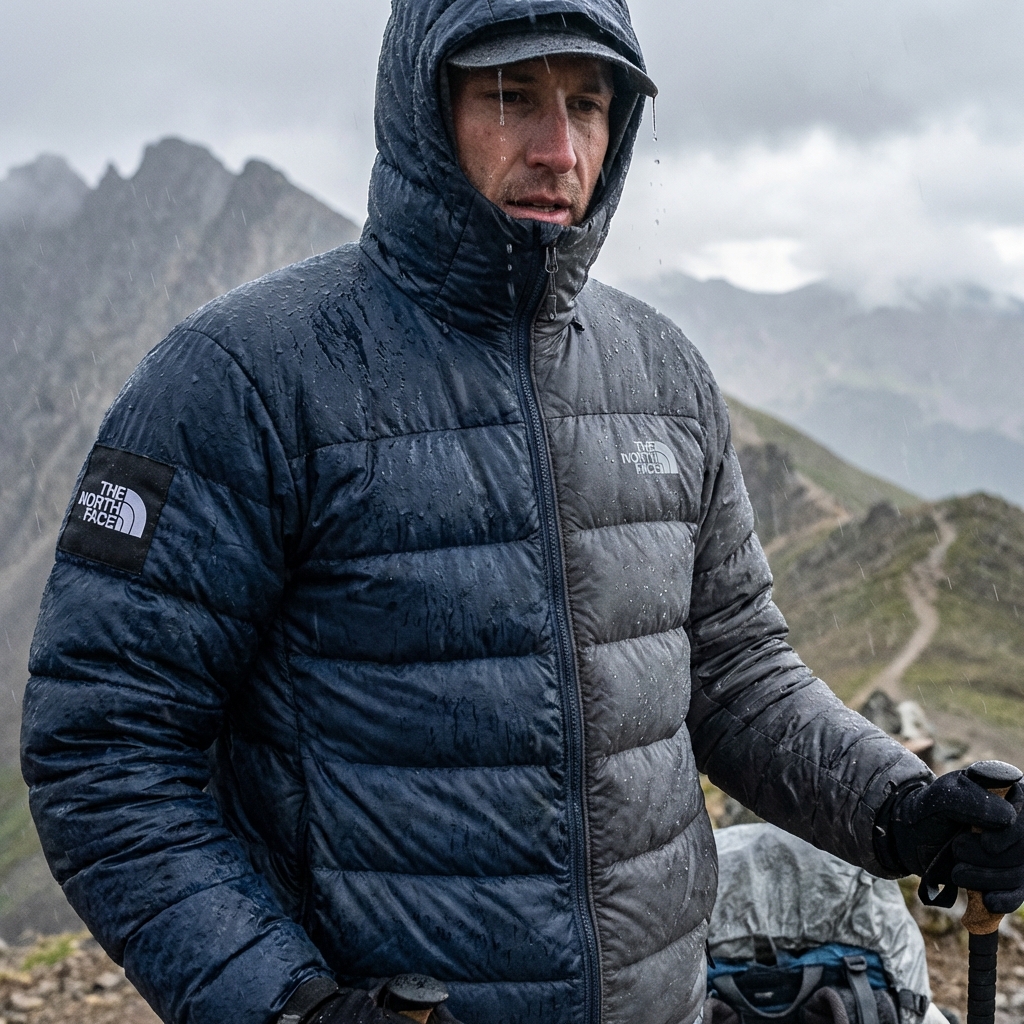
The recovery story matters too. Once down dries, it rebounds. Its loft returns. You’re back to that ultralight warmth advantage. For trips where you can control moisture exposure and have time to dry gear at camp, down makes sense.
How Synthetic Insulation Handles Wet Weather
Synthetic fibers like our PrimaLoft technology use engineered polyester that actively resists water absorption. These fibers don’t clump when wet. A soaked synthetic insulation layer retains 60 to 70 percent of its dry insulating value. That’s a significant advantage over down in genuinely wet conditions.
We engineered synthetic insulation for environments where moisture is unavoidable: Pacific Northwest coastal trails, alpine zones with frequent cloud cover, full-day rain events, or high-exertion activities where sweat load is heavy. The fibers maintain their structure, continue trapping air pockets, and keep working when down would fail.
The trade-off is weight and packability. Synthetic insulation requires more volume to match down’s warmth-to-weight ratio. A synthetic jacket that provides the same insulation as a lightweight down parka will weigh more and compress smaller. For ultralight backpackers going into truly dry regions, that matters. For most of us working through variable conditions, that penalty is worth the reliability.
Synthetic also dries faster than down because water sits on the surface rather than soaking in. You can air out a synthetic jacket and regain full performance in a few hours of sun. Down can take a full day or more to completely dry from a heavy soak.
Our Top Down Jackets for Wet Exploration
We’ve designed down options specifically for explorers who understand their environment and can manage moisture actively. The Breithorn Hoodie combines premium 700-fill down with a Gore-Tex outer shell, giving you moisture protection and the ability to layer under a rain jacket. The hood fits over your helmet, and the fit isn’t so beefy that you can’t move freely. We built this for alpine mountaineering where weight matters but conditions are variable.
Our down offerings include baffled construction that prevents down migration and keeps insulation distributed evenly, even after repeated use. We use ethically sourced down and back every jacket with our durability promise. If down companies aren’t transparent about sourcing and construction, we don’t carry it.
Down excels for autumn backpacking trips where rain is light and air temperature drops significantly. It’s also your best choice if you’re hiking in truly arid environments like high desert or interior ranges where humidity stays low.
Our Best Synthetic Options for Maximum Weather Protection
We’ve engineered synthetic insulation into jackets built for genuinely wet climates and high-exertion activities. Our PrimaLoft-equipped parkas use continuous-filament synthetic that resists moisture while maintaining exceptional breathability. These work best when you’re moving hard, generating sweat, or hiking in regions where rain is the default expectation rather than the exception.
Synthetic insulation in our women’s and men’s lines delivers full warmth even when damp, making it ideal for Pacific Northwest trails, winter rain in the Sierra, or extended alpine trips where you’re moving in and out of clouds. The loft consistency means you get reliable warmth across the entire jacket lifespan, not just when gear is pristine.
Our synthetic jackets compress reasonably well for their weight, and the material’s inherent water resistance means you can pack it into a damp pack without fear of moisture spreading to other gear. It’s also easier to clean; water and light soap are usually sufficient, versus the careful dry-cleaning synthetic often requires for down.
Direct Performance Comparison: Down vs Synthetic
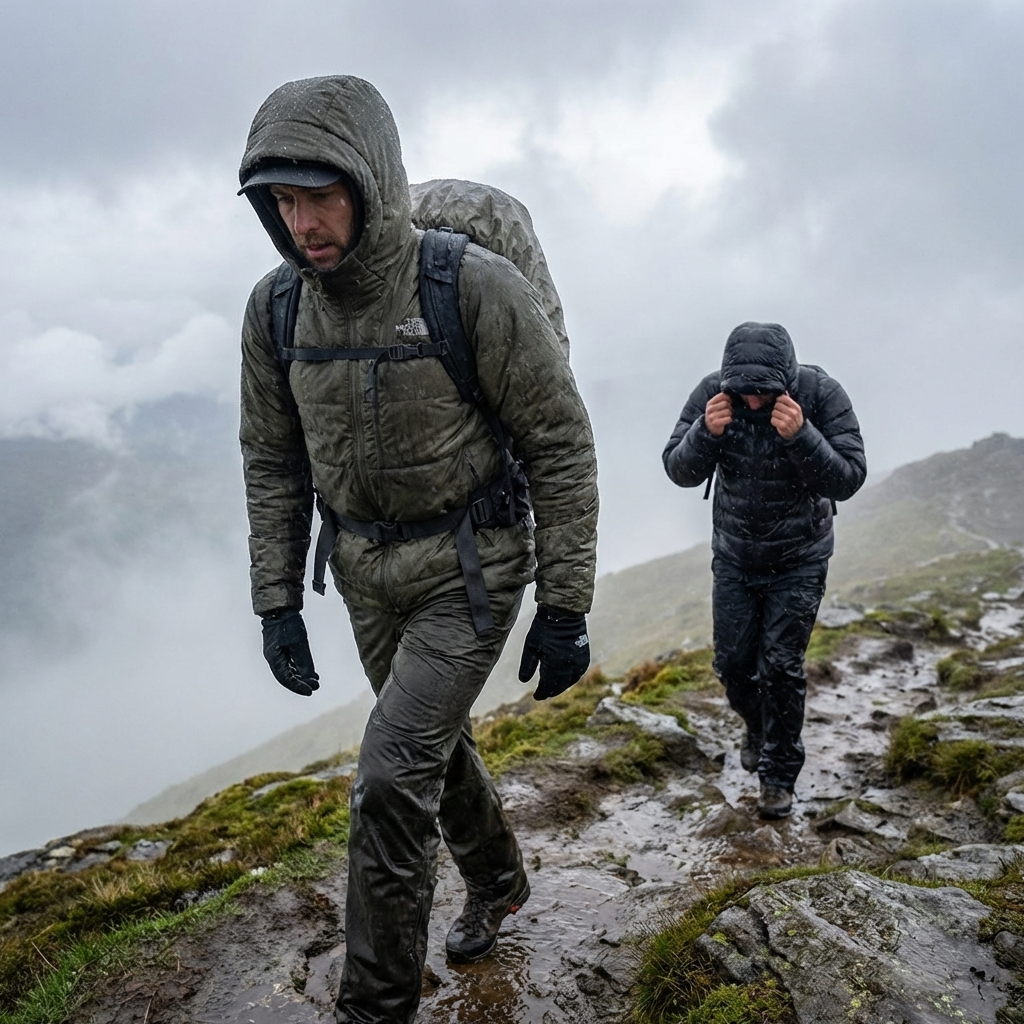
Let’s put numbers to the choice. Down delivers roughly 15 to 20 percent more warmth per ounce than synthetic insulation in dry conditions. That matters on ultralight trips where every ounce counts. In wet conditions, down loses that advantage entirely once saturated, while synthetic maintains 60 to 70 percent performance. The performance gap narrows dramatically.
Weight-wise, a down jacket designed for wet-weather performance weighs 12 to 16 ounces, while a synthetic option providing equivalent real-world wet-weather warmth weighs 18 to 24 ounces. That 6 to 8 ounce difference is noticeable on longer trips but not prohibitive for most Active Explorers.
Cost varies too. Down jackets command higher prices due to material sourcing and construction complexity. Synthetic options are generally more affordable, though our premium PrimaLoft jackets close that gap. If you’re buying one jacket to cover multiple seasons and conditions, synthetic often delivers better value.
Recovery time is measured in hours for synthetic (you can get back to dry, full-loft performance by afternoon sun) versus full days for down. If you’re on a tight schedule, synthetic’s fast rebound is worth considering.
Recovery and Maintenance: Which Bounces Back Faster
This is where synthetic’s real-world advantage becomes visible. Hang a damp synthetic jacket in a breeze for two to four hours, and you regain virtually all insulating power. Down requires overnight hanging or active drying time to fully recover, sometimes longer in humid conditions.
We recommend machine-washing synthetic at low temperature with minimal detergent every season or two. The material stays resilient through dozens of wash cycles. Down requires either professional dry cleaning or careful hand-washing in cool water, dried horizontally or hung gently to prevent fiber damage. That’s more work, more cost, and more risk of accidentally damaging the material.
In the field, pack a synthetic jacket damp if you must. It’ll dry on your back as you move or at camp. Do the same with down, and you risk permanent loft loss if that moisture isn’t fully driven out. This functional difference matters on multi-day trips where you’re generating constant moisture and weather is unpredictable.
Neither material lasts forever, but both can deliver years of reliable performance with reasonable care. Our testing shows synthetic insulation maintains consistent loft through 50-plus wash cycles, while down gradually loses some loft recovery ability after heavy use and cleaning. That’s incremental degradation, not failure.
Choosing Your Insulation: Real-World Selection Guide
Start with your destination. If you’re hiking in the Pacific Northwest, Colorado Rockies, or anywhere with frequent rain and cloud cover, synthetic wins. If you’re heading to the high desert, Interior Basin ranges, or dry alpine environments, down’s weight advantage and superior warmth-to-weight ratio make more sense.
Consider your exertion level. High-output activities like fast hiking or mountaineering generate substantial sweat. Synthetic’s moisture tolerance is more forgiving here. Lower-exertion trips with controlled pace and good rest periods let you manage down’s moisture sensitivity more easily.
Think about your trip length. Day hikes and overnights are more flexible; you can manage down’s drying needs. Extended trips in wet conditions without guaranteed sunny drying time favor synthetic because you need consistent, reliable warmth throughout.
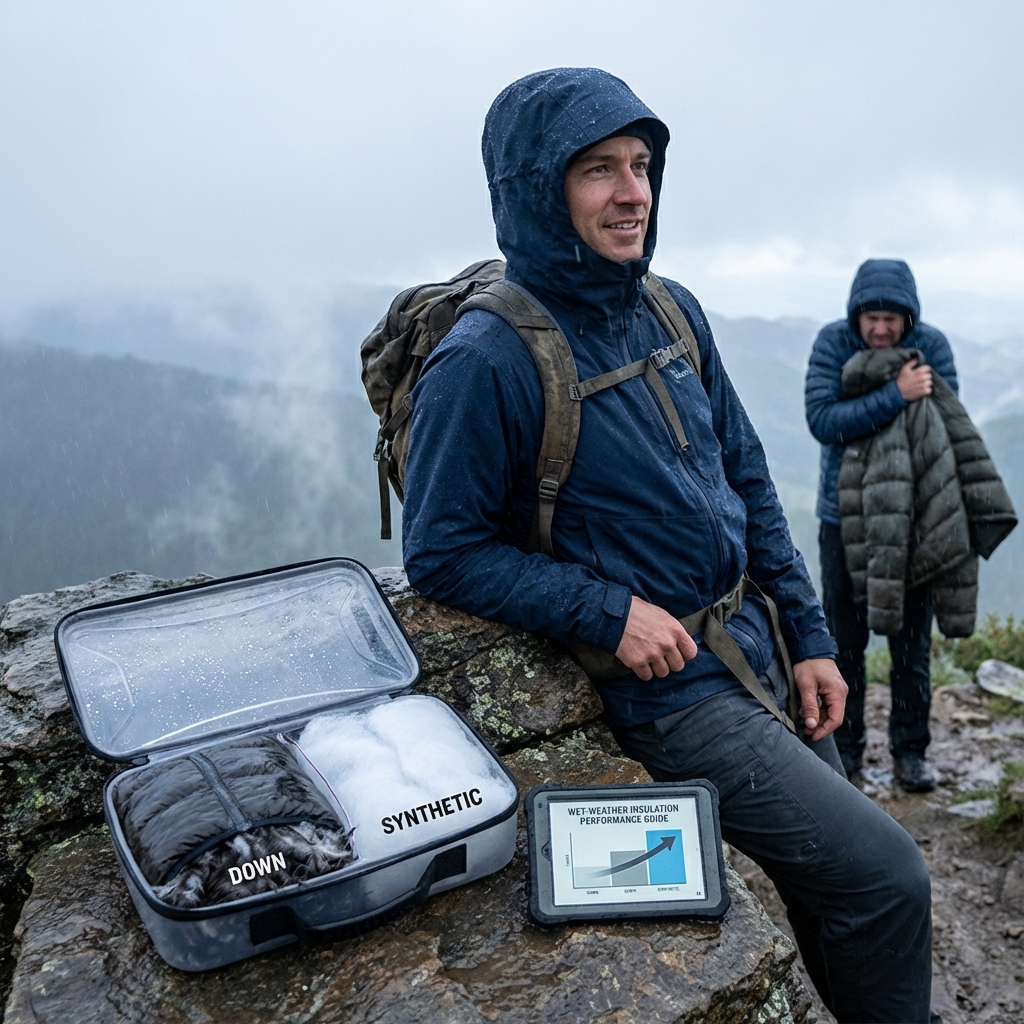
Be honest about your layer management discipline. Down works best when paired with quality outer shells and thoughtful layering choices. If you tend toward simpler systems or you’re climbing steep learning curves, synthetic’s forgiving performance is a practical advantage.
Our Recommendation for Wet-Weather Success
We recommend synthetic insulation for most of our Active Explorers in most conditions. Not because down is inferior, but because synthetic delivers genuinely reliable, field-tested performance across the wider range of real-world scenarios you’re likely to encounter.
We’ve engineered our jackets and coats with synthetic insulation to give you full warmth when damp, fast recovery time, simple maintenance, and peace of mind on longer trips. You don’t have to manage moisture obsessively or worry about catastrophic loft loss if weather deteriorates unexpectedly. You can focus on the trail, the views, and the experience.
The only scenario where we confidently recommend down is when you’re hiking in dry conditions, prioritizing weight above all else, or you’ve logged enough miles to understand your environment and can actively manage moisture. Otherwise, synthetic insulation is the proven performer that keeps you warm when it matters most.
When conditions get wet and the temperature drops, you need insulation that works when tested. We design our synthetic systems to do exactly that. That’s the gear we trust on our own expeditions, and it’s what we recommend for yours.
Ready for your next adventure? Gear up with apparel and equipment built for the wild. Explore the collection now.
Frequently Asked Questions (FAQ)
Does down insulation really lose all its warmth when wet?
Down naturally loses its insulating properties when moisture saturates the clusters, but it’s not a complete failure. We’ve found that quality down jackets with water-resistant shells can still perform reasonably well in light rain, though prolonged wet conditions will compromise their warmth. If you’re heading into consistent moisture, our synthetic options give you more reliable protection without that vulnerability.
Which insulation type is easier to care for after a wet adventure?
Synthetic insulation bounces back faster and requires less fussy maintenance than down, which is honestly one of our favorite reasons to recommend it for unpredictable weather. We can toss our synthetic pieces in the wash, let them dry, and they’re back to full loft within hours. Down jackets need gentler handling and more drying time, though they’ll last longer overall if you treat them right.
How do I choose between down and synthetic for my next wet-weather jacket?
We recommend synthetic if you’re dealing with frequent rain, humidity, or can’t commit to careful maintenance, and down if you’re prioritizing lightweight packability and willing to protect it with a quality shell. Think about your typical conditions: if you’re hiking in the Pacific Northwest, go synthetic; if you’re summiting in alpine conditions with a waterproof shell, down’s packability advantage shines. Your lifestyle determines which makes more sense for your gear rotation.
Leave a Reply